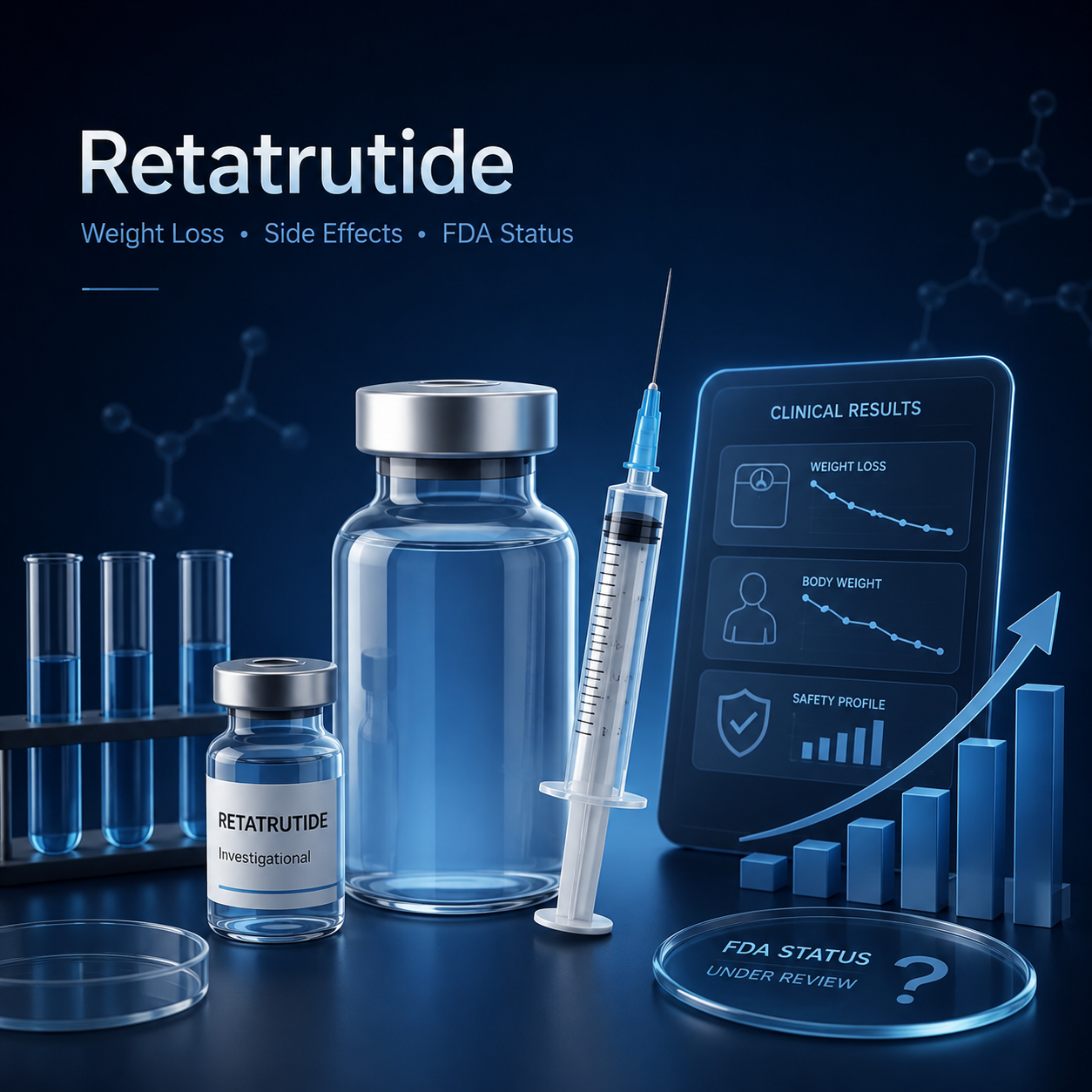
Retatrutida para adelgazar: resultados, efectos secundarios y situación ante la FDA
Una inyección semanal acaba de producir la mayor pérdida de peso media jamás registrada en un ensayo de un fármaco contra la obesidad, y eso es precisamente lo que ha disparado el interés por la retatrutida para adelgazar. En el programa de fase 3 de Eli Lilly, las personas que recibieron la dosis más alta perdieron de media un 28,3 % de su peso corporal a lo largo de 80 semanas, un territorio que antes pertenecía en exclusiva a la cirugía bariátrica. El inconveniente: a 31 de julio de 2026, la retatrutida sigue siendo un fármaco en investigación. Ningún médico puede recetarla, y todo lo que se venda con su nombre por internet no está regulado.
Respuesta rápida: La retatrutida no está aprobada por la FDA, y punto. En los ensayos de obesidad de fase 3 produjo una pérdida de peso media del 22,6–28,7 %, las cifras más altas jamás observadas en esta clase de fármacos. La mayoría de los efectos secundarios son gastrointestinales, más una rareza: un efecto de hormigueo cutáneo llamado disestesia con las dosis más altas. Lilly anunció el 23 de julio de 2026 que solicitará la aprobación en el primer trimestre de 2027, lo que sitúa finales de 2027 como la fecha más temprana realista para una decisión.
¿Cómo funciona la retatrutida para adelgazar?
Entre los péptidos para adelgazar, la retatrutida (código de desarrollo LY3437943) es el primero en activar tres receptores a la vez: GIP, GLP-1 y glucagón. La semaglutida (Wegovy/Ozempic) actúa solo sobre el GLP-1. La tirzepatida (Zepbound/Mounjaro) añade el GIP. La retatrutida añade el glucagón por encima de ambos, y se cree que ese tercer objetivo aumenta el gasto energético y la quema de grasa en el hígado, lo que podría explicar por qué sus cifras superan a todo lo demás de su clase (según el resumen del mecanismo de Lilly y el ensayo de fase 2 publicado en NEJM en 2023).
Su semivida es de unos seis días, por lo que se inyecta una vez a la semana. Y, pese a lo a menudo que se la llama así, «retatrutida» no es una marca comercial: es el nombre genérico. Todavía no existe ningún nombre comercial.
Resultados de pérdida de peso: lo que muestran realmente los ensayos
| Ensayo | Población | Pérdida de peso media (dosis más alta) | Duración |
|---|---|---|---|
| Fase 2 (N Engl J Med, junio de 2023) | 338 adultos con obesidad | 24,2 % (~26,2 kg) | 48 semanas |
| TRIUMPH-1 (datos preliminares, mayo de 2026) | 2339 adultos con obesidad/sobrepeso | 28,3 % (31,9 kg) | 80 semanas |
| TRIUMPH-1, extensión ciega | Subgrupo con IMC basal ≥35 | 30,3 % (38,6 kg) | 104 semanas |
| TRIUMPH-4 (comunicado de Lilly, diciembre de 2025) | Obesidad + artrosis de rodilla | 28,7 % (32,3 kg) | 68 semanas |
| TRANSCEND-T2D-1 (The Lancet, junio de 2026) | Diabetes de tipo 2 | 16,8 % | 40 semanas |
| TRIUMPH-3 (datos preliminares, julio de 2026) | Obesidad + enfermedad cardiovascular | 22,6 % | 80 semanas |
Destacan dos cosas. En el TRIUMPH-1, el 45,3 % de las personas con la dosis más alta perdió al menos un 30 % de su peso corporal, un resultado que un cirujano bariátrico reconocería. Y en la extensión ciega, a las 104 semanas las personas seguían adelgazando. El TRIUMPH-4 aportó una victoria de otro tipo: las puntuaciones de dolor de rodilla cayeron un 75,8 %, la presión arterial sistólica bajó hasta 14 mmHg y el 72 % de los participantes con prediabetes recuperó una glucemia normal.
Ahora, la letra pequeña. Salvo el TRANSCEND-T2D-1 —publicado en The Lancet en junio de 2026—, todos los resultados de fase 3 hasta la fecha son comunicados de prensa con datos preliminares, no artículos revisados por pares. ¿Ese llamativo 30,3 %? Procede de un subgrupo de la extensión formado por personas con obesidad grave (IMC basal ≥35) que continuaron con el fármaco, no del conjunto completo del ensayo. Y la pérdida menor del 16,8 % en la diabetes de tipo 2 no es una señal de alarma: es un patrón conocido de esta clase de fármacos, observado también con la semaglutida y la tirzepatida.
Dosis de retatrutida para adelgazar: lo que realmente sabemos
No existe una dosis aprobada de retatrutida para adelgazar, porque no existe una retatrutida aprobada. Lo que hay es un conjunto de protocolos de ensayo. Estos aumentan la dosis de forma lenta a lo largo de varios meses, porque es lo que mantiene controlados los efectos secundarios gastrointestinales: empezar más bajo ayudó de forma medible, y algunos grupos de fase 3 se detuvieron deliberadamente por debajo de la dosis máxima de la fase 2.
Cualquier cosa que en internet describa una dosis concreta de retatrutida está extrapolada de esos protocolos; no existe ninguna ficha técnica de la FDA. Nuestra calculadora de retatrutida reproduce las pautas publicadas de los ensayos para que puedas ver cómo estaban estructuradas: eso es todo lo que hace. Considera el resultado de cualquier calculadora de péptidos como un modelo educativo, nunca como una prescripción. Las decisiones reales sobre la dosis corresponden a un profesional sanitario colegiado, y solo tras la aprobación.
Efectos secundarios y seguridad
La mayor parte de lo que sienten las personas es gastrointestinal, y casi todo aparece durante los aumentos de dosis:
- Náuseas: alrededor del 43 % con la dosis más alta de fase 3, hasta un 60 % en la fase 2. Diarrea 32–33 %, vómitos 21–25 %, estreñimiento 26 %. En su mayoría de leves a moderados, pero los episodios gastrointestinales aun así llevaron a abandonar el fármaco a cerca del 11,3 % de los participantes del TRIUMPH-1, frente al 4,9 % con placebo.
- Disestesia: el efecto secundario que nadie esperaba. Hormigueo, ardor o una sensibilidad cutánea inusual en torno al 21 % con la dosis más alta y alrededor del 9 % un escalón por debajo. No se ha notificado con la semaglutida ni con la tirzepatida. El componente de glucagón es el principal sospechoso, pero el mecanismo no está establecido.
- Frecuencia cardíaca: un aumento dependiente de la dosis de hasta unos 6,7 lpm a las 24 semanas, que se atenúa después. En la fase 2, se produjeron arritmias en el 4–14 % de los tratados con retatrutida frente al 2–3 % con placebo. Los datos preliminares de la fase 3 no han señalado una señal importante de arritmia, pero aún no se dispone de los datos de seguridad completos revisados por pares.
- Desenlaces cardiovasculares: el TRIUMPH-3 no halló ninguna reducción estadísticamente significativa del infarto de miocardio, el ictus ni la muerte cardiovascular. El ensayo no tenía potencia estadística para detectarla, pero es una laguna real: el ensayo SELECT de Wegovy sí demostró un beneficio cardiovascular, y la retatrutida no lo ha hecho.
Dolor en el pecho, taquicardia, desmayos, incapacidad para retener líquidos: busca atención médica. No lo aguantes sin más.
Situación ante la FDA y calendario
La retatrutida no está aprobada y no puede recetarse ni venderse legalmente como medicamento en EE. UU. Cinco lecturas de fase 3 son ya positivas (TRIUMPH-1 a -4 y TRANSCEND-T2D-1). El 23 de julio de 2026, Lilly dijo que presentaría su solicitud para el fármaco contra la obesidad retatrutida en el primer trimestre de 2027, según informaron CNBC y Reuters ese mismo día. Una revisión prioritaria podría situar una decisión a finales de 2027; una revisión estándar la retrasaría a 2028. Hasta entonces, el único acceso legítimo es la inclusión en un ensayo clínico. Y el pipeline no se detiene aquí: nuestra calculadora de pemvidutida hace el seguimiento de otro péptido metabólico en investigación que avanza por los ensayos.
El problema del mercado gris
Cada vial de «retatrutida» que se vende hoy —como péptido de investigación, «no apto para el consumo humano» o como producto de formulación magistral— no está regulado y es ilegal venderlo para uso humano. La FDA envió cartas de advertencia a estos vendedores en septiembre de 2025, y ha declarado sin ambages que la retatrutida no puede usarse en formulación magistral según la ley federal. Así que la retatrutida de formulación magistral no es una zona gris: es ilegal. Lo que en realidad recibirías es una apuesta a ciegas: potencia desconocida, posible contaminación, fallos de esterilidad, cadena de frío rota.
Lo que internet malinterpreta
- «Es básicamente un Ozempic más potente.» Fármaco distinto, mecanismo distinto (triple agonista), base de pruebas distinta. No son intercambiables.
- «Provoca un 30 % de pérdida de peso.» El 30,3 % procede de un subgrupo de extensión con IMC ≥35. El resultado completo a 80 semanas fue del 28,3 %, un récord igualmente, pero el contexto importa.
- «Protege el corazón.» Sin demostrar. El único ensayo que midió episodios cardiovasculares mayores no halló ninguna reducción estadísticamente significativa.
- «Se puede comprar por internet sin más.» Puedes comprar un vial no regulado con la palabra «retatrutida» escrita en la etiqueta. Eso no es lo mismo.
Preguntas frecuentes
¿Está aprobada la retatrutida por la FDA?
No. A 31 de julio de 2026 sigue en investigación. Lilly tiene previsto presentar su solicitud de aprobación en el primer trimestre de 2027, con una posible decisión a finales de 2027 o en 2028.
¿Cuánto peso pierde la gente con la retatrutida?
En los ensayos de obesidad de fase 3, una media del 22,6–28,7 % del peso corporal con la dosis más alta, frente a alrededor del 2 % con placebo. La fase 2 mostró un 24,2 % a las 48 semanas. Las personas con diabetes de tipo 2 perdieron un 16,8 %; una respuesta menor en la diabetes es lo habitual en esta clase de fármacos.
¿Cuál es la dosis de retatrutida para adelgazar?
No existe una aprobada. Los protocolos de los ensayos empiezan bajos y aumentan de forma escalonada a lo largo de varios meses para mantener controlados los efectos secundarios, y algunos programas se detienen en una dosis de mantenimiento más baja que otros. Nuestras herramientas de la mejor calculadora de péptidos reproducen esas pautas solo con fines educativos, nunca como orientación posológica.
¿Es seguro comprar retatrutida por internet?
No. Todos los productos que se venden hoy no están regulados, y la formulación magistral de retatrutida es ilegal según la ley federal. La única vía legítima es un ensayo clínico.
Qué significa esto para ti
La pérdida de peso es real. También lo es la espera, y también el riesgo de lo que en realidad haya dentro de un vial comprado por internet. Si la retatrutida llega a aprobarse, la primera conversación que merece la pena tener es con un médico, no con un buscador.
Este artículo es de carácter educativo, no un consejo médico. La retatrutida está en investigación y no está aprobada; nunca inicies, suspendas ni dosifiques ningún compuesto sin un profesional sanitario colegiado.