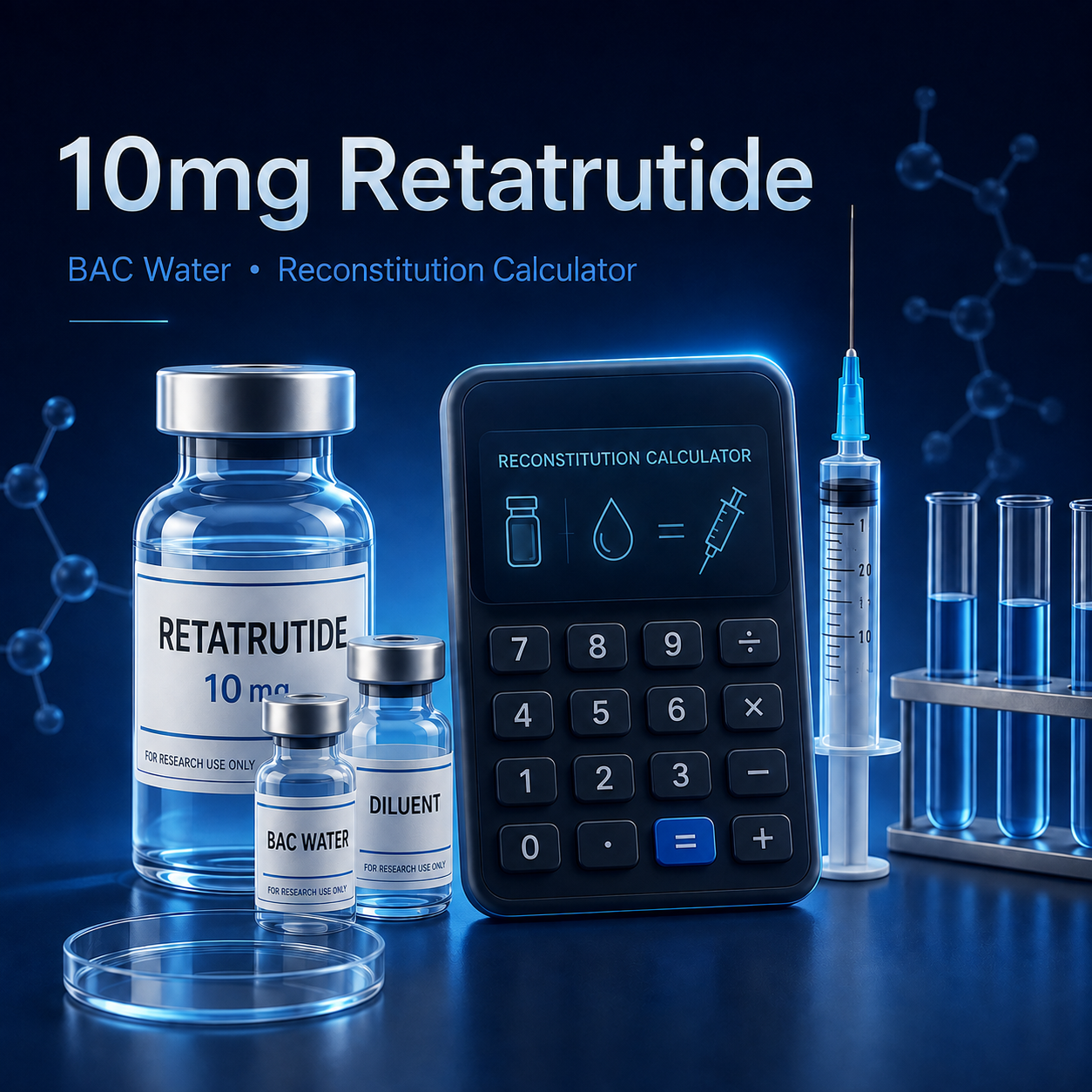
A 10 mg vial, a bottle of bacteriostatic water, and several online discussions can produce several different answers. The arithmetic behind concentration calculations is straightforward. The regulatory status and uncertain contents of products sold online make the real-world question considerably more complicated.
Quick Answer
There is no officially approved reconstitution amount for retatrutide. Retatrutide remains an investigational drug, and neither the FDA, Eli Lilly, nor a recognized medical organization publishes instructions for mixing a consumer retatrutide vial.
Online calculators can demonstrate how vial amount and liquid volume affect concentration, but they cannot confirm the identity, purity, sterility, or actual fill amount of an unregulated product. Use the retatrutide dosage calculator only for educational or laboratory-math modeling—not as a personal treatment protocol.
Why There Is No Single Answer to “How Much BAC Water?”
Bacteriostatic water is sterile water containing benzyl alcohol as a preservative. In approved medical settings, a manufacturer’s labeling or pharmacy instructions specify whether a product should be reconstituted, which diluent should be used, how much should be added, and how the resulting solution should be stored.
No equivalent manufacturer instructions exist for retail vials marketed online as retatrutide. Adding different amounts of liquid changes the concentration, but it does not establish that the underlying powder is authentic, sterile, stable, or suitable for human use.
| Factor | Less liquid added | More liquid added |
|---|---|---|
| Resulting concentration | Higher concentration | Lower concentration |
| Volume represented by a fixed amount | Smaller liquid volume | Larger liquid volume |
| Effect of a small measurement error | Potentially more significant | Distributed across more liquid |
| What the calculation cannot verify | Product identity, purity, sterility, stability, potency, or labeling accuracy | |
This is why a forum comment describing a particular syringe line or liquid volume cannot be treated as a universal answer. It depends on assumptions about the vial, the concentration, the measuring device, and—most importantly—the reliability of the product itself.
What You Are Actually Holding: Retatrutide’s Status in August 2026
Retatrutide, also known by the development code LY3437943, is an investigational once-weekly injectable being developed by Eli Lilly. It activates three metabolic receptor pathways: GIP, GLP-1, and glucagon.
Not FDA-approved
Retatrutide remains an investigational drug. A product described online as “retatrutide” is not an FDA-approved retail version of Lilly’s clinical-trial medicine.
No approved compounding pathway
The FDA has warned that retatrutide cannot be used as an ordinary active ingredient in products compounded under sections 503A or 503B of the Federal Food, Drug, and Cosmetic Act.
Online labeling is not verification
“Research use only” wording does not independently verify identity, potency, purity, sterility, manufacturing controls, or cold-chain handling.
Clinical trials use controlled material
Lilly-sponsored studies use protocol-controlled investigational medicine, documented manufacturing standards, medical screening, and scheduled safety monitoring.
Lilly has advised that people should not take products claiming to be retatrutide outside a Lilly-sponsored clinical trial. The concern is not limited to dose calculation: online products can contain an incorrect amount, a different active ingredient, impurities, or microbial contamination.
The Reconstitution Calculation Principle
A reconstitution calculator models relationships between three variables. It does not determine whether preparing or using a particular product is medically appropriate.
Starting amount
The amount printed on the vial label. The calculation assumes this label is accurate.
Liquid volume
Changing the liquid volume changes the calculated concentration of the resulting solution.
Calculated concentration
Concentration describes how much labeled material is represented by a given liquid volume.
Every result depends on the assumption that the vial contains exactly what the label claims. Mathematics cannot detect an incorrect compound, inaccurate fill amount, degradation, contamination, or loss of sterility.
Explore the calculation framework
PeptidesCalculator.org provides transparent calculation tools that show how changing an input affects concentration and volume. The tools are intended for educational and research-math purposes.
Open the Retatrutide CalculatorYou can also browse all peptide calculators and review the calculation logic used across different vial sizes, concentration scenarios, and laboratory measurement formats.
Retatrutide Side Effects at a Glance
Published and company-reported clinical-trial findings indicate that gastrointestinal reactions are the most frequently reported side effects. Rates vary according to trial, dose group, escalation schedule, and study population.
- Gastrointestinal symptoms: nausea, diarrhea, vomiting, and constipation have been commonly reported in clinical development.
- Dysesthesia: tingling, burning, sensitivity, or pins-and-needles sensations have been reported more prominently with retatrutide than with some other incretin-based medicines.
- Dose-related discontinuation: withdrawal caused by adverse events generally increased in higher-dose trial groups.
- Long-term uncertainty: the medicine remains under investigation, and the complete long-term safety profile is not yet established.
With an unregulated product, clinicians may also need to consider that the vial’s contents differ from its label. Packaging or a photograph of the product may be relevant when assessing an exposure.
How Retatrutide Is Studied in Clinical Trials
Lilly’s clinical-development program has generally evaluated retatrutide as a once-weekly investigational injection with gradual dose escalation. Trial participants are medically screened, assigned to a formal protocol, supplied with controlled study medication, and monitored for adverse events.
That context is fundamentally different from purchasing a vial online and attempting to reproduce a trial regimen. A clinical protocol includes eligibility criteria, exclusion criteria, laboratory monitoring, predefined stopping rules, product accountability, and medical oversight.
Retatrutide produced substantial average weight reduction in its published Phase 2 study. Lilly has also announced strong topline results from Phase 3 development. However, a company press release is not the same as a complete peer-reviewed publication or regulatory approval.
Clinical-trial findings should therefore be interpreted as evidence about Lilly’s investigational product under controlled research conditions—not evidence that an independently sold powder contains the same molecule or has the same safety profile.
What the Internet Gets Wrong
-
“It is basically approved.”
Successful clinical-trial results do not equal FDA approval. Regulatory review, manufacturing evaluation, labeling negotiations, and a formal agency decision are separate stages. -
“Progress photos prove that it works and is safe.”
Online anecdotes cannot confirm what product was used, whether other medicines were involved, how outcomes were measured, or which adverse events were omitted. -
“Research use only means the product is legitimate.”
The phrase is a labeling statement. It does not demonstrate compliance with pharmaceutical manufacturing, sterility, potency, or dispensing requirements. -
“Another person’s syringe line applies to every vial.”
A volume reference has no meaning without knowing the labeled vial amount, liquid volume, resulting concentration, and syringe calibration. -
“A precise calculator guarantees a precise result.”
A calculator can process the numbers entered. It cannot verify whether those numbers accurately describe the physical product.
The peptide library covers additional topics including product labeling, analytical documentation, purity claims, storage limitations, and common calculation mistakes.
Questions Readers Ask About Retatrutide Reconstitution and Safety
Is there an official amount of BAC water for a 10 mg vial?
No. There is no FDA-approved retail retatrutide vial and no manufacturer-approved consumer reconstitution instruction. Numbers shared by vendors, forums, or social-media accounts are not official prescribing information.
How long does reconstituted retatrutide last?
There is no validated consumer storage period for an online retatrutide vial. Stability depends on formulation, manufacturing, sterility, container integrity, temperature, light exposure, and other factors that cannot be established from a generic label.
Is retatrutide the same as semaglutide or tirzepatide?
No. Semaglutide primarily activates GLP-1 receptors. Tirzepatide activates GIP and GLP-1 receptors. Retatrutide is designed to activate GIP, GLP-1, and glucagon receptors.
Can a calculator verify what is inside a vial?
No. A calculator only processes entered values. Confirming identity, purity, concentration, and contaminants requires appropriate analytical testing and documented manufacturing controls.
Can retatrutide be legally purchased as an approved medicine?
Retatrutide remains investigational as of August 2026. Products advertised online are not FDA-approved retail versions of Lilly’s clinical-trial medicine. Legitimate access to the investigational product is through an authorized clinical study.
The arithmetic can be modeled. The product cannot be authenticated by arithmetic.
Sources
- Jastreboff AM et al. Retatrutide Phase 2 clinical trial, published in The New England Journal of Medicine: NEJMoa2301972
- Eli Lilly, information about retatrutide: What to Know About Retatrutide
- Eli Lilly Phase 3 topline announcement distributed through PR Newswire: Retatrutide Phase 3 obesity trial announcement
- Partnership for Safe Medicines, June 2026 update: Safe Medicines report
- U.S. Food and Drug Administration: FDA’s concerns with unapproved GLP-1 drugs used for weight loss
- FDA warning letter to GLP-1 Solution, September 9, 2025: FDA warning letter