
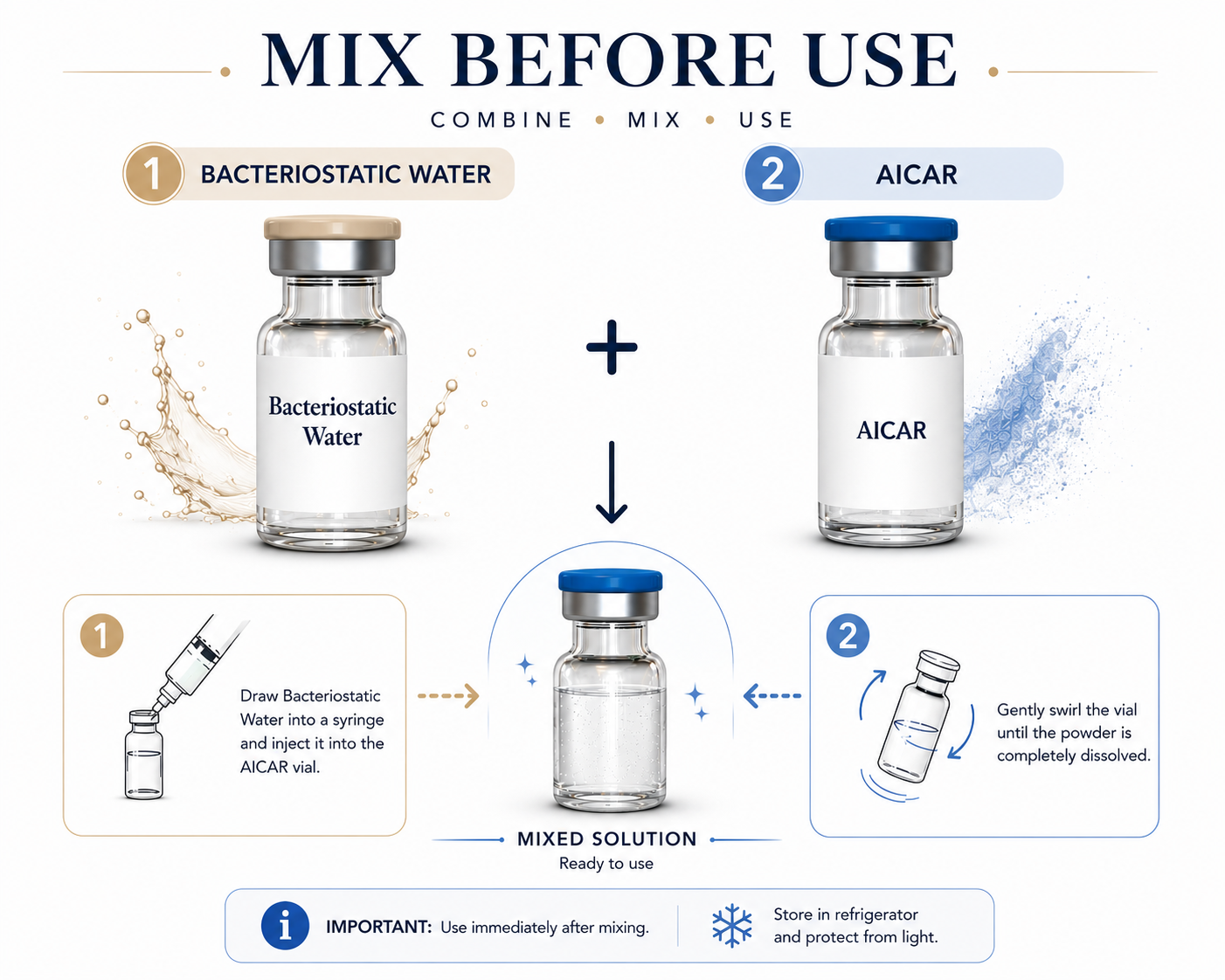
AICAR and BAC Water Mix

AICAR Reconstitution Calculator

Enter the amount you want to measure. The vial buttons will highlight which vial strengths create cleaner syringe-unit measurements.

What amount do you need?

Type the target amount, then choose mg or mcg. Example: 2mg or 500mcg.

Syringe size:
Possible vial strengths:
Best Match Good Match Usable Harder to Measure

Example AICAR Titration Schedule

Research Context (as described)TimelineDoseNotes
Skeletal muscle research (6.5-week protocol)Weeks 1–4500 mg/kg body weight (daily injection)Front-loaded “high dose” phase
Skeletal muscle research (6.5-week protocol)Weeks 4–6.5Lower dose (daily injection)Article notes the dose is reduced, but does not specify the exact amount
Metabolic syndrome / type 2 diabetes exampleUp to 13 weeks1 mg/kg per day (injections)Presented as an example tied to blood sugar homeostasis research
Fat tissue metabolism example4–8 weeks0.5–1.0 g/kg per day (intraperitoneal injection)Article cites 0.7 g/kg as an “optimal” value for this context
Possible vial strengths:

What Is It?

AICAR

AMPK activator research compound.

Bacteriostatic Water

Sterile water containing a bacteriostatic preservative, commonly used when preparing multi-use research vials.

How To Mix AICAR

1
Clean

Use alcohol swabs to clean the tops of both vials.

2
Draw BAC Water

Draw the selected amount of bacteriostatic water.

3
Inject Slowly

Add the liquid slowly down the side of the vial.

4
Swirl Gently

Do not shake. Swirl gently until dissolved.

5
Store Properly

Store as directed and protect from heat and light.

Best Practices & Common Mistakes

Best Practices

  • Use sterile technique.
  • Protect from light and heat.
  • Store refrigerated when appropriate.
  • Use clean syringe-unit math before measuring.

Common Mistakes

  • Confusing milligrams with milliliters.
  • Choosing an option with awkward decimal units.
  • Using too little liquid for very small measurements.
  • Shaking the vial aggressively.

AICAR Storage & Handling

Lyophilized Powder: −20°C (−4°F) for long-term storage (up to 24 months). Refrigeration 2–8°C (36–46°F) for short-term use (up to ~3 months). Original sealed vial in the freezer is safest.
Reconstituted Solution: 2–8°C (36–46°F), use within ~7–14 days. Keep sealed, avoid light, and do not repeat freeze-thaw cycles.

Frequently Asked Questions

AICAR, also called acadesine or AICA-riboside, is a research compound used to study AMPK signaling and cellular energy metabolism. It is often marketed beside peptides, but it is not a peptide; it is a nucleoside-related compound that can be converted inside cells into ZMP.
No. AICAR is a research compound, while A1C or HbA1c is a blood test used to estimate average blood sugar over about three months. If someone searches “normal AIC,” they usually mean A1C, not AICAR.
AICAR is commonly called a “peptide” online because it appears on peptide-research websites, but chemically that label is wrong. For calculator users, the important point is that AICAR is handled as a research compound with concentration math, not as a normal amino-acid peptide chain.
AICAR calculator math starts with the vial amount and final liquid volume. For example, a 50 mg AICAR vial brought to 8 mL final volume gives 6.25 mg/mL; a 2 mg research amount would equal 0.32 mL, or 32 units on a U-100 syringe.
The main safety issue is that AICAR affects energy-signaling biology, and not all effects are simply “AMPK activation.” It also has anti-doping relevance: AICAR is listed as a prohibited metabolic modulator in sport, so endurance and “exercise mimetic” claims should be treated carefully.
Practical takeaway: If your real goal is weight or metabolic health, the most useful next step is discussing approved treatment options with a clinician rather than relying on an unapproved compound.
Important: This tool is for informational and research-reference purposes only. Not intended for human or veterinary use.
← All peptides