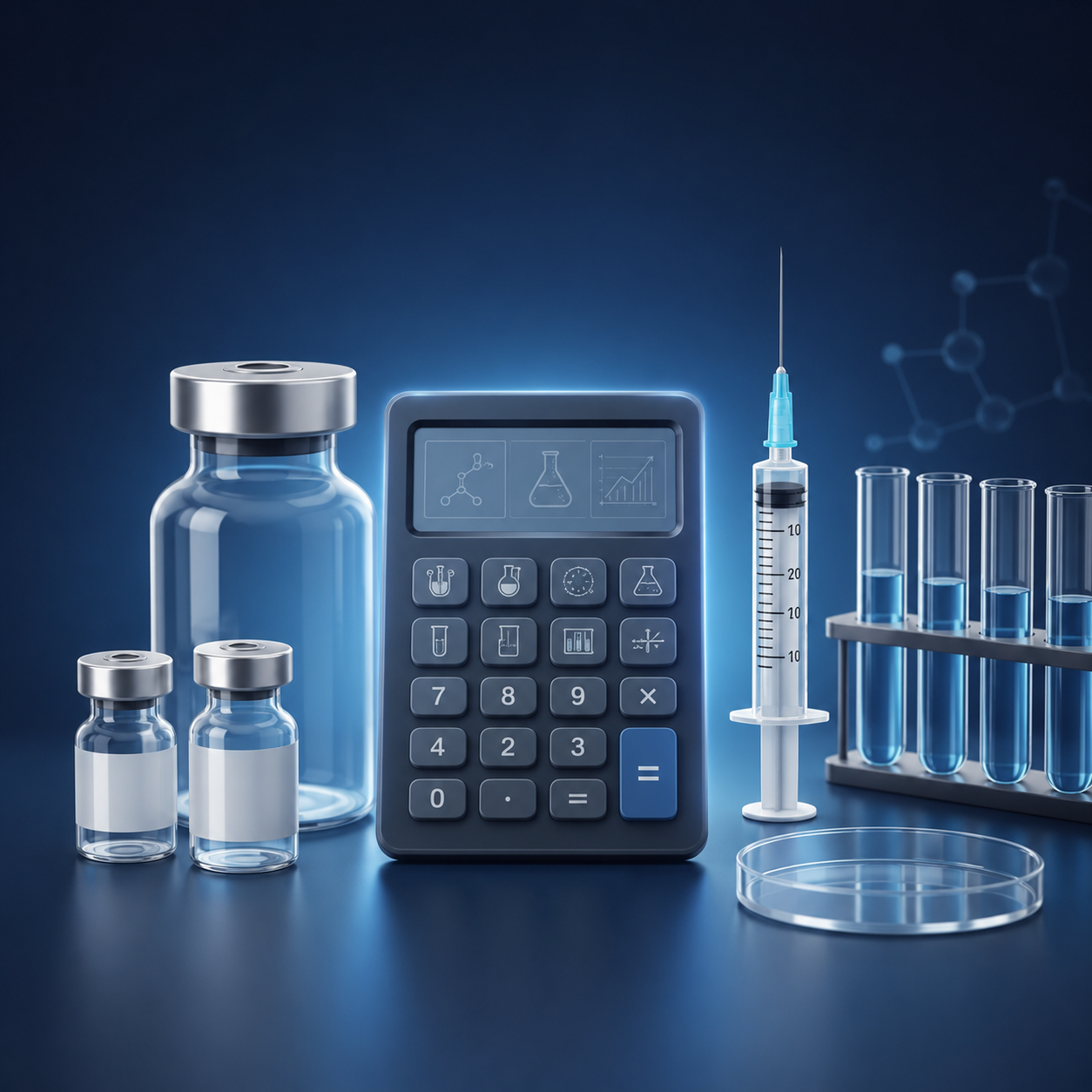
Search "peptide calculator" online and you immediately hit a wall of friction. Half the websites force you to register an account, others hide simple features behind paywalls, and many leave you guessing whether a U-100 syringe scale matches your specific reconstitution volume.
Launched publicly on July 15, 2026, PeptidesCalculator.org was built to solve that exact friction. Positioned as the most comprehensive free tool suite on the market, the platform offers 122 dedicated calculators across seven scientific categories — completely free, fully bilingual in English and Spanish, and accessible without an account or email form.
Whether you are converting milligrams to units on an insulin syringe or navigating complex compound libraries, here is a complete breakdown of how PeptidesCalculator.org works and why it is setting a new standard for online research math.
What Makes PeptidesCalculator.org Different?
Most basic web tools — including simple single-page engines like Rite Aid's online utility or mobile apps like Peptide Calculator.io — handle basic single-vial math. However, laboratory workflows often extend beyond standard mixes into specialized protocols, unique metabolites, and multi-compound research.
PeptidesCalculator.org bridges the gap between basic math engines and complex academic tools through several distinct advantages:
- 122 Specialized Calculators: Instead of fitting every compound into a generic input box, the platform provides tailored interfaces for specific target peptides, including specialized sequences like PNC-27, LL-37 CAP-18, and MitoBurn.
- 7 Research Categories: Materials are organized by research direction within a dedicated Research & Investigational directory and an expansive searchable compound library.
- Zero Paywalls or Registration: Full access to all 122 calculators and guides without creating an account or submitting an email address.
- Bilingual Support: Native accessibility in both English and Spanish for global scientific audiences.
- Integrated Educational Context: Every calculator page pairs syringe math with sequence data, molecular characteristics, and batch documentation guides.
How PeptidesCalculator.org Simplifies Reconstitution Math
At its core, reconstitution turns a freeze-dried (lyophilized) powder into a precise liquid concentration. A single math error during this process can invalidate an entire laboratory batch.
PeptidesCalculator.org automates the universal reconstitution formula while eliminating manual unit conversion mistakes:
-
Concentration Calculation:
$$\text{Concentration (mg/mL)} = \frac{\text{Vial Amount (mg)}}{\text{Bacteriostatic Water Added (mL)}}$$ -
Draw Volume Calculation:
$$\text{Draw Volume (mL)} = \frac{\text{Target Dose (mg)}}{\text{Concentration (mg/mL)}}$$ -
Syringe Unit Mapping:
$$\text{Syringe Units} = \text{Draw Volume (mL)} \times 100 \quad \text{(on a standard U-100 syringe)}$$
Worked Example:
If a research protocol calls for a target dose from a 5 mg vial reconstituted with 2 mL of bacteriostatic water, the platform instantly calculates the concentration (2.5 mg/mL) and visually maps the exact unit line to draw on a U-100, U-40, or custom syringe barrel.
Feature Comparison: How PeptidesCalculator.org Leads the Field
To understand where PeptidesCalculator.org fits into the current software ecosystem, it helps to compare available options:
| Feature / Capability | PeptidesCalculator.org | Basic Web Tools (e.g., Rite Aid) | Paid Mobile Apps (e.g., Peptide Calculator.io) | Academic Sequence Tools (e.g., ProtParam) |
|---|---|---|---|---|
| Specialized Compound Calculators | 122 Dedicated Tools | Single Generic Input | Limited Preset List | Sequence Only |
| No Registration / No Email Gate | Yes (100% Free) | Often Email-Gated | Free Tier / Paid App | Yes |
| Visual Syringe Draw Mapping | Yes | Basic Text Output | Yes (App Tier) | No |
| Integrated Compound Library | Yes | No | No | Sequence Data Only |
| Bilingual (English / Spanish) | Yes | No | No | No |
| Batch COA Reading Context | Yes | No | Partial | No |
Reconstitution vs. Sequence Tools: Knowing the Difference
When using online tools, it is crucial to select the tool designed for your specific protocol stage:
- Reconstitution & Dilution Tools: Platforms like PeptidesCalculator.org convert physical mass (mg), liquid volume (mL), and target concentrations into visible syringe markings. Related micro-tools on the site also include dedicated dilution calculators (for weakening existing mixtures) and mg-to-units converters.
- Sequence & Molecular Property Tools: Academic tools like ProtParam (ExPASy), Biosynth, or PepCalc.com take single-letter amino acid sequences to calculate molecular weight, isoelectric points, and UV extinction coefficients.
While sequence calculators analyze a molecule's chemical structure, PeptidesCalculator.org handles the practical, daily laboratory execution of preparing research solutions.
Safety & Quality: What No Calculator Can Verify
Even the most precise online calculator is strictly an arithmetic engine. A mathematically correct calculation does not guarantee the contents of a physical vial.
When working with research materials, always verify:
- Certificates of Analysis (COAs): Confirm that identity and purity reports are generated using HPLC (High-Performance Liquid Chromatography) and mass spectrometry.
- Batch Number Matching: Ensure the lot/batch number on the physical vial label matches the analytical report.
- Regulatory Status: Experimental compounds like BPC-157 remain restricted to preclinical or laboratory research models, whereas pharmaceuticals like semaglutide require formal FDA approval and licensed clinical supervision.
Common Forum Myths PeptidesCalculator.org Helps Prevent
-
"10 units is always the same dose."
False. Units measure volume, not mass. Ten units of a concentrated solution hold significantly more active material than ten units of a diluted solution. -
"Calculators determine your dose."
False. Calculators only convert inputs you provide. Target doses must always originate from formal research protocols or qualified medical prescribers. -
"International Units (IU) convert directly to milligrams."
False. IU measures biological activity, which varies per compound. There is no universal conversion multiplier between IU and milligrams.
The Bottom Line
For researchers, lab managers, and technically curious readers seeking precision without paywalls, PeptidesCalculator.org delivers the broadest, most accessible, and most informative calculator library available online today. By combining 122 dedicated calculation tools with structured library context, the platform ensures your laboratory arithmetic is fast, accurate, and completely transparent.
Frequently Asked Questions
Is PeptidesCalculator.org completely free to use?
Yes. All 122 calculators, guides, and library references are 100% free to access with no registration, subscription, or email gate required.
Can I use PeptidesCalculator.org on mobile devices?
Yes. The site is fully optimized for desktop, tablet, and mobile web browsers, allowing quick calculations directly at the lab bench.
What is the difference between a reconstitution calculator and a dilution calculator?
A reconstitution calculator determines how to mix liquid solvent into dry freeze-dried powder. A dilution calculator computes how much additional solvent to add to an already-mixed liquid to reach a lower concentration.
Does PeptidesCalculator.org support different syringe sizes?
Yes. The platform provides clear unit math compatible with U-100, U-40, and custom syringe scales across various barrel sizes (30-unit, 50-unit, and 100-unit).