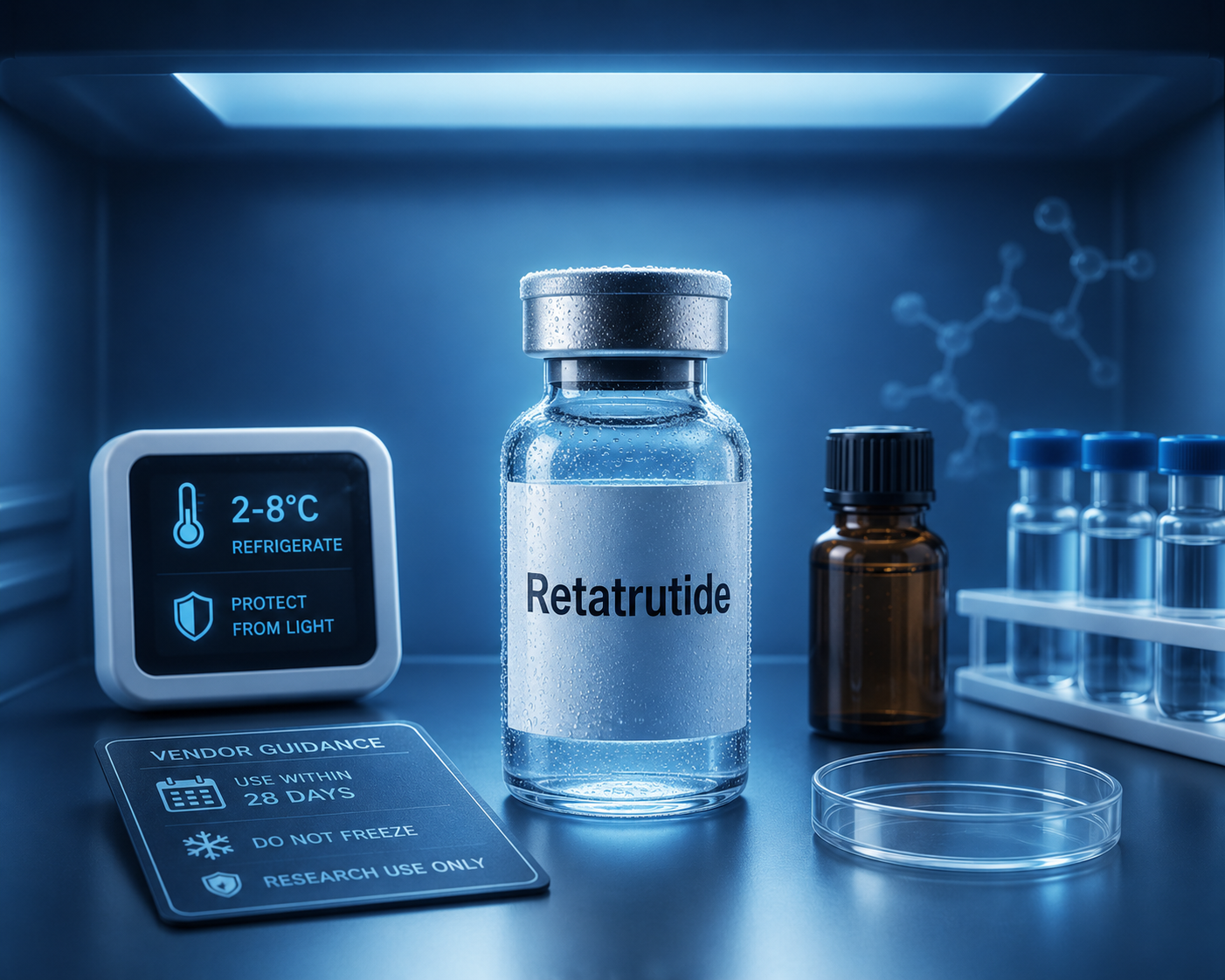
You've added bacteriostatic water to the vial, the powder has dissolved, and now the clock is ticking. How to store reconstituted retatrutide comes down to a few handling rules — but it also comes with a caveat most storage guides skip: there are no official storage instructions for retatrutide anywhere, because retatrutide is not an approved drug.
There are no official retatrutide storage instructions
Retatrutide (LY3437943) is Eli Lilly's investigational triple agonist — it activates GLP-1, GIP and glucagon receptors simultaneously. As of August 2026 it is not FDA-approved. Lilly has not yet filed its New Drug Application (filing is projected for Q4 2026 or Q1 2027, putting the earliest realistic approval in late 2027–2028), and the only legitimate supply on Earth moves inside Lilly's TRIUMPH and TRANSCEND clinical trials.
That has direct consequences for anyone holding a vial:
- No manufacturer guidance exists. Lilly publishes detailed storage labelling for approved products like tirzepatide; it publishes nothing for retatrutide, because there is no marketed product to label.
- Anything sold online is unregulated. The retatrutide peptide powder in "for sale" listings is labelled for laboratory research only and is not pharmaceutical-grade. The FDA sent warning letters to websites selling compounded retatrutide in September 2025, and Lilly's own statement is blunt: "Illicit retatrutide products may contain unknown ingredients, harmful contaminants and impurities."
- "Compounded retatrutide" is not a legal category. Because the drug was never approved, there is no recognised bulk substance for 503A compounding — unlike semaglutide during its shortage.
So the guidance below is the best available — but "best available" here means vendor convention, not validated pharmaceutical science. Nothing in this article is medical advice, and no one should start, stop or dose any compound without a licensed clinician.
How to store reconstituted retatrutide: the vendor consensus
Every figure in this table traces to research-peptide suppliers (Palmetto Peptides, SeekPeptides) and general peptide references such as Creative Peptides — not to any clinical or regulatory source.
| Parameter | Recommendation |
|---|---|
| Temperature | 2–8 °C (standard refrigerator) |
| Freezing | Never — ice crystals cause precipitation and loss of activity |
| Light | More light-sensitive in solution than as powder; use an amber vial, foil wrap or opaque box |
| Solvent | Bacteriostatic (BAC) water |
| Conservative use-by | 28 days refrigerated |
| Extended claim | Up to 4–6 weeks under strict sterile handling; 28–30 days is the recommended ceiling |
| Room temperature | ~21 days maximum below 30 °C — not recommended (see below) |
| Discard if | Cloudy, discoloured, or any visible particles |
Two points deserve emphasis. Freezing is the most common way people ruin a vial: it feels like it should preserve things, and instead the ice crystals physically disrupt the 39-amino-acid peptide as they form. And the 28-day window isn't arbitrary — it matches the general rule of thumb for any peptide reconstituted with bacteriostatic water, which Creative Peptides puts at up to about four weeks refrigerated.
Room temperature: the invisible potency drain
One vendor's stability notes quantify what happens outside the fridge: held below 30 °C, a reconstituted vial retains roughly 85% potency by day 21 and only about 60% by day 35. That matters because degradation is invisible — a solution can look perfectly clear while a third of its potency is gone, which means the dose you draw is no longer the dose you think it is. If dose accuracy matters to you, refrigeration isn't optional.
Storing the unmixed (lyophilised) powder
For completeness, the vendor guidance for the dry powder:
| Parameter | Recommendation |
|---|---|
| Temperature | −20 °C or below (freezer) |
| Shelf life | 24+ months at −20 °C |
| Light and moisture | Protect from both |
| Freeze–thaw | Vendors say the dry powder tolerates multiple cycles |
The asymmetry is the point: freezing protects the powder but destroys the solution. The moment you add water, the rules flip.
Why storage is really a dosing problem
In the trials, retatrutide dosing is precise — escalation from 2 mg through 4, 6, 9 and 12 mg in four-week steps, a schedule that produced a mean −24.2% body weight at 48 weeks on 12 mg in the 2023 NEJM Phase 2 study. A heat-degraded or six-week-old vial makes that kind of precision impossible: you cannot titrate a dose you can't measure. Our retatrutide dosage calculator shows how the trial escalation schedules map onto real vial math, and the same library covers other investigational agents such as pemvidutide.
Side effects worth knowing before something goes wrong
Storage mistakes sit on top of an already demanding safety profile. In the TRIUMPH-4 trial, nausea hit 43% and diarrhoea about 33% at 12 mg. Dysesthesia — tingling, burning, abnormal skin sensitivity — appeared in 20.9% of participants at 12 mg, a signal not seen with semaglutide or tirzepatide. Class-wide GLP-1 risks (pancreatitis, gallbladder disease, thyroid C-cell tumours) apply as well.
Red flags that warrant urgent care: severe or persistent abdominal pain, symptoms of gallbladder disease, or any unexpected reaction after injecting grey-market product — and be straight with the clinician about what was injected. Unregulated vials add contamination and mis-dosing risks no trial ever measured, and Reddit threads full of other people's "results" tell you nothing about what's in yours.
What the internet gets wrong
- "Follow the storage instructions on the label." There is no label. Some sites even publish storage guidance for a hypothetical "retatrutide pen" — no retatrutide pen exists.
- "Freeze it to make it last." True for the dry powder, destructive for the solution.
- "If it's clear, it's fine." Potency loss is invisible; a room-temperature vial can be down to ~85% potency by day 21 with zero change in appearance.
- "People on Reddit keep theirs for months." Those anecdotes involve unverifiable grey-market product of unknown composition.
- "It's basically like storing Ozempic." Approved products have validated stability data behind their label windows. Extrapolating those windows to an unapproved molecule is guesswork.
FAQ
How long does reconstituted retatrutide last in the fridge?
Vendor guidance says about 28 days at 2–8 °C when mixed with bacteriostatic water. Some claim 4–6 weeks under strict sterile technique, but 28–30 days is the recommended ceiling.
Can you freeze reconstituted retatrutide?
No. Freezing the solution causes ice-crystal damage, precipitation and loss of activity. Only the dry powder belongs in a freezer, at −20 °C.
How long can reconstituted retatrutide sit at room temperature?
One vendor's data allows roughly 21 days below 30 °C — with potency already down to about 85% by then and ~60% by day 35. Refrigerate instead.
How do you know if it's gone bad?
Cloudiness, discolouration or visible particles mean discard immediately. But a clear vial is not proof of potency — chemical degradation doesn't change how the solution looks.
Does retatrutide need protection from light?
Yes, in both forms — and the reconstituted solution is more light-sensitive than the powder. Use an amber vial, foil wrap or an opaque box.
Is there an approved retatrutide product with official storage instructions?
No. As of August 2026 no approved product exists in any form. If approval arrives — late 2027 at the earliest — Lilly will publish validated storage labelling with it.
The bottom line
Refrigerate at 2–8 °C, keep it in the dark, never freeze it, and treat 28 days as the outer limit — while remembering that all of this is vendor convention for unregulated research material, not validated guidance for an approved medicine. If and when retatrutide reaches the market, its label will replace every number on this page. Until then, this article is educational information only, and our peptide dosage calculator library exists to help you understand the published trial data — not to substitute for a licensed clinician.