
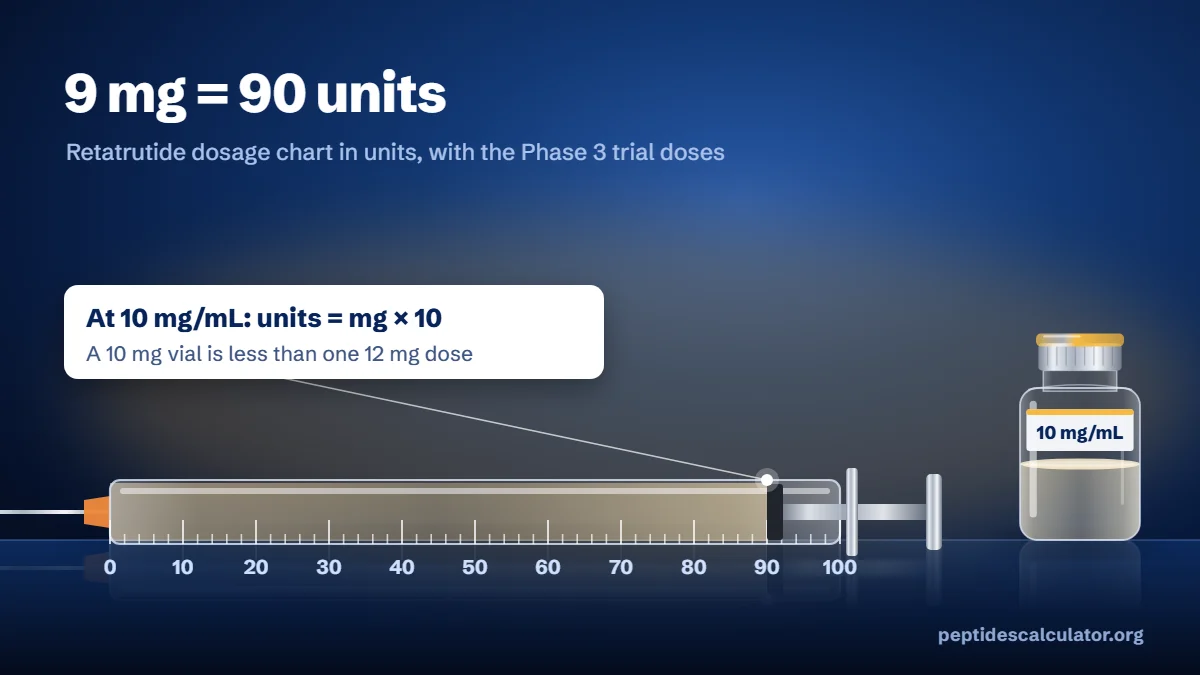
Retatrutide has no approved dose yet, so every chart is built from the Phase 3 trial doses: 2 mg to start, then 4, 6, 9 and 12 mg once a week. How many units that is depends only on your vial’s concentration. At 10 mg/mL (for example a 20 mg vial with 2 mL of bacteriostatic water) units = mg × 10: 2 mg = 20 units, 4 mg = 40 units, 9 mg = 90 units. At 5 mg/mL every number doubles, and 6 mg or more no longer fits in one syringe.
Open the retatrutide calculator → Enter your vial, water and dose to get exact units.
Dose chart: mg to units
Rule: units = mg ÷ mg/mL × 100 on a U-100 insulin syringe. Rows are the doses used in Eli Lilly’s TRIUMPH trials:
| Weekly dose | Units at 5 mg/mL | Units at 10 mg/mL | Units at 15 mg/mL | Units at 20 mg/mL |
|---|---|---|---|---|
| 2 mg | 40 | 20 | 13.3 | 10 |
| 4 mg | 80 | 40 | 26.7 | 20 |
| 6 mg | 120 ** | 60 | 40 | 30 |
| 9 mg | 180 ** | 90 | 60 | 45 |
| 12 mg | 240 ** | 120 ** | 80 | 60 |
** More than a 100-unit (1 mL) syringe holds. At these doses a stronger concentration is used, which means less water per vial.
Reverse chart: units to mg
| Syringe | Volume | mg at 5 mg/mL | mg at 10 mg/mL | mg at 15 mg/mL | mg at 20 mg/mL |
|---|---|---|---|---|---|
| 10 units | 0.1 mL | 0.5 mg | 1 mg | 1.5 mg | 2 mg |
| 20 units | 0.2 mL | 1 mg | 2 mg | 3 mg | 4 mg |
| 25 units | 0.25 mL | 1.25 mg | 2.5 mg | 3.75 mg | 5 mg |
| 30 units | 0.3 mL | 1.5 mg | 3 mg | 4.5 mg | 6 mg |
| 40 units | 0.4 mL | 2 mg | 4 mg | 6 mg | 8 mg |
| 50 units | 0.5 mL | 2.5 mg | 5 mg | 7.5 mg | 10 mg |
| 60 units | 0.6 mL | 3 mg | 6 mg | 9 mg | 12 mg |
| 80 units | 0.8 mL | 4 mg | 8 mg | 12 mg | 16 mg |
| 100 units | 1 mL | 5 mg | 10 mg | 15 mg | 20 mg |
The trial schedule in units
In TRIUMPH-1, everyone started at 2 mg weekly and stepped up every four weeks until reaching their assigned dose: 4 mg after one step, 9 mg after 2 → 4 → 6, and 12 mg after 2 → 4 → 6 → 9. This is the fastest path to 12 mg, shown in units:
| Weeks | Dose | Units at 10 mg/mL | Units at 20 mg/mL |
|---|---|---|---|
| 1–4 | 2 mg | 20 | 10 |
| 5–8 | 4 mg | 40 | 20 |
| 9–12 | 6 mg | 60 | 30 |
| 13–16 | 9 mg | 90 | 45 |
| 17+ | 12 mg | 120 ** | 60 |
This is how a trial was run, not a prescription. Lilly plans to file for US approval in the first quarter of 2027, so the approved schedule could differ.
How many doses one vial gives
This is the surprise for many people: at high doses, small vials run out almost immediately. Full weekly doses per vial:
| Vial | 2 mg/week | 4 mg/week | 6 mg/week | 9 mg/week | 12 mg/week |
|---|---|---|---|---|---|
| 10 mg | 5 | 2 | 1 | 1 | 0 |
| 20 mg | 10 | 5 | 3 | 2 | 1 |
| 30 mg | 15 | 7 | 5 | 3 | 2 |
At 12 mg, a 10 mg vial is not even one dose. Mixing two vials to make one injection adds measuring error, so people on high doses use larger vials and stronger concentrations.
What the doses delivered in Phase 3
TRIUMPH-1 enrolled 2,339 adults with obesity or overweight and at least one weight-related condition, without diabetes. The two columns are two ways of counting: the first assumes people kept taking the drug; the second includes everyone, also those who stopped.
| TRIUMPH-1, 80 weeks | If people stayed on treatment | Everyone randomized |
|---|---|---|
| 4 mg | −19.0% | −17.6% |
| 9 mg | −25.9% | −23.7% |
| 12 mg | −28.3% | −25.0% |
| Placebo | −2.2% | −3.9% |
In people with type 2 diabetes (TRIUMPH-2) weight loss was smaller, up to 20.8% at 12 mg, and in people with severe obesity and heart disease (TRIUMPH-3) up to 22.6%. Side effects rose with dose: at 12 mg, 42% had nausea and 25% vomiting (15% and 5% on placebo), and 11.3% stopped because of side effects. One newer finding is dysesthesia, unusual skin sensations such as tingling or burning, in about 12% on 9 or 12 mg versus 0.9% on placebo, mostly mild.
Before you use any chart
- Check the concentration on your own vial. A chart for the wrong mg/mL gives the wrong dose; recalculate whenever the vial or the water volume changes.
- Research vials are not the trial drug. Retatrutide sold online is not approved and its real content is unverified; the trial results apply to Lilly’s product.
- Small steps exist for a reason. In the trials, side effects and dropouts were highest at the top doses.
More on retatrutide: how much BAC water for 10 mg retatrutide, storing mixed retatrutide, and the retatrutide trial overview. Same charts for tirzepatide and semaglutide. For any other vial use the retatrutide calculator.
Comparing drugs? See the GLP-1 dosage chart with semaglutide, tirzepatide, retatrutide and more side by side.
Sources
- Eli Lilly via BioSpace. Lilly’s triple agonist, retatrutide, delivered powerful weight loss in pivotal Phase 3 obesity trial (TRIUMPH-1, May 21, 2026).
- Eli Lilly. Retatrutide successful in two additional Phase 3 obesity trials (TRIUMPH-2 and TRIUMPH-3, July 23, 2026).