
Tirzepatide Reconstitution Calculator
Enter the amount you want to measure. The vial buttons will highlight which vial strengths create cleaner syringe-unit measurements.
What amount do you need?
Type the target amount, then choose mg or mcg. Example: 2mg or 500mcg.
Work the dose out from body weight
Syringe size:
Possible vial strengths:
Best Match
Good Match
Usable
Harder to Measure
Example Tirzepatide Titration Schedule
| Phase | Weeks | Dose | Frequency |
|---|---|---|---|
| Start | Weeks 1–4 | 2.5 mg | 1× weekly |
| Titration 1 | Weeks 5–8 | 5 mg | 1× weekly |
| Titration 2 | Weeks 9–12 | 7.5 mg | 1× weekly |
| Titration 3 | Weeks 13–16 | 10 mg | 1× weekly |
| Titration 4 | Weeks 17–20 | 12.5 mg | 1× weekly |
| Target dose | Weeks 21+ | 15 mg | 1× weekly |
FDA-approved (Zepbound/Mounjaro). The label specifies weekly dosing with no cycling or scheduled breaks; the 2.5 mg step is for initiation only.
Possible vial strengths:
What Is It?
Tirzepatide
Dual GLP-1 / GIP agonist used in metabolic research.
Bacteriostatic Water
Sterile water containing a bacteriostatic preservative, commonly used when preparing multi-use research vials.
How To Mix Tirzepatide
1
CleanUse alcohol swabs to clean the tops of both vials.
2
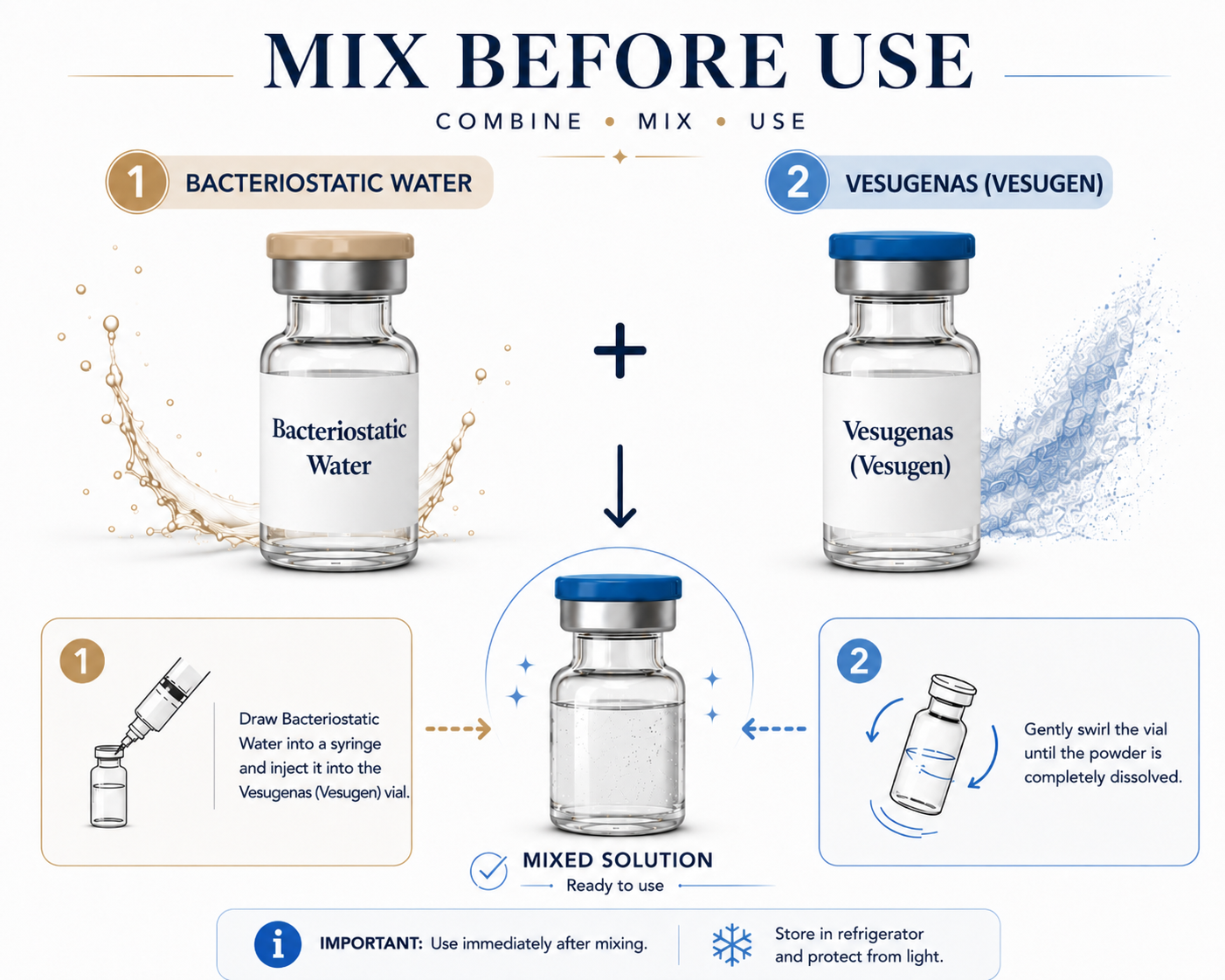
Draw BAC WaterDraw the selected amount of bacteriostatic water.
3
Inject SlowlyAdd the liquid slowly down the side of the vial.
4
Swirl GentlyDo not shake. Swirl gently until dissolved.
5
Store ProperlyStore as directed and protect from heat and light.
Best Practices & Common Mistakes
Best Practices
- Use sterile technique.
- Protect from light and heat.
- Store refrigerated when appropriate.
- Use clean syringe-unit math before measuring.
Common Mistakes
- Confusing milligrams with milliliters.
- Choosing an option with awkward decimal units.
- Using too little liquid for very small measurements.
- Shaking the vial aggressively.
Tirzepatide Storage & Handling
Lyophilized Powder: −20°C (−4°F) for long-term storage (up to 24 months). Refrigeration 2–8°C (36–46°F) for short-term use (up to ~3 months). Original sealed vial in the freezer is safest.
Reconstituted Solution: 2–8°C (36–46°F), use within ~7–14 days. Keep sealed, avoid light, and do not repeat freeze-thaw cycles.
Reconstituted Solution: 2–8°C (36–46°F), use within ~7–14 days. Keep sealed, avoid light, and do not repeat freeze-thaw cycles.
Frequently Asked Questions
There's no fixed answer — units measure volume, not mass, so it depends on your concentration. On a U-100 syringe, 100 units = 1 mL. With a common mix of 1 mL BAC water in a 5 mg vial (5 mg/mL): 2.5 mg = 0.5 mL = 50 units, and 5 mg = 100 units. Reconstitute at a different volume and the units change. Enter your vial and dose in the calculator for the exact number.
The same rule in reverse: units are volume, so the mg depends on concentration. 20 units = 0.2 mL and 40 units = 0.4 mL on a U-100 syringe. At 5 mg/mL (a 5 mg vial in 1 mL), that's 1 mg and 2 mg; at 10 mg/mL it doubles to 2 mg and 4 mg. Confirm your mg/mL first, then let the calculator convert.
The approved products (Mounjaro / Zepbound) start at 2.5 mg once weekly for 4 weeks — a starter dose meant to ease GI side effects, then stepped up by 2.5 mg every 4 weeks toward 5, 7.5, 10, 12.5 and 15 mg. Compounded vials follow the same amounts; you just measure them yourself in syringe units. These figures are shown for reference, not as a recommendation — dose decisions belong with a licensed clinician.
Swab both vial tops, draw your chosen amount of bacteriostatic water, add it slowly down the side of the powder vial, then swirl gently until clear — never shake. Your water volume sets the concentration: 1 mL in a 5 mg vial gives 5 mg/mL, while 2 mL gives 2.5 mg/mL and makes small doses easier to measure. The calculator highlights the volumes that land on clean unit marks.
Because doses are prescribed in mg but drawn in units, every mg step has a unit value that depends entirely on your mix. At 5 mg/mL: 2.5 mg = 50 units, 5 mg = 100 units (a full U-100 syringe), 7.5 mg = 75 units only if you reconstitute more concentrated. That's why there's no universal "units chart" — change the BAC water and the whole table shifts. Set your concentration once, then read every dose off the calculator.
Practical takeaway: If your goal involves weight management, metabolic health, recovery, physical performance, cognitive function, appearance, or general well-being, discuss it with a licensed healthcare professional. They can help you evaluate approved, evidence-based options rather than relying on an unapproved or investigational compound. This calculator is intended only for transparent research-reference calculations and does not determine an appropriate amount, recommend use, or replace professional medical guidance.
References
Important: This tool is for informational and research-reference purposes only. Not intended for human or veterinary use.