
Semaglutide Reconstitution Calculator
Enter the amount you want to measure. The vial buttons will highlight which vial strengths create cleaner syringe-unit measurements.
What amount do you need?
Type the target amount, then choose mg or mcg. Example: 2mg or 500mcg.
Work the dose out from body weight
Syringe size:
Possible vial strengths:
Best Match
Good Match
Usable
Harder to Measure
Example Semaglutide Titration Schedule
| Phase | Weeks | Dose | Frequency |
|---|---|---|---|
| Start | Weeks 1–4 | 0.25 mg | 1× weekly |
| Titration 1 | Weeks 5–8 | 0.5 mg | 1× weekly |
| Titration 2 | Weeks 9–12 | 1.0 mg | 1× weekly |
| Titration 3 | Weeks 13–16 | 1.7 mg | 1× weekly |
| Target dose | Weeks 17+ | 2.4 mg | 1× weekly |
FDA-approved (Wegovy). Official steps are 0.25 → 0.5 → 1.0 → 1.7 → 2.4 mg; the 750 mcg step does not exist in the label.
Possible vial strengths:
What Is It?
Semaglutide
GLP-1 analogue widely studied for weight and glycemic research.
Bacteriostatic Water
Sterile water containing a bacteriostatic preservative, commonly used when preparing multi-use research vials.
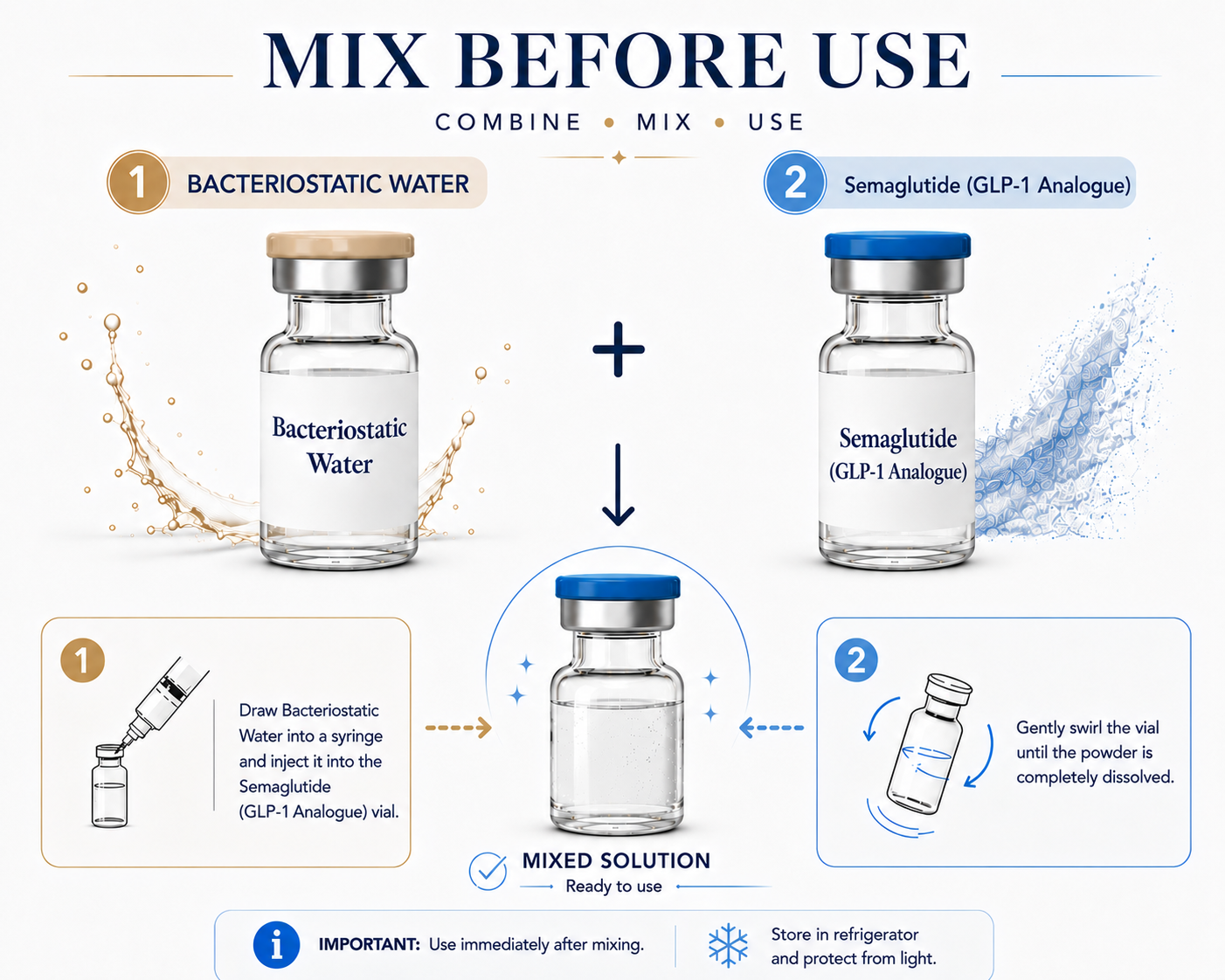
How To Mix Semaglutide
1
CleanUse alcohol swabs to clean the tops of both vials.
2
Draw BAC WaterDraw the selected amount of bacteriostatic water.
3
Inject SlowlyAdd the liquid slowly down the side of the vial.
4
Swirl GentlyDo not shake. Swirl gently until dissolved.
5
Store ProperlyStore as directed and protect from heat and light.
Best Practices & Common Mistakes
Best Practices
- Use sterile technique.
- Protect from light and heat.
- Store refrigerated when appropriate.
- Use clean syringe-unit math before measuring.
Common Mistakes
- Confusing milligrams with milliliters.
- Choosing an option with awkward decimal units.
- Using too little liquid for very small measurements.
- Shaking the vial aggressively.
Semaglutide Storage & Handling
Lyophilized Powder: −20°C (−4°F) for long-term storage (up to 24 months). Refrigeration 2–8°C (36–46°F) for short-term use (up to ~3 months). Original sealed vial in the freezer is safest.
Reconstituted Solution: 2–8°C (36–46°F), use within ~7–14 days. Keep sealed, avoid light, and do not repeat freeze-thaw cycles.
Reconstituted Solution: 2–8°C (36–46°F), use within ~7–14 days. Keep sealed, avoid light, and do not repeat freeze-thaw cycles.
Frequently Asked Questions
Any volume sets the concentration, but Semaglutide is commonly reconstituted with ~2 mL of bacteriostatic water per vial because it dissolves more reliably at lower concentrations. Example: a 5 mg vial + 2 mL = 2.5 mg/mL, so a 0.25 mg (250 mcg) starting amount is 0.1 mL = 10 units on a 1 mL insulin syringe. Add the water slowly down the side and swirl — never shake. Pick the pairing the calculator marks as a "Best Match."
Semaglutide is poorly soluble in plain water at neutral pH, so clumping or cloudiness usually means the concentration is too high — not that you need to shake harder. Add more bacteriostatic water (follow your supplier's recommended volume, often ~2 mL) and swirl gently until clear. If it still won't dissolve, the solution isn't usable; shaking can't force solubility the chemistry doesn't allow.
TThe approved prescription schedule escalates slowly to limit nausea: 0.25 mg once weekly for 4 weeks, then 0.5 → 1.0 → 1.7 → 2.4 mg, raising the dose every 4 weeks. These are the amounts used for the approved medicines (Ozempic / Wegovy), shown for reference — not a recommendation. Dosing decisions belong with a licensed clinician.
Once mixed, keep it refrigerated at 2–8°C (36–46°F), protected from light, and use it within a few weeks — many references cite up to ~28 days. Sealed lyophilized powder stores longest frozen at −20°C. Discard it if it turns cloudy or shows particles, and avoid repeated freeze-thaw cycles.
Vials are labeled in milligrams (mg), but Semaglutide doses are usually written in micrograms (mcg): 1 mg = 1000 mcg, so 0.25 mg = 250 mcg. Before measuring, confirm three numbers — vial strength (mg), water added (mL), and concentration (mg/mL) — then units = mL × 100 on a 1 mL insulin syringe. The calculator does the conversion, but sanity-check it by hand.
Practical takeaway: If your goal involves weight management, metabolic health, recovery, physical performance, cognitive function, appearance, or general well-being, discuss it with a licensed healthcare professional. They can help you evaluate approved, evidence-based options rather than relying on an unapproved or investigational compound. This calculator is intended only for transparent research-reference calculations and does not determine an appropriate amount, recommend use, or replace professional medical guidance.
References
Important: This tool is for informational and research-reference purposes only. Not intended for human or veterinary use.