
Need a Reliable Peptide Supplier? Click HERE!!!SponsoredVisit ↗
Mazdutide and BAC Water Mix

Mazdutide Reconstitution Calculator

Enter the amount you want to measure. The vial buttons will highlight which vial strengths create cleaner syringe-unit measurements.

What amount do you need?

Type the target amount, then choose mg or mcg. Example: 2mg or 500mcg.

Work the dose out from body weight

Syringe size:
Possible vial strengths:
Best Match Good Match Usable Harder to Measure

Example Mazdutide Titration Schedule

PhaseWeeksDoseFrequency
StartWeeks 1–42 mg1× weekly
Titration 1Weeks 5–84 mg1× weekly
Target doseWeeks 9+6 mg1× weekly

Approved in China (NMPA, June 2025) for chronic weight management at 4 or 6 mg once weekly. The 2.5–10 mg volume tables described research-vial dilutions, not the approved schedule.

Possible vial strengths:

What Is It?

Mazdutide

Dual GLP-1 / glucagon receptor agonist.

Bacteriostatic Water

Sterile water containing a bacteriostatic preservative, commonly used when preparing multi-use research vials.

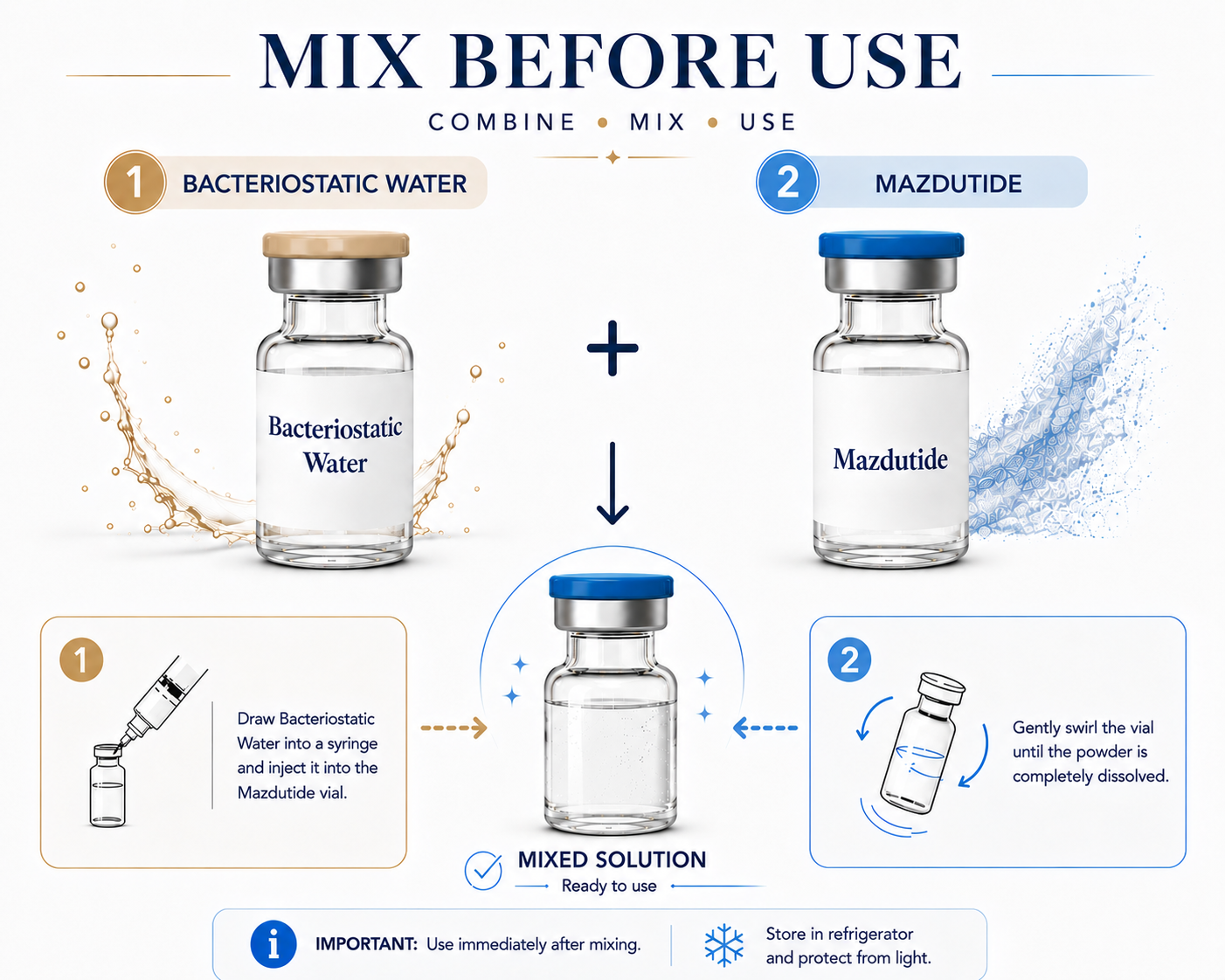
How To Mix Mazdutide

1
Clean

Use alcohol swabs to clean the tops of both vials.

2
Draw BAC Water

Draw the selected amount of bacteriostatic water.

3
Inject Slowly

Add the liquid slowly down the side of the vial.

4
Swirl Gently

Do not shake. Swirl gently until dissolved.

5
Store Properly

Store as directed and protect from heat and light.

Best Practices & Common Mistakes

Best Practices

  • Use sterile technique.
  • Protect from light and heat.
  • Store refrigerated when appropriate.
  • Use clean syringe-unit math before measuring.

Common Mistakes

  • Confusing milligrams with milliliters.
  • Choosing an option with awkward decimal units.
  • Using too little liquid for very small measurements.
  • Shaking the vial aggressively.

Mazdutide Storage & Handling

Lyophilized Powder: −20°C (−4°F) for long-term storage (up to 24 months). Refrigeration 2–8°C (36–46°F) for short-term use (up to ~3 months). Original sealed vial in the freezer is safest.
Reconstituted Solution: 2–8°C (36–46°F), use within ~7–14 days. Keep sealed, avoid light, and do not repeat freeze-thaw cycles.

Frequently Asked Questions

It's dosed once weekly with slow escalation — research and the approved Chinese schedules step up roughly 2 → 3 → 4.5 → 6 mg (and higher doses like 9 mg are in late-stage trials), raising the dose every 4 weeks to limit nausea. These figures are shown for reference, not as a recommendation; dosing decisions belong with a licensed clinician.
It's a dual GCG/GLP-1 receptor agonist — it acts on the glucagon receptor as well as GLP-1, which is meant to raise energy expenditure on top of appetite suppression. It's notable as the first drug of its class approved (in China, in 2025, by Innovent and Lilly); outside China it remains investigational and not approved. For the calculator, the mechanism doesn't change the mg-to-units math.
They target different receptor combinations: tirzepatide is GLP-1/GIP, retatrutide is GLP-1/GIP/glucagon (triple), and mazdutide is GLP-1/glucagon — no GIP. The glucagon arm is the shared theme with retatrutide. They're separate molecules with their own concentrations, so the calculator handles each individually; pick the matching calculator and enter that compound's vial and dose.
It can. Mazdutide is sold as both an acetate and a TFA salt, and the calculator treats the entered mass as pure active peptide. If part of the vial's weight is the salt, entering the total mg can slightly overstate the active amount. Check the Certificate of Analysis (CoA) for the free-base (net peptide) figure and enter that for the most accurate units.
Its long half-life — engineered through a fatty-diacid chain that binds plasma albumin and slows clearance — supports once-weekly injection rather than daily. Because it's long-acting, levels build over the first several weeks before reaching a steady state, so a single-dose calculation describes your first injection while later weekly troughs sit higher.
Practical takeaway: If your goal involves weight management, metabolic health, recovery, physical performance, cognitive function, appearance, or general well-being, discuss it with a licensed healthcare professional. They can help you evaluate approved, evidence-based options rather than relying on an unapproved or investigational compound. This calculator is intended only for transparent research-reference calculations and does not determine an appropriate amount, recommend use, or replace professional medical guidance.

About the author

Maria Hrabina is a pharmacist and scientific reviewer with a strong interest in peptide science, pharmacology, and emerging therapeutic compounds.

Her work focuses on understanding how peptide-based compounds interact with biological signaling pathways and how they are being investigated across areas such as metabolic health, dermatology, recovery, regenerative research, and pharmaceutical development.

Maria follows research on a broad range of peptides, from compounds used in approved medicines to experimental molecules still being evaluated in laboratory, preclinical, and clinical studies.

Her approach combines scientific curiosity with critical evaluation of evidence. She believes promising mechanisms and early research deserve attention, but should not be presented as established clinical benefits until they are supported by adequate human data.

Her areas of focus include scientific literature review, mechanisms of action, pharmacology, pharmacokinetics, safety, pharmaceutical formulation, and the overall quality of evidence behind peptide-based compounds.

She is particularly interested in the process of translating an experimental molecule into a reliable pharmaceutical product — including compound characterization, purity, stability, formulation, dose selection, safety assessment, and controlled clinical trials.

Maria believes peptide science has significant long-term potential, but that its progress depends on rigorous research, high manufacturing standards, transparent safety data, and responsible scientific communication.

Through her writing, she aims to help readers understand both sides of peptide research: what makes these compounds scientifically promising and what questions remain before their potential can be considered clinically established.

Areas of interest: Peptide Science · Therapeutic Peptides · Peptide Pharmacology · Metabolic Peptides · Cosmetic Peptides · Drug Development · Pharmacokinetics · Drug Safety · Pharmaceutical Formulation · Emerging Therapies · Evidence-Based Medicine

Important: This tool is for informational and research-reference purposes only. Not intended for human or veterinary use.
← All peptides