
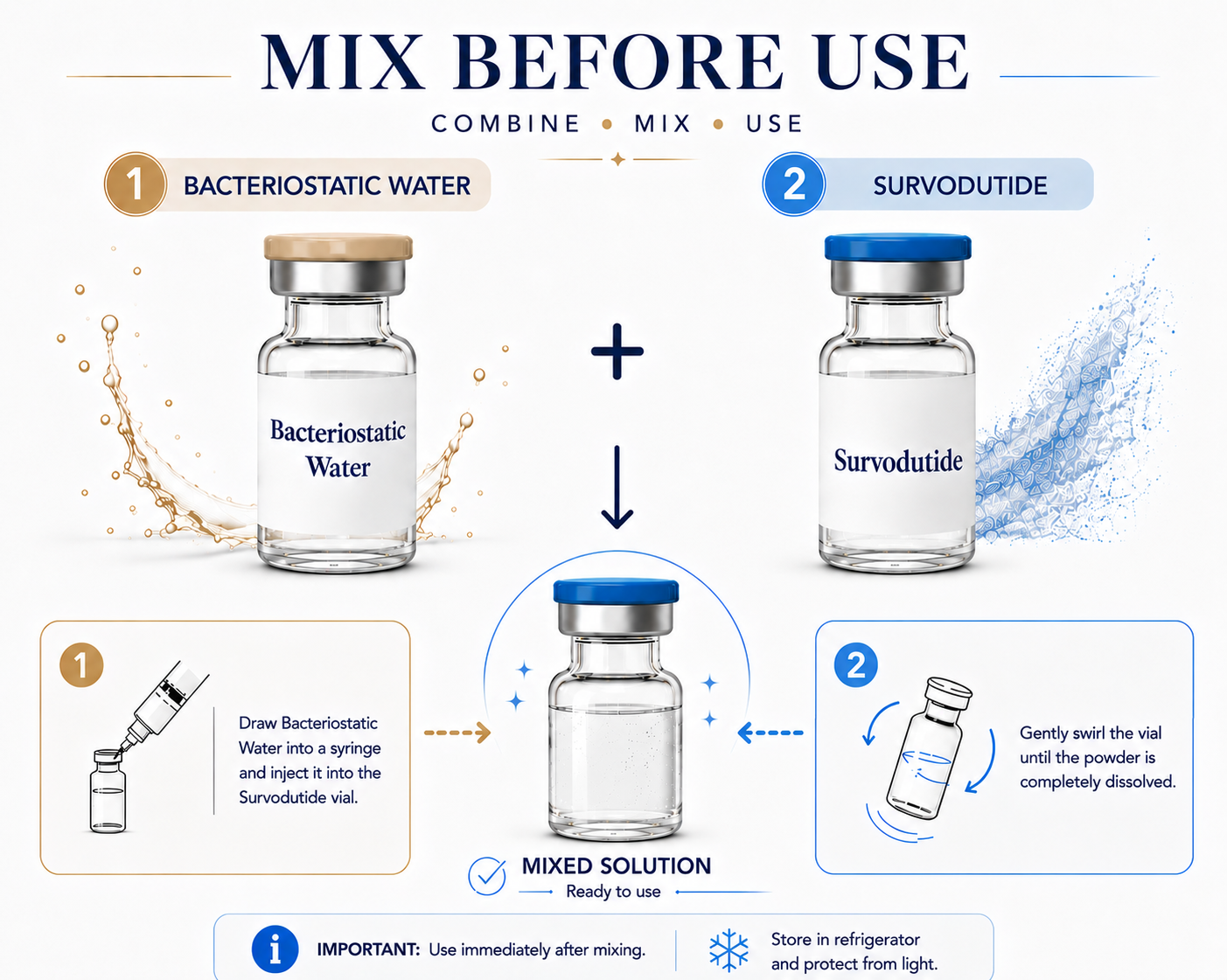
Survodutide and BAC Water Mix

Survodutide Reconstitution Calculator

Enter the amount you want to measure. The vial buttons will highlight which vial strengths create cleaner syringe-unit measurements.

What amount do you need?

Type the target amount, then choose mg or mcg. Example: 2mg or 500mcg.

Syringe size:
Possible vial strengths:
Best Match Good Match Usable Harder to Measure

Example Survodutide Titration Schedule

WeekWeekly DoseInjection Volume (mL / Units)
Weeks 1–20.6 mg (600 mcg)0.12 mL (12 units)
Weeks 3–41.2 mg (1,200 mcg)0.24 mL (24 units)
Weeks 5–61.8 mg (1,800 mcg)0.36 mL (36 units)
Weeks 7–82.4 mg (2,400 mcg)0.48 mL (48 units)
Weeks 9–103.6 mg (3,600 mcg)0.72 mL (72 units)
Weeks 11–124.8 mg (4,800 mcg)0.96 mL (96 units)
Week 13+6.0 mg (6,000 mcg)1.20 mL (120 units)
Possible vial strengths:

What Is It?

Survodutide

GLP-1 / glucagon dual agonist in clinical study.

Bacteriostatic Water

Sterile water containing a bacteriostatic preservative, commonly used when preparing multi-use research vials.

How To Mix Survodutide

1
Clean

Use alcohol swabs to clean the tops of both vials.

2
Draw BAC Water

Draw the selected amount of bacteriostatic water.

3
Inject Slowly

Add the liquid slowly down the side of the vial.

4
Swirl Gently

Do not shake. Swirl gently until dissolved.

5
Store Properly

Store as directed and protect from heat and light.

Best Practices & Common Mistakes

Best Practices

  • Use sterile technique.
  • Protect from light and heat.
  • Store refrigerated when appropriate.
  • Use clean syringe-unit math before measuring.

Common Mistakes

  • Confusing milligrams with milliliters.
  • Choosing an option with awkward decimal units.
  • Using too little liquid for very small measurements.
  • Shaking the vial aggressively.

Survodutide Storage & Handling

Lyophilized Powder: −20°C (−4°F) for long-term storage (up to 24 months). Refrigeration 2–8°C (36–46°F) for short-term use (up to ~3 months). Original sealed vial in the freezer is safest.
Reconstituted Solution: 2–8°C (36–46°F), use within ~7–14 days. Keep sealed, avoid light, and do not repeat freeze-thaw cycles.

Frequently Asked Questions

In trials it's dosed once weekly with a long, slow escalation — starting around 0.6 mg and stepping up every 2 weeks (1.2 → 1.8 → 2.4 → 3.6 → 4.8 mg) toward roughly 6 mg, to ease nausea over a longer ramp than most GLP-1s. These are research figures shown for reference, not a recommendation; dosing belongs with a licensed clinician.
It's a GLP-1/glucagon dual receptor agonist developed by Boehringer Ingelheim and Zealand Pharma. The glucagon arm is meant to raise energy expenditure alongside appetite suppression. Unlike most drugs here, it's studied not only for obesity but prominently for liver disease (MASH). It's investigational and not approved anywhere yet. For the calculator, the mechanism doesn't change the mg-to-units math.
The receptor mix differs: tirzepatide is GLP-1/GIP, retatrutide is GLP-1/GIP/glucagon (triple), and survodutide is GLP-1/glucagon — no GIP. Survodutide shares the glucagon arm with retatrutide but is being positioned heavily for liver (MASH), which sets it apart. They're separate molecules with their own concentrations, so use the matching calculator and enter that compound's vial and dose.
Add BAC water slowly down the side of the vial and swirl gently until clear — never shake. Because the early doses are tiny (0.6 mg), a moderate concentration helps: a 5 mg vial with 1 mL gives 5 mg/mL, so 0.6 mg = 0.12 mL (12 units). Very concentrated mixes make those small early doses hard to measure accurately — the calculator highlights the cleanest unit matches.
That's one of its main research directions. Beyond weight loss, survodutide is in trials for MASH (metabolic-associated steatohepatitis), a fatty liver condition — its glucagon activity is thought to act on liver fat directly. None of this is approved use; it's investigational. The calculator only prepares a measurement and says nothing about what the compound is suitable for.
Practical takeaway: If your real goal is weight or metabolic health, the most useful next step is discussing approved treatment options with a clinician rather than relying on an unapproved compound.
Important: This tool is for informational and research-reference purposes only. Not intended for human or veterinary use.
← All peptides