
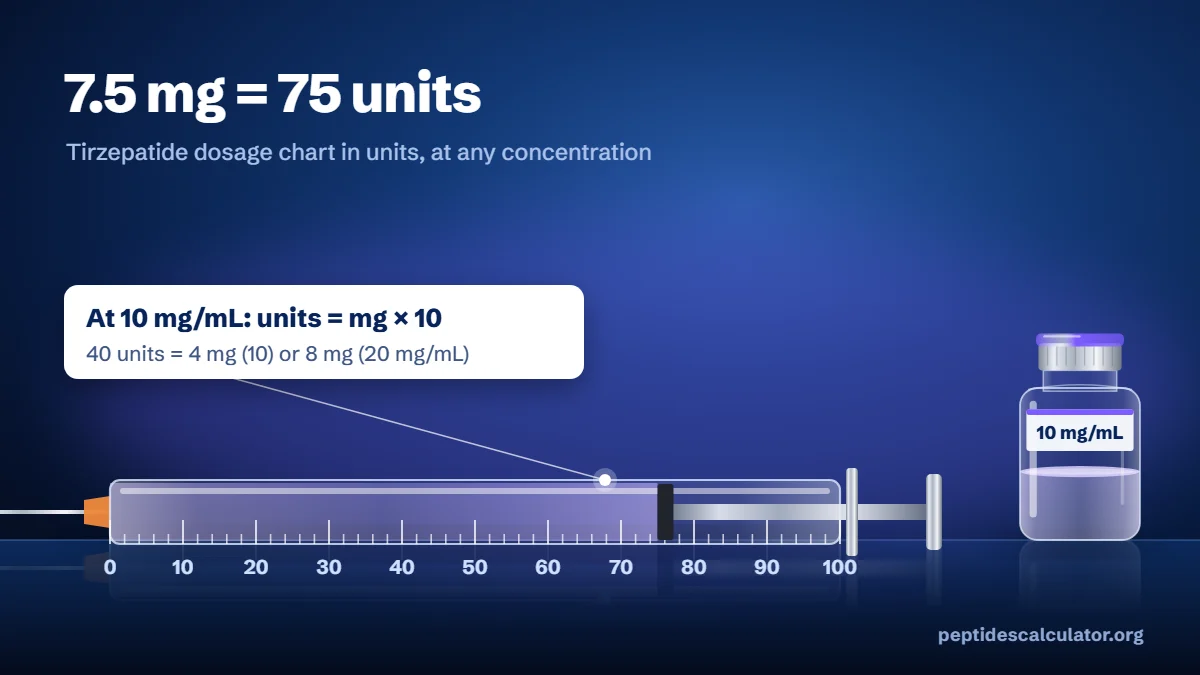
How many units a tirzepatide dose is depends only on the concentration printed on your vial. At 10 mg/mL, a common compounded strength, the rule is simply mg × 10: 2.5 mg = 25 units, 5 mg = 50 units, 7.5 mg = 75 units on a U-100 insulin syringe. At 20 mg/mL every number halves. Going the other way, 40 units is 4 mg at 10 mg/mL, 8 mg at 20 mg/mL and 2 mg at 5 mg/mL, so the same mark on the syringe can mean very different doses.
Open the tirzepatide calculator → Enter your concentration and dose to get exact units.
The one rule behind every chart
units = dose in mg ÷ concentration in mg/mL × 100. A U-100 insulin syringe has 100 units in 1 mL, so 1 unit is always 0.01 mL. That gives quick shortcuts: at 5 mg/mL multiply mg by 20, at 10 mg/mL by 10, at 20 mg/mL by 5, at 25 mg/mL by 4.
Dose chart: mg to units
The rows are the dose steps on the Zepbound and Mounjaro labels. Find your concentration column:
| Weekly dose | Units at 5 mg/mL | Units at 10 mg/mL | Units at 15 mg/mL | Units at 20 mg/mL | Units at 25 mg/mL |
|---|---|---|---|---|---|
| 2.5 mg | 50 | 25 | 16.7 | 12.5 | 10 |
| 5 mg | 100 | 50 | 33.3 | 25 | 20 |
| 7.5 mg | 150 ** | 75 | 50 | 37.5 | 30 |
| 10 mg | 200 ** | 100 | 66.7 | 50 | 40 |
| 12.5 mg | 250 ** | 125 ** | 83.3 | 62.5 | 50 |
| 15 mg | 300 ** | 150 ** | 100 | 75 | 60 |
** More than one 100-unit (1 mL) syringe holds. At these doses, a stronger concentration is needed.
Reverse chart: units to mg
If your instructions are written in units, this table shows what you are actually taking:
| Syringe | Volume | mg at 5 mg/mL | mg at 10 mg/mL | mg at 15 mg/mL | mg at 20 mg/mL |
|---|---|---|---|---|---|
| 5 units | 0.05 mL | 0.25 mg | 0.5 mg | 0.75 mg | 1 mg |
| 10 units | 0.1 mL | 0.5 mg | 1 mg | 1.5 mg | 2 mg |
| 15 units | 0.15 mL | 0.75 mg | 1.5 mg | 2.25 mg | 3 mg |
| 20 units | 0.2 mL | 1 mg | 2 mg | 3 mg | 4 mg |
| 25 units | 0.25 mL | 1.25 mg | 2.5 mg | 3.75 mg | 5 mg |
| 30 units | 0.3 mL | 1.5 mg | 3 mg | 4.5 mg | 6 mg |
| 40 units | 0.4 mL | 2 mg | 4 mg | 6 mg | 8 mg |
| 50 units | 0.5 mL | 2.5 mg | 5 mg | 7.5 mg | 10 mg |
| 60 units | 0.6 mL | 3 mg | 6 mg | 9 mg | 12 mg |
| 75 units | 0.75 mL | 3.75 mg | 7.5 mg | 11.25 mg | 15 mg |
| 100 units | 1 mL | 5 mg | 10 mg | 15 mg | 20 mg |
Week by week: the label schedule in units
Both labels start at 2.5 mg once a week for 4 weeks, then 5 mg, and allow further 2.5 mg steps if needed, each after at least 4 weeks. The table shows the fastest the schedule can go, not a plan: going higher is not required, and 5, 10 and 15 mg are all approved maintenance doses for Zepbound.
| Earliest timing | Dose | Units at 10 mg/mL | Units at 20 mg/mL |
|---|---|---|---|
| Weeks 1–4 | 2.5 mg | 25 | 12.5 |
| Weeks 5–8 | 5 mg | 50 | 25 |
| Weeks 9–12 | 7.5 mg | 75 | 37.5 |
| Weeks 13–16 | 10 mg | 100 | 50 |
| Weeks 17–20 | 12.5 mg | 125 ** | 62.5 |
| Weeks 21+ | 15 mg | 150 ** | 75 |
** 150 units does not fit in one syringe; at 15 mg a 20 mg/mL (or stronger) vial is used.
Zepbound vials: always 0.5 mL, never the same mg
This surprises a lot of people. Every Zepbound single-dose vial holds its dose in exactly 0.5 mL, whatever the strength. So the concentration rises with the dose, and one full dose is always the 0.5 mL line (the 50 mark on a U-100 syringe):
| Zepbound vial | Concentration | One full dose |
|---|---|---|
| 2.5 mg / 0.5 mL | 5 mg/mL | 0.5 mL = 50 units |
| 5 mg / 0.5 mL | 10 mg/mL | 0.5 mL = 50 units |
| 7.5 mg / 0.5 mL | 15 mg/mL | 0.5 mL = 50 units |
| 10 mg / 0.5 mL | 20 mg/mL | 0.5 mL = 50 units |
| 12.5 mg / 0.5 mL | 25 mg/mL | 0.5 mL = 50 units |
| 15 mg / 0.5 mL | 30 mg/mL | 0.5 mL = 50 units |
That is why “50 units of Zepbound” means nothing on its own: it is 2.5 mg from one vial and 15 mg from another. The vial is single-dose with no preservative; the label says to throw it away after use, even if some medicine is left. Lilly’s instructions use a 1 mL syringe recommended by your healthcare provider and measure in mL, not units.
Four mistakes that cause big dosing errors
- Using a chart for the wrong concentration. If your pharmacy switches you from 10 mg/mL to 20 mg/mL and you keep drawing the same units, your dose doubles. Recalculate every time the label changes.
- Mixing up mL and units. “Take 0.5” on a prescription usually means 0.5 mL, which is 50 units. The Institute for Safe Medication Practices warned in June 2026 that prescriptions written in mg or mL, paired with syringes marked in units, are a common source of GLP-1 errors.
- Assuming every syringe is U-100. A 0.3 mL insulin syringe still has 100 units per mL but only holds 30 units, and some have half-unit marks. U-40 syringes (for some pet insulins) use a different scale; never use them with these charts.
- Reusing single-dose vials. Branded vials have no preservative. Only multi-dose vials made with bacteriostatic water are meant to be punctured more than once.
If you miss a dose
Per the label: take it as soon as possible within 4 days (96 hours). If more than 4 days have passed, skip it and take the next dose on your usual day. You can move your injection day as long as doses stay at least 3 days (72 hours) apart.
Mixing powder yourself? Our guide on how much BAC water for tirzepatide covers water volumes for 5–60 mg vials. For any other strength use the tirzepatide calculator or the units-to-mg guide. Semaglutide has its own semaglutide dosage chart in units.
Comparing drugs? See the GLP-1 dosage chart with semaglutide, tirzepatide, retatrutide and more side by side.
Prefer a pill? Orforglipron (Foundayo) is a once-daily GLP-1 tablet with no injections and no fasting rules. Our orforglipron dosage chart lists all six tablet strengths, the step-up schedule and how trial doses such as 36 mg convert to today’s tablets.
Sources
- Drugs.com (AHFS monograph). Tirzepatide (Mounjaro and Zepbound dosing, maintenance doses, missed-dose rules).
- Eli Lilly. Zepbound single-dose vial: Instructions for Use (0.5 mL vials, 1 mL syringe, discard after use).
- Becker’s Hospital Review / ISMP. 5 common GLP-1 medication errors pharmacists need to know (June 25, 2026).