
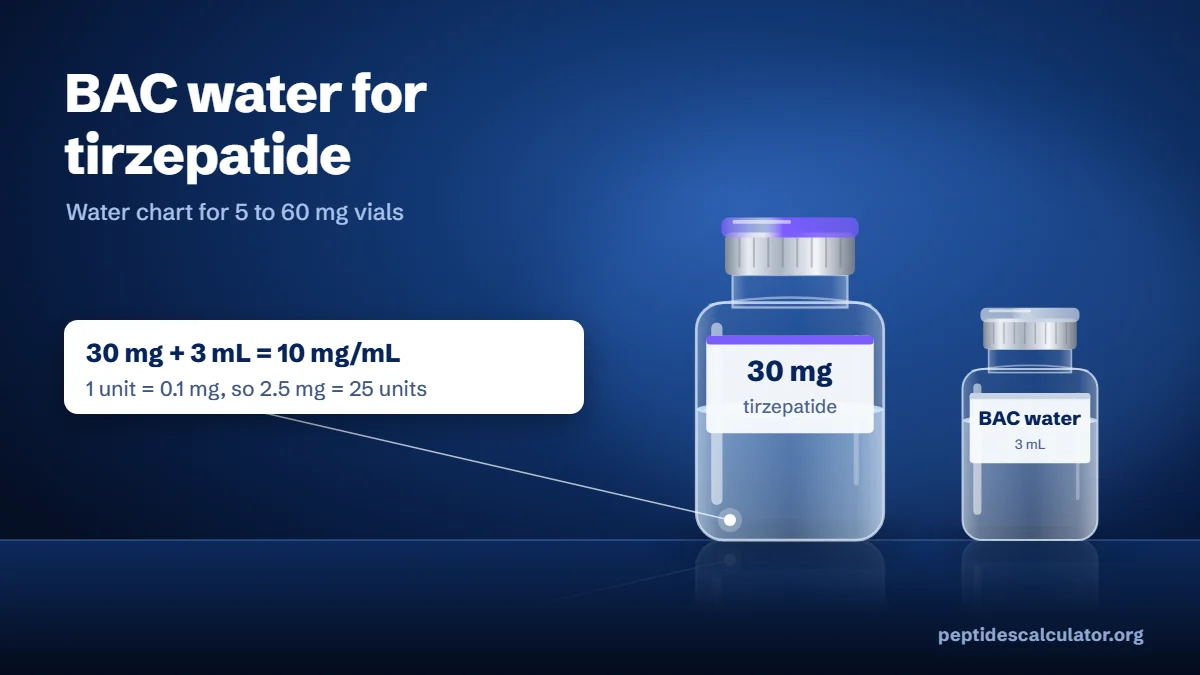
The simplest choice is to mix tirzepatide to 10 mg/mL: add 1 mL of bacteriostatic water for every 10 mg in the vial. Then 1 unit on a U-100 insulin syringe holds 0.1 mg, so the dose in mg times 10 is the number of units: 2.5 mg = 25 units, 5 mg = 50 units. For large vials (40–60 mg) or doses above 10 mg, mix to 20 mg/mL instead, so the volume fits the vial and one syringe.
Open the tirzepatide calculator → Enter your vial, water and weekly amount to get exact units.
How much water for each vial size
| Vial | Water for 10 mg/mL | Water for 20 mg/mL | Weeks at 2.5 mg |
|---|---|---|---|
| 5 mg | 0.5 mL | 0.25 mL | 2 |
| 10 mg | 1 mL | 0.5 mL | 4 |
| 15 mg | 1.5 mL | 0.75 mL | 6 |
| 20 mg | 2 mL | 1 mL | 8 |
| 30 mg | 3 mL | 1.5 mL | 12 |
| 40 mg | 4 mL * | 2 mL | 16 |
| 60 mg | 6 mL * | 3 mL | 24 |
* More than many vials hold (most are about 3 mL); use the 20 mg/mL column. Adding water does not change how much tirzepatide is in the vial, only how much is in each unit.
How many units for each weekly amount
These are the dose steps on the approved label (see below). The table shows units on a U-100 syringe at three common concentrations:
| Weekly amount | Units at 5 mg/mL | Units at 10 mg/mL | Units at 20 mg/mL |
|---|---|---|---|
| 2.5 mg | 50 | 25 | 12.5 |
| 5 mg | 100 | 50 | 25 |
| 7.5 mg | 150 ** | 75 | 37.5 |
| 10 mg | 200 ** | 100 | 50 |
| 12.5 mg | 250 ** | 125 ** | 62.5 |
| 15 mg | 300 ** | 150 ** | 75 |
** More than one 100-unit (1 mL) syringe holds; use a stronger mix. A 5 mg/mL mix is what you get from a 10 mg vial with 2 mL of water: easy to read at the low doses, but it runs out of syringe room at 7.5 mg.
Worked examples
- 10 mg vial: 1 mL water = 10 mg/mL. 2.5 mg = 25 units; the vial holds four 2.5 mg amounts.
- 30 mg vial (the most searched size): 3 mL = 10 mg/mL, so 5 mg = 50 units. Or 1.5 mL = 20 mg/mL, so 5 mg = 25 units.
- 60 mg vial: 3 mL = 20 mg/mL, so 2.5 mg = 12.5 units and 15 mg = 75 units.
For any other combination, use the tirzepatide calculator or, to convert units back to mg, our units-to-mg guide.
Already have a mixed vial or a pharmacy vial? Our tirzepatide dosage chart in units converts mg to units and back for 5–25 mg/mL.
How long one vial lasts, and why that matters
Divide the vial's mg by your weekly amount: a 30 mg vial at 5 mg a week lasts 6 weeks; a 60 mg vial at 2.5 mg lasts 24 weeks. That is far longer than the usual 28-day limit for an opened multi-dose vial, and nobody has published how long dissolved research tirzepatide stays stable. A smaller vial that you finish within about four weeks is the safer choice. Keep the mixed vial at 2–8 °C.
How to mix
- Let the vial reach room temperature and wipe both stoppers with alcohol.
- Draw the planned water volume and let it run slowly down the inside wall of the vial.
- Swirl gently; do not shake. Use it only if the solution is clear.
- Label the vial with the date and the mg/mL.
More detail, including when not to use BAC water, is in our BAC water guide.
What the approved label says
Tirzepatide is approved as Mounjaro (type 2 diabetes) and Zepbound (weight management). The Zepbound label starts at 2.5 mg once a week for 4 weeks, then increases in 2.5 mg steps, at least 4 weeks apart; maintenance doses are 5, 10 or 15 mg, and 15 mg is the maximum. Approved pens and single-dose vials (2.5–15 mg) come ready to inject and need no mixing.
Powder vials sold online are a different product. The FDA declared the tirzepatide shortage over on December 19, 2024; compounding pharmacies had to stop making copies by February 18, 2025 (503A) and March 19, 2025 (503B). Vials labelled for research are not checked by any regulator, so the amount in them is unverified.
Sources
- Drugs.com. Zepbound dosage (label dosing: 2.5 mg start, 2.5 mg steps every 4 weeks, maintenance 5/10/15 mg, maximum 15 mg).
- Eli Lilly. Zepbound: getting patients started (strengths and single-dose vials).
- Pharmacy Times. FDA affirms tirzepatide shortage resolved, sets transition period for compounding (December 20, 2024).