
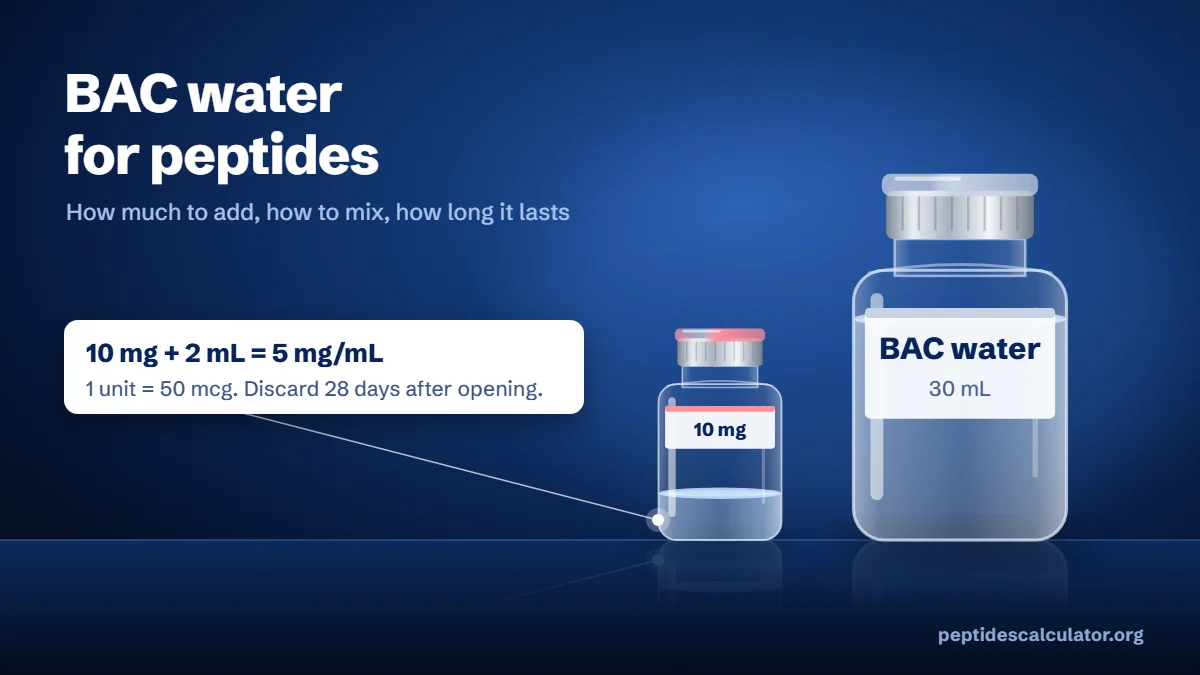
Bacteriostatic water (BAC water) is sterile water with 0.9% benzyl alcohol added as a preservative. It is the standard liquid for dissolving freeze-dried peptide powder. The preservative stops bacteria from growing after the rubber stopper has been punctured, so one vial can be used for several draws. How much you add does not change how much peptide is in the vial; it only changes how much peptide is in each unit on the syringe.
Open the peptide calculator → Enter vial mg, water mL and your amount to get the exact units.
BAC water vs sterile water vs saline
- Bacteriostatic water for injection: sterile water + benzyl alcohol (0.9%; Hospira also makes a 1.1% glass vial). Multiple-dose: repeated draws from one vial are allowed. This is what most peptide labels and clinics use.
- Sterile water for injection: no preservative. Single-dose: once the stopper is punctured, the rest should be thrown away. It suits a vial you will use all at once, not one you draw from for weeks.
- Saline (0.9% sodium chloride): salt water, sterile, sold with or without a preservative. Not the usual choice for peptides unless your product's instructions say so.
- Tap, bottled or distilled water: not sterile. Never inject them.
How much BAC water to add
There is no single correct amount. Most peptide vials are mixed with 1 to 3 mL. The table shows the concentration you get and how much peptide is in 10 units (0.1 mL) on a U-100 insulin syringe:
| Vial | + 1 mL water | + 2 mL water | + 3 mL water |
|---|---|---|---|
| 2 mg | 2 mg/mL 10 units = 200 mcg | 1 mg/mL 10 units = 100 mcg | 0.67 mg/mL 10 units = 67 mcg |
| 5 mg | 5 mg/mL 10 units = 500 mcg | 2.5 mg/mL 10 units = 250 mcg | 1.67 mg/mL 10 units = 167 mcg |
| 10 mg | 10 mg/mL 10 units = 1 mg | 5 mg/mL 10 units = 500 mcg | 3.33 mg/mL 10 units = 333 mcg |
| 20 mg | 20 mg/mL 10 units = 2 mg | 10 mg/mL 10 units = 1 mg | 6.67 mg/mL 10 units = 667 mcg |
A practical rule: pick the water volume that puts your amount at 10 units or more. Syringe marks are 1 or 2 units apart, so at 5 units a misread of one mark is a 20% error; at 25 units it is 4%. More water means more units for the same amount, which is easier to measure, but a larger volume to inject. Many peptide vials hold about 3 mL, so that is usually the practical maximum.
- 10 mg vial: 2 mL is the most common choice: 5 mg/mL, so 1 unit = 50 mcg and 250 mcg = 5 units. If your amount is a few hundred micrograms, 3 mL or a smaller vial gives easier numbers.
- 5 mg vial: 2 mL gives 2.5 mg/mL; 250 mcg = 10 units.
- Blend vials (e.g. 70–80 mg GLOW or KLOW): each peptide has its own concentration; see our GLOW and KLOW guide.
To go the other way, from units to mg, use our units-to-mg guide. For doses published in studies and by clinics, see the peptide dosing chart.
How to mix peptides with BAC water
- Let the peptide vial reach room temperature. Wipe both rubber stoppers with an alcohol swab and let them dry.
- Draw the planned volume of BAC water with a clean syringe.
- Insert the needle into the peptide vial and let the water run slowly down the inside wall of the glass, not straight onto the powder.
- Do not shake. Swirl or roll the vial gently until the powder has dissolved. The solution should be clear; if it stays cloudy or has particles, do not use it.
- Write the date and the concentration (mg/mL) on the vial, then keep it in the fridge.
How long BAC water lasts after opening
- Unopened: until the expiry date on the label, at room temperature (Hospira: 20–25 °C).
- Opened (stopper punctured): the usual rule for multiple-dose vials is to throw them away 28 days after first opening, unless the maker gives a different date, and at once if sterility is in doubt. Write the discard date on the vial when you first use it.
- Mixed peptide: the 28-day rule is about sterility, not about how long the peptide stays potent. Stability depends on the peptide; follow its label and keep it at 2–8 °C. Our calculator pages list storage notes for each peptide.
When BAC water is not the right choice
- Products that specify another solvent. For example, the original maker of IGF-1 LR3 dissolves it in dilute acetic acid. Always follow the product's own instructions.
- Newborns. The label says "not for use in neonates": benzyl alcohol has been linked to toxicity in newborns.
- Allergy to benzyl alcohol. Use a preservative-free sterile water and a single-use approach instead.
- Capsules, tablets and nasal sprays are already in their final form and need no water.
Where to get BAC water
In the US, bacteriostatic water for injection (for example Hospira, made by Pfizer) is labelled "Rx only" and is sold by pharmacies and medical suppliers. Many websites also sell bottles marketed for research use. Whatever the source, check that the label says USP, names the preservative (benzyl alcohol 0.9%), and shows a lot number and expiry date, and that the flip-off cap and seal are intact. A 30 mL vial is enough for 10–15 peptide vials at 2–3 mL each, but remember the 28-day limit once it is opened.
Common mistakes
- Thinking more water means a weaker dose. The dose depends on how many units you draw, not on the water.
- Using so little water that the amount is only a few units.
- Spraying water onto the powder and shaking the vial.
- Keeping an opened vial of BAC water for months.
- Using sterile water for injection for a vial you will draw from many times.
Want your dose to be a round number of units? The reverse peptide calculator works back from the syringe to the water.
Drug-specific water guides: how much BAC water for tirzepatide and for 10 mg retatrutide.
The math behind it: the peptide calculator formula explained and why vial strengths differ.
Sources
- Pfizer (Hospira). Bacteriostatic Water for Injection, USP: prescribing information (composition, multiple-dose use, "not for use in neonates", storage 20–25 °C).
- The Joint Commission. Managing multi-dose vials of injectable medication (discard within 28 days of opening unless the manufacturer specifies otherwise).