
Enter the amount you want to measure. The vial buttons will highlight which vial strengths create cleaner syringe-unit measurements.
⚠ Use acetic acid — not bacteriostatic water
IGF-1 LR3 is insoluble or unstable in standard BAC water. Manufacturer protocols require reconstitution in dilute acetic acid (0.1%) — or, for IGF-1 variants, 50 mM acetic acid. Volumes shown below refer to acetic acid, not water.
What amount do you need?
Type the target amount, then choose mg or mcg. Example: 2mg or 500mcg.
Syringe size:
Possible vial strengths:
Best Match Good Match Usable Harder to Measure
Example IGF-1 LR3 Titration Schedule
Usage Protocols (Based on Preclinical & Anecdotal Data)
As a research chemical, there are no clinically established protocols for human use. The following information is compiled from preclinical studies and informal community reports.
Parameter Details
Standard Research Dose Doses in research typically range from 20mcg to 100mcg per day. Some studies have used higher weight-based doses (e.g., 80-120 mcg/kg).
Common Anecdotal Dosage User reports suggest a range of 20-60 mcg injected post-workout, with some clinics recommending 100 mcg per injection. Doses for men are often cited as 40-50 mcg/day, while women may use around 20 mcg/day.
Administration Route Typically administered via subcutaneous (SubQ) or intramuscular (IM) injection into the muscle group trained that day. SubQ injection into the abdomen is also common.
Timing Due to its half-life, it is often administered once daily. Anecdotal reports suggest administering post-workout to maximize localized effects. Some clinics recommend injecting before exercise with a meal containing protein and carbohydrates to manage blood sugar.
Cycle Length A common reported cycle is 4-6 weeks on, followed by 4-8 weeks off to prevent desensitization. Some clinics suggest an 8-week on/8-week off cycle
Possible vial strengths:
What Is It?
IGF-1 LR3
Long R3 insulin-like growth factor-1 analogue.
Acetic Acid (0.1%)
A dilute solution of acetic acid (typically 0.1% for most peptides, or 50 mM for IGF-1 variants) used to reconstitute peptides that are insoluble or unstable in standard bacteriostatic water. IGF-1 LR3 requires an acidic carrier to dissolve fully and remain stable — plain BAC water will not work and may damage the peptide.
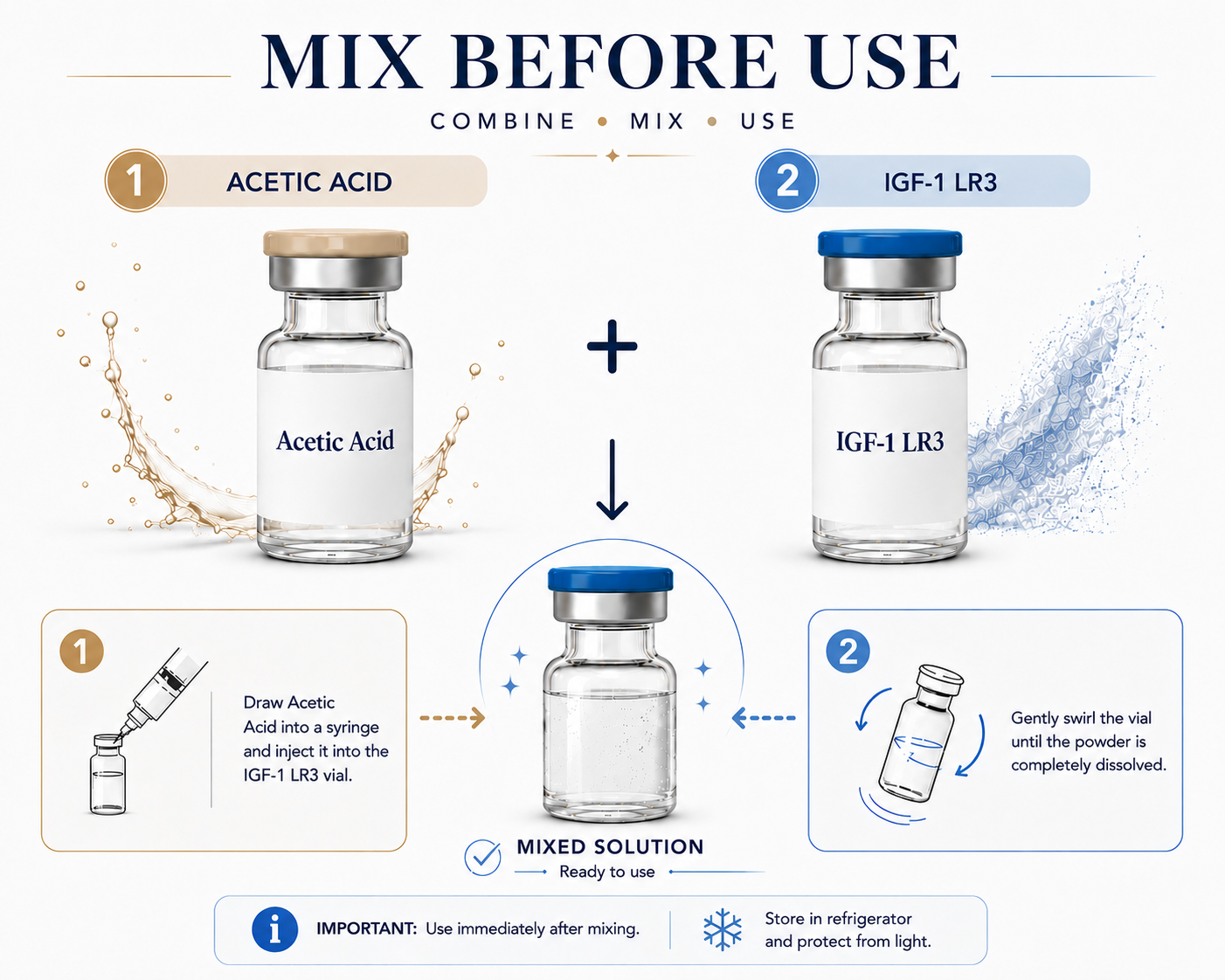
How To Mix IGF-1 LR3
1
Clean
Use alcohol swabs to clean the tops of both vials.
2
Draw Acetic Acid
Draw the selected amount of 0.1% acetic acid.
3
Inject Slowly
Add the liquid slowly down the side of the vial.
4
Swirl Gently
Do not shake. Swirl gently until dissolved.
5
Store Properly
Store as directed and protect from heat and light.
Best Practices & Common Mistakes
Best Practices
Use sterile technique.
Protect from light and heat.
Store refrigerated when appropriate.
Use clean syringe-unit math before measuring.
Common Mistakes
Confusing milligrams with milliliters.
Choosing an option with awkward decimal units.
Using too little liquid for very small measurements.
Shaking the vial aggressively.
IGF-1 LR3 Storage & Handling
Lyophilized Powder: −20°C (−4°F) for long-term storage (up to 24 months). Refrigeration 2–8°C (36–46°F) for short-term use (up to ~3 months). Original sealed vial in the freezer is safest.
Reconstituted Solution: 2–8°C (36–46°F), use within ~7–14 days. Keep sealed, avoid light, and do not repeat freeze-thaw cycles.
Frequently Asked Questions
IGF-1 LR3 is a modified version of insulin-like growth factor 1, not regular IGF-1 with a different label. The “LR3” version has an arginine substitution at position 3 and a 13-amino-acid extension, changes that reduce binding to IGF-binding proteins and make the molecule behave differently in research models.
IGF-1 LR3 reconstitution searches usually come from one practical concern: whether the peptide stays fully dissolved. A calculator can handle final concentration after the vial is in solution, but solvent choice depends on the actual formulation, supplier documentation, and whether the liquid stays clear rather than cloudy or precipitated.
IGF-1 LR3 is normally measured by mass, such as mcg or mg, not by international units. On a U-100 syringe, “units” describe volume, not peptide strength; for example, a 1 mg vial brought to 2 mL equals 500 mcg/mL, so 10 syringe units equals 0.10 mL, or 50 mcg of material. That is concentration math only, not a dose recommendation.
IGF-1 LR3 is discussed in bodybuilding circles as an anabolic peptide, but the safety question starts with its insulin-like biology. Research discussions commonly focus on glucose lowering, lightheadedness, water retention, injection-site reactions, and concerns around prolonged growth-factor signaling; because controlled human safety data are limited, casual “before and after” claims should not be treated as proof of safety.
A typical steroid panel is not the same as a specific IGF-1 LR3 detection method. Labcorp offers IGF-1 blood testing that measures IGF-1 as a hormone marker, while anti-doping research has used specialized mass-spectrometry methods to detect IGF-1 analogs such as LongR3-IGF-I. The safe answer is not “it will never show up,” but “it depends on what test was ordered.”
Practical takeaway: If your real goal is weight or metabolic health, the most useful next step is discussing approved treatment options with a clinician rather than relying on an unapproved compound.