
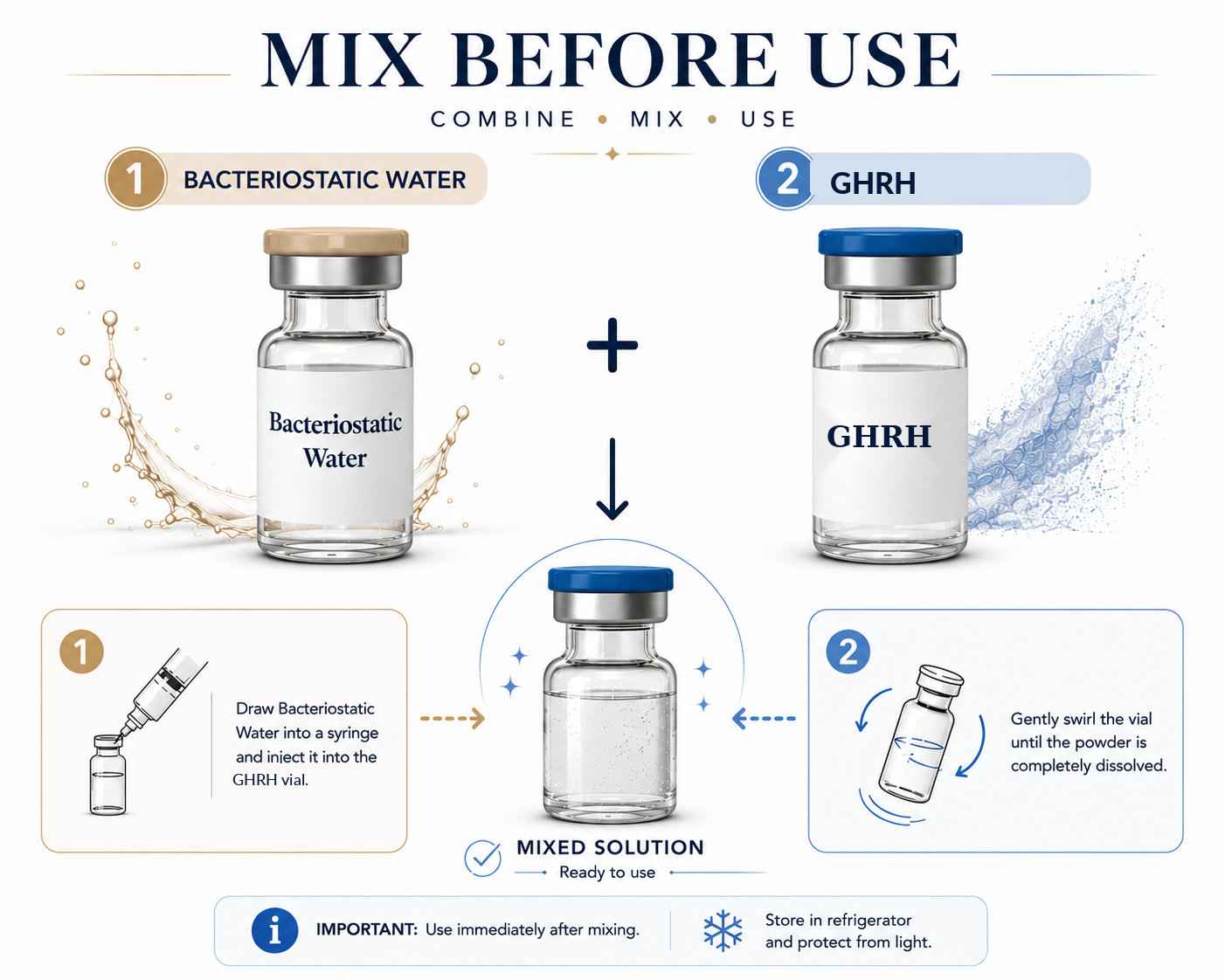
GHRH and BAC Water Mix

GHRH Reconstitution Calculator

Enter the amount you want to measure. The vial buttons will highlight which vial strengths create cleaner syringe-unit measurements.

What amount do you need?

Type the target amount, then choose mg or mcg. Example: 2mg or 500mcg.

Syringe size:
Possible vial strengths:
Best Match Good Match Usable Harder to Measure

Example GHRH Titration Schedule

Per-Dose AmountUnits (U-100)Injection Volume (mL)
100 mcg (0.10 mg)4 units0.04 mL
200 mcg (0.20 mg)8 units0.08 mL
300 mcg (0.30 mg)12 units0.12 mL
400 mcg (0.40 mg)16 units0.16 mL
500 mcg (0.50 mg)20 units0.20 mL
Possible vial strengths:

What Is It?

GHRH

Native GH-releasing hormone reference compound.

Bacteriostatic Water

Sterile water containing a bacteriostatic preservative, commonly used when preparing multi-use research vials.

How To Mix GHRH

1
Clean

Use alcohol swabs to clean the tops of both vials.

2
Draw BAC Water

Draw the selected amount of bacteriostatic water.

3
Inject Slowly

Add the liquid slowly down the side of the vial.

4
Swirl Gently

Do not shake. Swirl gently until dissolved.

5
Store Properly

Store as directed and protect from heat and light.

Best Practices & Common Mistakes

Best Practices

  • Use sterile technique.
  • Protect from light and heat.
  • Store refrigerated when appropriate.
  • Use clean syringe-unit math before measuring.

Common Mistakes

  • Confusing milligrams with milliliters.
  • Choosing an option with awkward decimal units.
  • Using too little liquid for very small measurements.
  • Shaking the vial aggressively.

GHRH Storage & Handling

Lyophilized Powder: −20°C (−4°F) for long-term storage (up to 24 months). Refrigeration 2–8°C (36–46°F) for short-term use (up to ~3 months). Original sealed vial in the freezer is safest.
Reconstituted Solution: 2–8°C (36–46°F), use within ~7–14 days. Keep sealed, avoid light, and do not repeat freeze-thaw cycles.

Frequently Asked Questions

GHRH is a hormone your hypothalamus makes — a 44-amino-acid peptide that signals the pituitary to release your own growth hormone in natural pulses. It isn't sold as a product to inject; what people actually use are GHRH analogs that copy this signal, such as sermorelin (the first 29 amino acids of GHRH), tesamorelin, and CJC-1295. So "GHRH" is the body's own messenger, while the injectable versions are man-made analogs of it.
These three are constantly confused but sit at different points in the same pathway. GHRH analogs (sermorelin, tesamorelin, CJC-1295) are a "release" signal acting on the pituitary's GHRH receptor; GHRPs (ipamorelin, GHRP-2, GHRP-6) are a separate "release" signal acting on the ghrelin receptor — the two are often paired precisely because they work through different receptors. HGH (somatropin) is the finished hormone itself, injected directly rather than coaxed out of your own pituitary. In short: GHRH and GHRP tell your body to make more GH; HGH is the GH.
There's no generic "GHRH" vial to reconstitute — you reconstitute a specific GHRH analog, and each has its own concentration and dosing math. If you're trying to mix and dose one of these, use the dedicated calculator for it: sermorelin, tesamorelin, or CJC-1295. Mixing and storage instructions belong to the individual analog, not to "GHRH" as a category — which is why this page sends you to the right one instead of giving a single recipe.
HGH (human growth hormone, somatropin) is a peptide hormone, not an anabolic steroid — different molecules acting through different receptors, even though both get lumped into "performance" talk. It can increase height only in people whose growth plates are still open, which mainly means children and teens with a genuine deficiency; in adults whose plates have fused, it does not add height. Whether any GH therapy is appropriate is strictly a matter for an endocrinologist.
In the US, somatropin (HGH) is a prescription-only medicine approved for specific conditions, and federal law specifically bars distributing or possessing it for non-approved uses — a tighter restriction than most prescription drugs, so this site does not source it. Among the GHRH analogs, only tesamorelin (Egrifta) is FDA-approved (for HIV-associated lipodystrophy); sermorelin's branded approval was discontinued and it's now usually compounded, while CJC-1295 is investigational. Reported risks of raising GH/IGF-1 include fluid retention, joint aches, and effects on blood sugar. For storage of any specific analog, follow that compound's own calculator page — lyophilized peptides generally stay refrigerated and out of light, and are used within weeks once reconstituted.
Practical takeaway: If your real goal is weight or metabolic health, the most useful next step is discussing approved treatment options with a clinician rather than relying on an unapproved compound.
Important: This tool is for informational and research-reference purposes only. Not intended for human or veterinary use.
← All peptides