
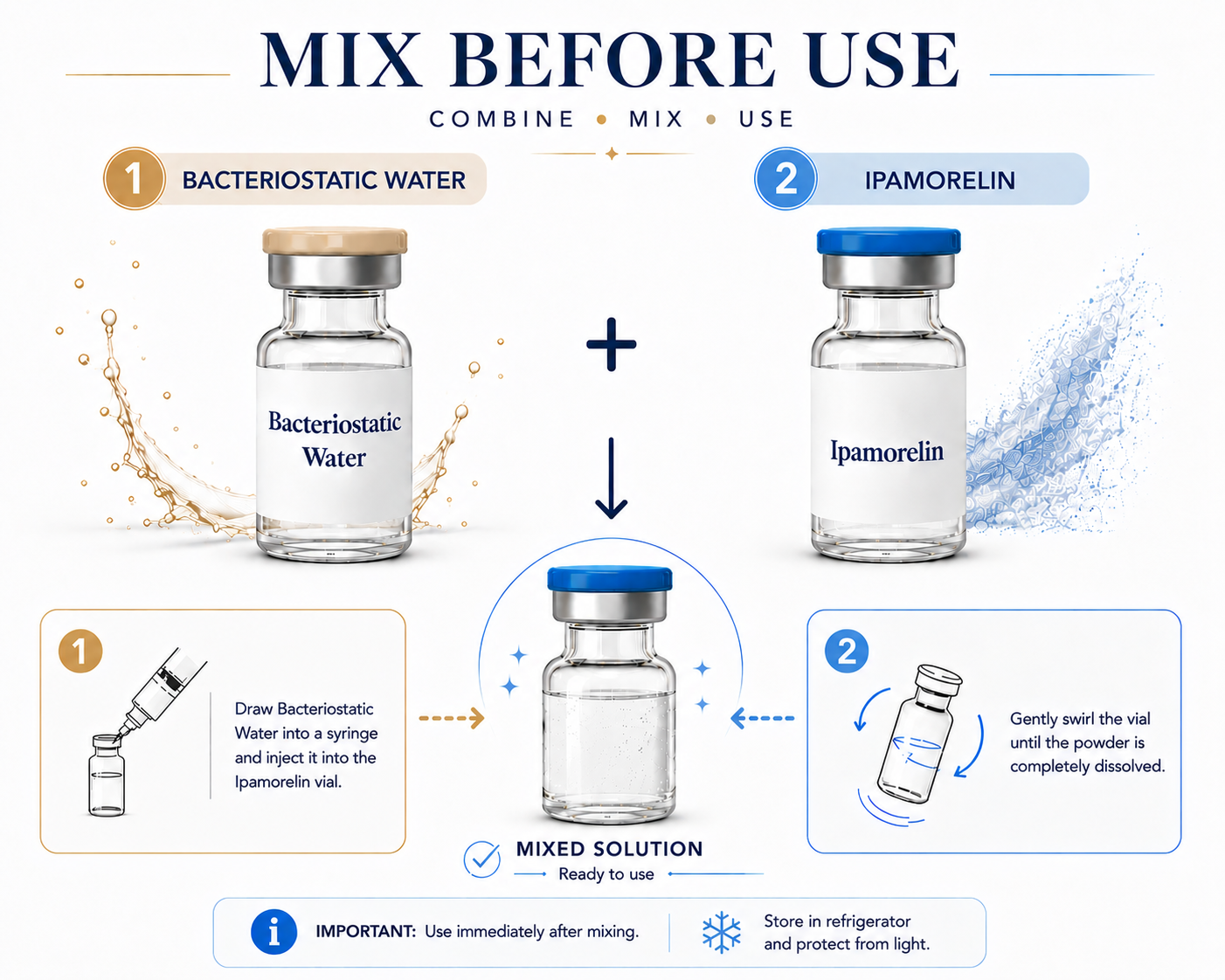
Ipamorelin and BAC Water Mix

Ipamorelin Reconstitution Calculator

Enter the amount you want to measure. The vial buttons will highlight which vial strengths create cleaner syringe-unit measurements.

What amount do you need?

Type the target amount, then choose mg or mcg. Example: 2mg or 500mcg.

Syringe size:
Possible vial strengths:
Best Match Good Match Usable Harder to Measure

Example Ipamorelin Titration Schedule

Protocol ItemGuidance
Dose100–500 mcg per dose
Frequency1–7× weekly (source notes multiple injections/day may be used to increase GH secretion)
Cycle8–12 weeks on, then 4–8 weeks off
Timing NotesCarbohydrates and fatty acids may blunt GH release. Often taken 30 minutes before eating or 2 hours after eating.
Possible vial strengths:

What Is It?

Ipamorelin

Selective ghrelin receptor agonist, mild GH pulse.

Bacteriostatic Water

Sterile water containing a bacteriostatic preservative, commonly used when preparing multi-use research vials.

How To Mix Ipamorelin

1
Clean

Use alcohol swabs to clean the tops of both vials.

2
Draw BAC Water

Draw the selected amount of bacteriostatic water.

3
Inject Slowly

Add the liquid slowly down the side of the vial.

4
Swirl Gently

Do not shake. Swirl gently until dissolved.

5
Store Properly

Store as directed and protect from heat and light.

Best Practices & Common Mistakes

Best Practices

  • Use sterile technique.
  • Protect from light and heat.
  • Store refrigerated when appropriate.
  • Use clean syringe-unit math before measuring.

Common Mistakes

  • Confusing milligrams with milliliters.
  • Choosing an option with awkward decimal units.
  • Using too little liquid for very small measurements.
  • Shaking the vial aggressively.

Ipamorelin Storage & Handling

Lyophilized Powder: −20°C (−4°F) for long-term storage (up to 24 months). Refrigeration 2–8°C (36–46°F) for short-term use (up to ~3 months). Original sealed vial in the freezer is safest.
Reconstituted Solution: 2–8°C (36–46°F), use within ~7–14 days. Keep sealed, avoid light, and do not repeat freeze-thaw cycles.

Frequently Asked Questions

Ipamorelin is a synthetic pentapeptide that works as a selective growth hormone secretagogue, binding the ghrelin receptor (GHS-R1a) in the pituitary to trigger short, natural-style pulses of growth hormone. It was originally developed by Novo Nordisk and is one of the most receptor-selective GHRPs, which is why it circulates as a research peptide rather than an approved medicine. It contains no growth hormone itself — it prompts your own pituitary to release more.
In research and clinical write-ups, ipamorelin is discussed in micrograms — commonly around 100–300 mcg per dose, subcutaneously, once or up to a few times a day. Because its half-life is only about 2 hours, doses are usually timed to an empty stomach and often before bed, when natural GH release peaks. These figures are not an approved schedule; the right amount, frequency, and whether it's appropriate at all are clinical decisions.
Add bacteriostatic water to the dry vial and let it dissolve without shaking. For example, a 5 mg vial + 2 mL of water gives 2.5 mg/mL (2,500 mcg/mL); a 250 mcg dose is then 0.1 mL, which is 10 units on a U-100 insulin syringe. Adjust the math to your vial's actual strength — the calculator above handles any vial size and target dose. Working in micrograms matters here, since ipamorelin doses are far smaller than the milligram doses used for GLP-1 peptides.
Ipamorelin's defining trait is selectivity: unlike older secretagogues such as GHRP-6, it raises growth hormone with little effect on cortisol, prolactin, or strong hunger signaling, so appetite spikes tend to be mild or absent. It does not directly raise testosterone — it acts on the GH/IGF-1 axis, not the reproductive hormone axis. This "clean" profile is exactly why it's the ghrelin-receptor half so often paired with a separate GHRH-type peptide that works through a different receptor; how any such pairing is dosed is a clinical decision, not something to merge on a calculator.
Despite ipamorelin's online reputation as the "safest" or "cleanest" peptide, that reputation rests mostly on short Phase II trials and anecdote — it has never been approved by the FDA or any major regulator and has limited long-term human safety data. Reported effects include injection-site reactions, headache, and water retention, and any sustained rise in GH/IGF-1 can affect blood sugar and insulin sensitivity, so it is not risk-free. Store lyophilized vials refrigerated and out of light; once reconstituted, keep them cold and use within a few weeks. Selectivity reduces certain side effects — it does not make an unapproved compound proven-safe.
Practical takeaway: If your real goal is weight or metabolic health, the most useful next step is discussing approved treatment options with a clinician rather than relying on an unapproved compound.
Important: This tool is for informational and research-reference purposes only. Not intended for human or veterinary use.
← All peptides