Need a Reliable Peptide Supplier? Click HERE!!!SponsoredVisit ↗
Sermorelin and BAC Water Mix

Sermorelin Reconstitution Calculator

Enter the amount you want to measure. The vial buttons will highlight which vial strengths create cleaner syringe-unit measurements.

What amount do you need?

Type the target amount, then choose mg or mcg. Example: 2mg or 500mcg.

Work the dose out from body weight

Syringe size:
Possible vial strengths:
Best Match Good Match Usable Harder to Measure

Example Sermorelin Titration Schedule

ItemDetails
Standard dose200–300 mcg SC once nightly
Frequency5–7 nights per week
Practical ceilingSomatostatin feedback caps response
HistoryGeref: FDA-approved 1997–2008 (discontinued commercially, not for safety)

The only once-FDA-approved GH-axis peptide. Its defining feature is nightly dosing: the bedtime injection produces a ~2.8× larger GH peak than morning dosing. '1–7× per week' framing obscures that daily-night use is the protocol.

Possible vial strengths:

What Is It?

Sermorelin

GHRH (1-29) analogue.

Bacteriostatic Water

Sterile water containing a bacteriostatic preservative, commonly used when preparing multi-use research vials.

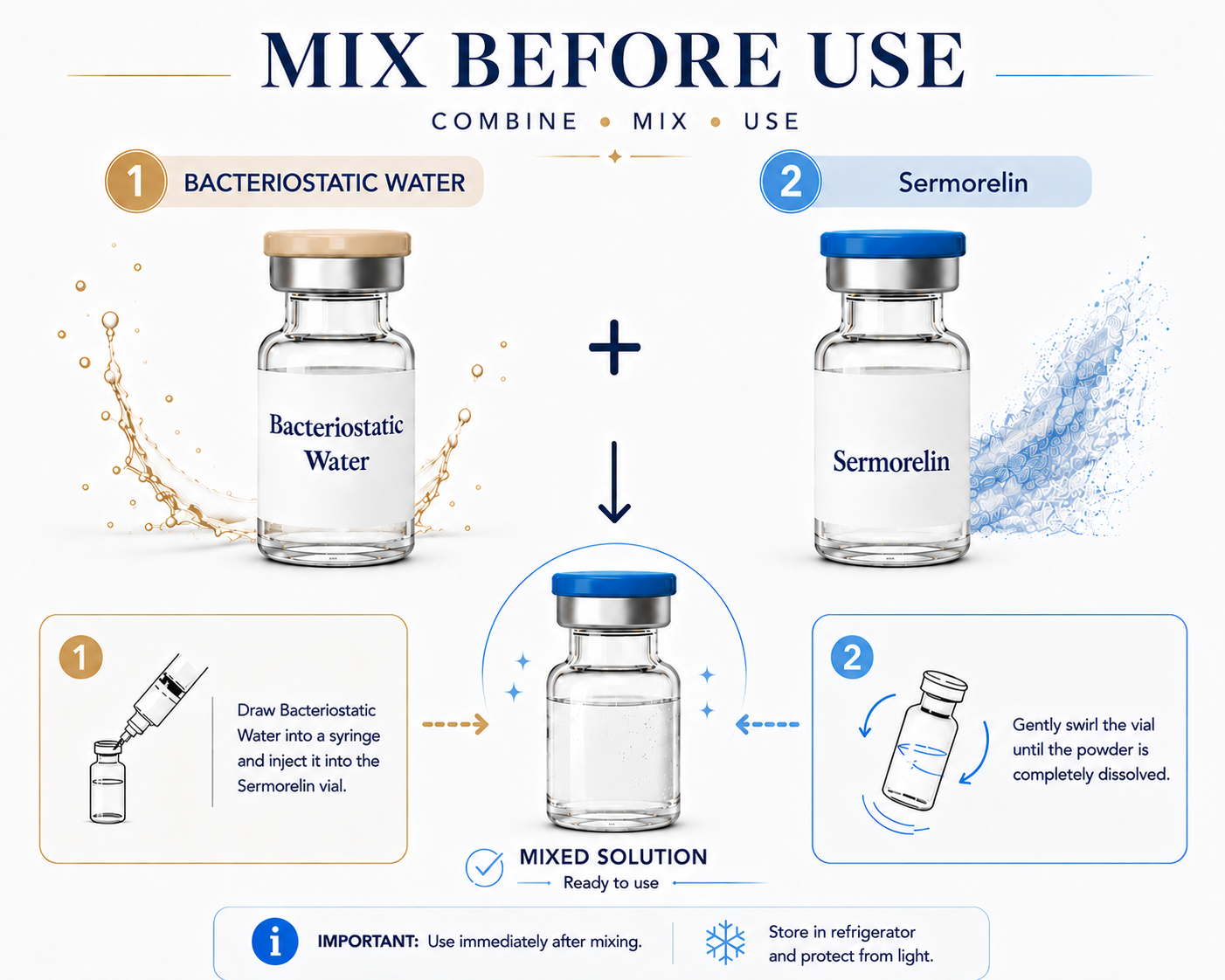
How To Mix Sermorelin

1
Clean

Use alcohol swabs to clean the tops of both vials.

2
Draw BAC Water

Draw the selected amount of bacteriostatic water.

3
Inject Slowly

Add the liquid slowly down the side of the vial.

4
Swirl Gently

Do not shake. Swirl gently until dissolved.

5
Store Properly

Store as directed and protect from heat and light.

Best Practices & Common Mistakes

Best Practices

  • Use sterile technique.
  • Protect from light and heat.
  • Store refrigerated when appropriate.
  • Use clean syringe-unit math before measuring.

Common Mistakes

  • Confusing milligrams with milliliters.
  • Choosing an option with awkward decimal units.
  • Using too little liquid for very small measurements.
  • Shaking the vial aggressively.

Sermorelin Storage & Handling

Lyophilized Powder: −20°C (−4°F) for long-term storage (up to 24 months). Refrigeration 2–8°C (36–46°F) for short-term use (up to ~3 months). Original sealed vial in the freezer is safest.
Reconstituted Solution: 2–8°C (36–46°F), use within ~7–14 days. Keep sealed, avoid light, and do not repeat freeze-thaw cycles.

Frequently Asked Questions

Sermorelin is a synthetic peptide made of the first 29 amino acids of GHRH (growth hormone–releasing hormone), the signal your hypothalamus uses to tell the pituitary to release growth hormone. It is not a steroid; it works one step "upstream," prompting your own pituitary to make GH in natural pulses rather than supplying the hormone directly. Because it preserves that feedback loop, it's the GHRH analog with the longest history of clinical and anti-aging-clinic use.
Sermorelin is dosed in micrograms — commonly in the low hundreds of mcg per day, given subcutaneously, usually once daily at bedtime on most days of the week. Night dosing is deliberate: your largest natural GH pulse happens during deep sleep, and sermorelin works with that rhythm rather than overriding it. These are reference figures, not an approved schedule, and the right dose and frequency are decisions for a prescriber.
Add bacteriostatic water to the dry vial and swirl gently — don't shake. For example, a 5 mg vial + 2.5 mL of water gives 2 mg/mL (2,000 mcg/mL); a 300 mcg dose is then 0.15 mL, which is 15 units on a U-100 insulin syringe. Note that "units" measure volume, not mass — on a U-100 syringe 100 units = 1 mL, so how many mcg sit in a unit depends entirely on your concentration. The calculator above does this conversion for any vial size and dose so you don't have to.
Injectable (subcutaneous) sermorelin is the standard, evidence-based form. Oral capsules, sublingual troches, and nasal sprays are marketed widely, but peptides like sermorelin are largely broken down in the gut and absorbed poorly across the mouth or nose, so the amount actually reaching your bloodstream is uncertain and generally far lower than an injection. If you see "sermorelin tablets" or sprays, treat their effectiveness as unproven compared with the injection — not as an equivalent swap.
There's no human evidence that sermorelin causes cancer; the documented caution is the general one for anything raising GH/IGF-1 — that higher IGF-1 could theoretically promote an existing tumor, which is why it's avoided in people with active cancer, not proof that sermorelin starts it. Commonly reported effects are mild: injection-site reactions, flushing, or headache. On status, sermorelin was once FDA-approved under the brand Geref, which was discontinued for business reasons (the FDA noted it was not withdrawn for safety or efficacy), so today it's typically supplied through compounding pharmacies by prescription rather than as an approved brand. Store the dry vial refrigerated and out of light; once reconstituted, keep it cold and use within a few weeks.
Practical takeaway: If your goal involves weight management, metabolic health, recovery, physical performance, cognitive function, appearance, or general well-being, discuss it with a licensed healthcare professional. They can help you evaluate approved, evidence-based options rather than relying on an unapproved or investigational compound. This calculator is intended only for transparent research-reference calculations and does not determine an appropriate amount, recommend use, or replace professional medical guidance.

About the author

Maria Hrabina is a pharmacist and scientific reviewer with a strong interest in peptide science, pharmacology, and emerging therapeutic compounds.

Her work focuses on understanding how peptide-based compounds interact with biological signaling pathways and how they are being investigated across areas such as metabolic health, dermatology, recovery, regenerative research, and pharmaceutical development.

Maria follows research on a broad range of peptides, from compounds used in approved medicines to experimental molecules still being evaluated in laboratory, preclinical, and clinical studies.

Her approach combines scientific curiosity with critical evaluation of evidence. She believes promising mechanisms and early research deserve attention, but should not be presented as established clinical benefits until they are supported by adequate human data.

Her areas of focus include scientific literature review, mechanisms of action, pharmacology, pharmacokinetics, safety, pharmaceutical formulation, and the overall quality of evidence behind peptide-based compounds.

She is particularly interested in the process of translating an experimental molecule into a reliable pharmaceutical product — including compound characterization, purity, stability, formulation, dose selection, safety assessment, and controlled clinical trials.

Maria believes peptide science has significant long-term potential, but that its progress depends on rigorous research, high manufacturing standards, transparent safety data, and responsible scientific communication.

Through her writing, she aims to help readers understand both sides of peptide research: what makes these compounds scientifically promising and what questions remain before their potential can be considered clinically established.

Areas of interest: Peptide Science · Therapeutic Peptides · Peptide Pharmacology · Metabolic Peptides · Cosmetic Peptides · Drug Development · Pharmacokinetics · Drug Safety · Pharmaceutical Formulation · Emerging Therapies · Evidence-Based Medicine

Important: This tool is for informational and research-reference purposes only. Not intended for human or veterinary use.
← All peptides