
Enter the amount you want to measure. The vial buttons will highlight which vial strengths create cleaner syringe-unit measurements.
⚠ Use acetic acid — not bacteriostatic water
TB-500 is insoluble or unstable in standard BAC water. Manufacturer protocols require reconstitution in dilute acetic acid (0.1%) — or, for IGF-1 variants, 50 mM acetic acid. Volumes shown below refer to acetic acid, not water.
What amount do you need?
Type the target amount, then choose mg or mcg. Example: 2mg or 500mcg.
Syringe size:
Possible vial strengths:
Best Match Good Match Usable Harder to Measure
Example TB-500 Titration Schedule
Protocol Item
Guidance
Standard Dose Range
300–1000 mcg per dose
Higher-Dose Note
2–3 mg has been used in severe injuries (reported positive effects)
Frequency
Daily
Typical Cycle Length
30 days (can be extended up to 90 days)
Minimum Cycle Break
30-day minimum break between cycles
Adjustment Note
Cycle length and intensity depend on response and goal
Possible vial strengths:
What Is It?
TB-500
Synthetic thymosin beta-4 fragment.
Acetic Acid (0.1%)
A dilute solution of acetic acid (typically 0.1% for most peptides, or 50 mM for IGF-1 variants) used to reconstitute peptides that are insoluble or unstable in standard bacteriostatic water. TB-500 requires an acidic carrier to dissolve fully and remain stable — plain BAC water will not work and may damage the peptide.
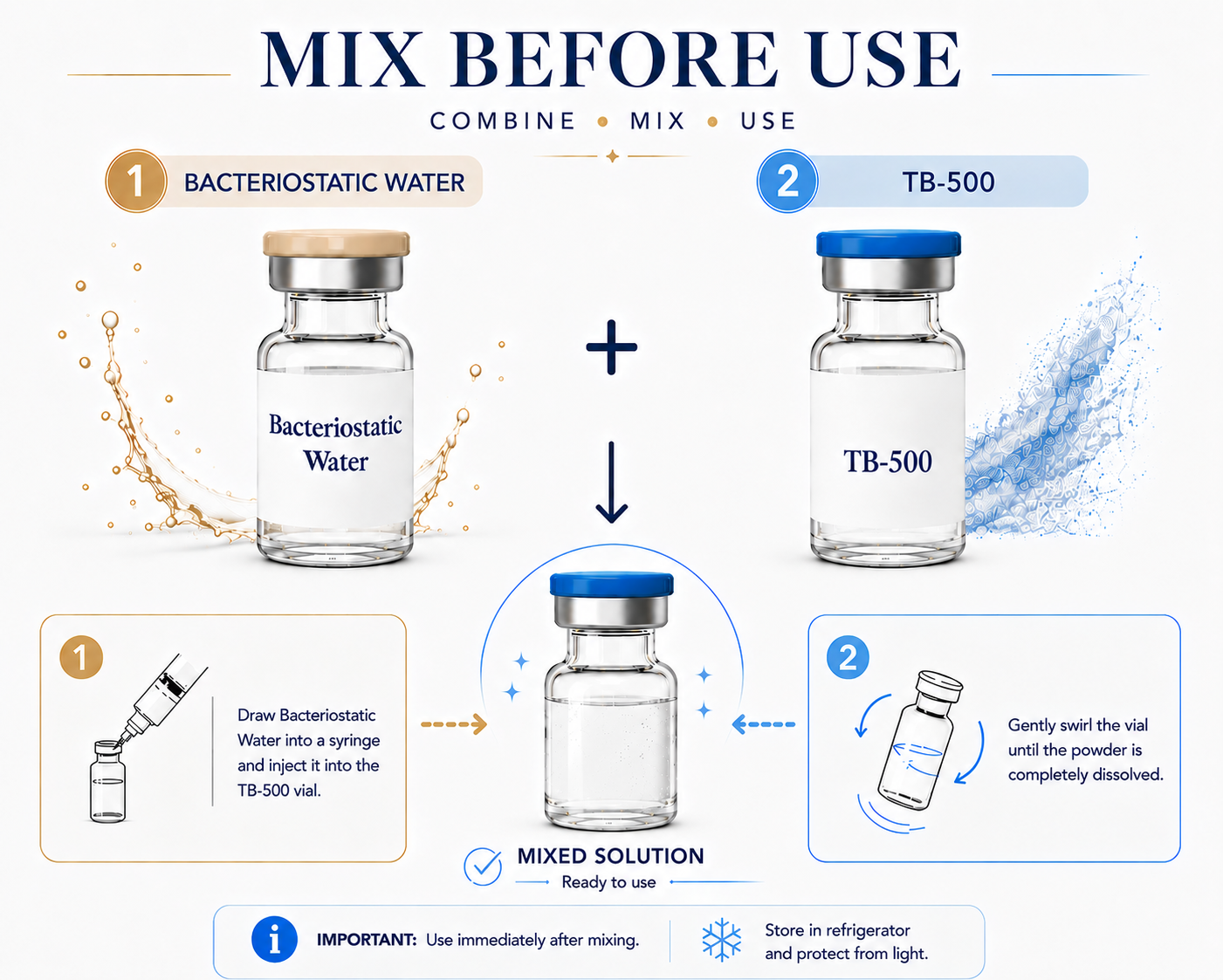
How To Mix TB-500
1
Clean
Use alcohol swabs to clean the tops of both vials.
2
Draw Acetic Acid
Draw the selected amount of 0.1% acetic acid.
3
Inject Slowly
Add the liquid slowly down the side of the vial.
4
Swirl Gently
Do not shake. Swirl gently until dissolved.
5
Store Properly
Store as directed and protect from heat and light.
Best Practices & Common Mistakes
Best Practices
Use sterile technique.
Protect from light and heat.
Store refrigerated when appropriate.
Use clean syringe-unit math before measuring.
Common Mistakes
Confusing milligrams with milliliters.
Choosing an option with awkward decimal units.
Using too little liquid for very small measurements.
Shaking the vial aggressively.
TB-500 Storage & Handling
Lyophilized Powder: −20°C (−4°F) for long-term storage (up to 24 months). Refrigeration 2–8°C (36–46°F) for short-term use (up to ~3 months). Original sealed vial in the freezer is safest.
Reconstituted Solution: 2–8°C (36–46°F), use within ~7–14 days. Keep sealed, avoid light, and do not repeat freeze-thaw cycles.
Frequently Asked Questions
TB-500 is a synthetic fragment of thymosin beta-4 (Tβ4), a natural repair protein found in nearly every cell. The fragment keeps Tβ4's active actin-binding region and is studied as a "healing" peptide — not a steroid, and not a hormone.
In research and anecdotal use it's referenced in milligrams — commonly around 2–5 mg per week by subcutaneous injection, often split into smaller doses, with a higher "loading" period followed by less frequent maintenance. These are reference figures, not an approved regimen, and dosing is a clinical decision.
Add bacteriostatic water and swirl gently — don't shake. A 5 mg vial + 2.5 mL gives 2 mg/mL (2,000 mcg/mL), so a 2 mg dose = 1 mL = 100 units on a U-100 syringe. Use the calculator above for your exact vial size.
They heal through different mechanisms: TB-500 works by regulating actin and cell migration, acting systemically throughout the body, while BPC-157 leans on blood-vessel growth and works more locally. TB-500 shows stronger animal signals in muscle, skin, and cardiac tissue; unlike BPC-157 it has no oral form, so it's injected. How anyone pairs them is a clinical decision, not something a calculator should merge.
Most of TB-500's reputation rests on animal studies — and importantly, the stronger human data is for full-length thymosin beta-4, not the TB-500 fragment that's actually sold. There's no human evidence it causes cancer, though its role in cell migration and vessel growth is a theoretical caution. It's not FDA-approved and is banned by WADA. Store the dry vial refrigerated and dark; once mixed, keep cold and use within a few weeks.
Practical takeaway: If your real goal is weight or metabolic health, the most useful next step is discussing approved treatment options with a clinician rather than relying on an unapproved compound.