GHK-Cu (Copper Peptide) and BAC Water Mix

GHK-Cu (Copper Peptide) Reconstitution Calculator

Enter the amount you want to measure. The vial buttons will highlight which vial strengths create cleaner syringe-unit measurements.

What amount do you need?

Type the target amount, then choose mg or mcg. Example: 2mg or 500mcg.

Syringe size:
Possible vial strengths:
Best Match Good Match Usable Harder to Measure

Example GHK-Cu (Copper Peptide) Titration Schedule

Protocol ItemGuidance
Dose1–5 mg per dose
CyclingDaily, for 6 weeks, with a 30-day minimum cycle break between
Annual FrequencyCan be cycled 3–4× per year
Possible vial strengths:

What Is It?

GHK-Cu (Copper Peptide)

Copper-bound GHK studied in skin and wound research.

Bacteriostatic Water

Sterile water containing a bacteriostatic preservative, commonly used when preparing multi-use research vials.

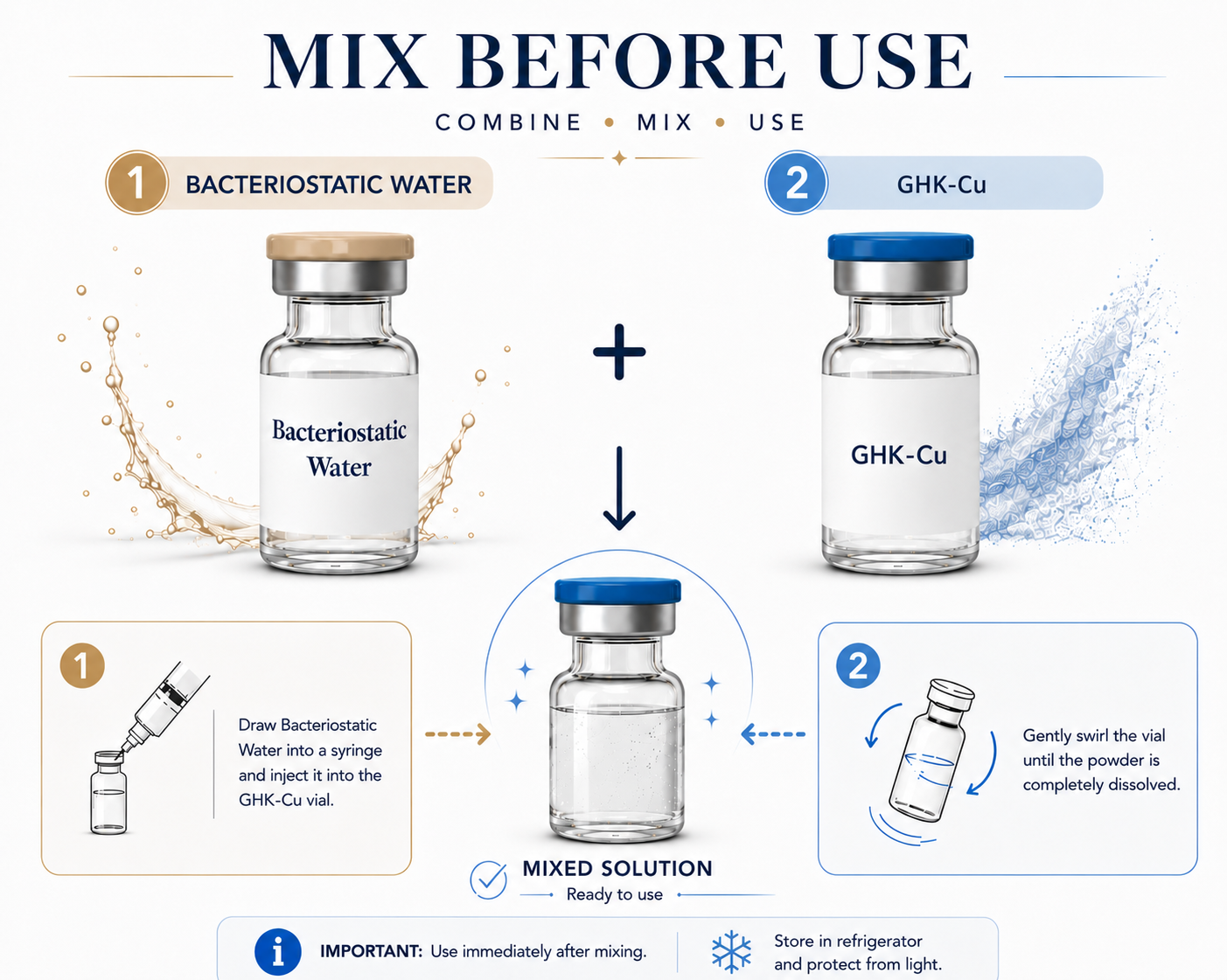
How To Mix GHK-Cu (Copper Peptide)

1
Clean

Use alcohol swabs to clean the tops of both vials.

2
Draw BAC Water

Draw the selected amount of bacteriostatic water.

3
Inject Slowly

Add the liquid slowly down the side of the vial.

4
Swirl Gently

Do not shake. Swirl gently until dissolved.

5
Store Properly

Store as directed and protect from heat and light.

Best Practices & Common Mistakes

Best Practices

  • Use sterile technique.
  • Protect from light and heat.
  • Store refrigerated when appropriate.
  • Use clean syringe-unit math before measuring.

Common Mistakes

  • Confusing milligrams with milliliters.
  • Choosing an option with awkward decimal units.
  • Using too little liquid for very small measurements.
  • Shaking the vial aggressively.

GHK-Cu (Copper Peptide) Storage & Handling

Lyophilized Powder: −20°C (−4°F) for long-term storage (up to 24 months). Refrigeration 2–8°C (36–46°F) for short-term use (up to ~3 months). Original sealed vial in the freezer is safest.
Reconstituted Solution: 2–8°C (36–46°F), use within ~7–14 days. Keep sealed, avoid light, and do not repeat freeze-thaw cycles.

Frequently Asked Questions

GHK-Cu is the copper complex of the natural human tripeptide GHK — the peptide bound to a copper ion. It's the most-studied "copper peptide," used mainly for skin and hair: it signals collagen and elastin production and delivers copper as a cofactor for tissue-repair enzymes. The copper is central to its activity, which is why it's the standard active form.
Topical serums are usually around 1–2% applied to skin or scalp. For injectable research use, references sit near 1–2 mg per day or several times a week subcutaneously. These are reference figures, not an approved regimen, and dosing is a clinical decision.
Add bacteriostatic water and swirl gently — don't shake. A 50 mg vial + 5 mL gives 10 mg/mL, so a 2 mg dose = 0.2 mL = 20 units on a U-100 syringe. A blue tint after mixing is normal — that's the copper.
For skin, the evidence is best for firmness, fine lines, and post-procedure recovery — it supports collagen, elastin, and antioxidant defense. For hair, copper peptides are studied for thicker growth and a healthier scalp, but results are modest, not transformative. Topical application is the route with the most support for both.
It's generally well tolerated, but "copper peptides ruined my skin" usually traces to overuse or layering it with vitamin C, retinoids, or acids, which can clash with copper and trigger irritation — introduce it slowly and don't stack strong actives in the same routine. There's no human evidence it causes cancer. It's used in cosmetics but isn't an FDA-approved drug; store the dry vial or powder refrigerated and dark, and once mixed keep it cold and use within a few weeks.
Practical takeaway: If your real goal is weight or metabolic health, the most useful next step is discussing approved treatment options with a clinician rather than relying on an unapproved compound.
Important: This tool is for informational and research-reference purposes only. Not intended for human or veterinary use.
← All peptides