
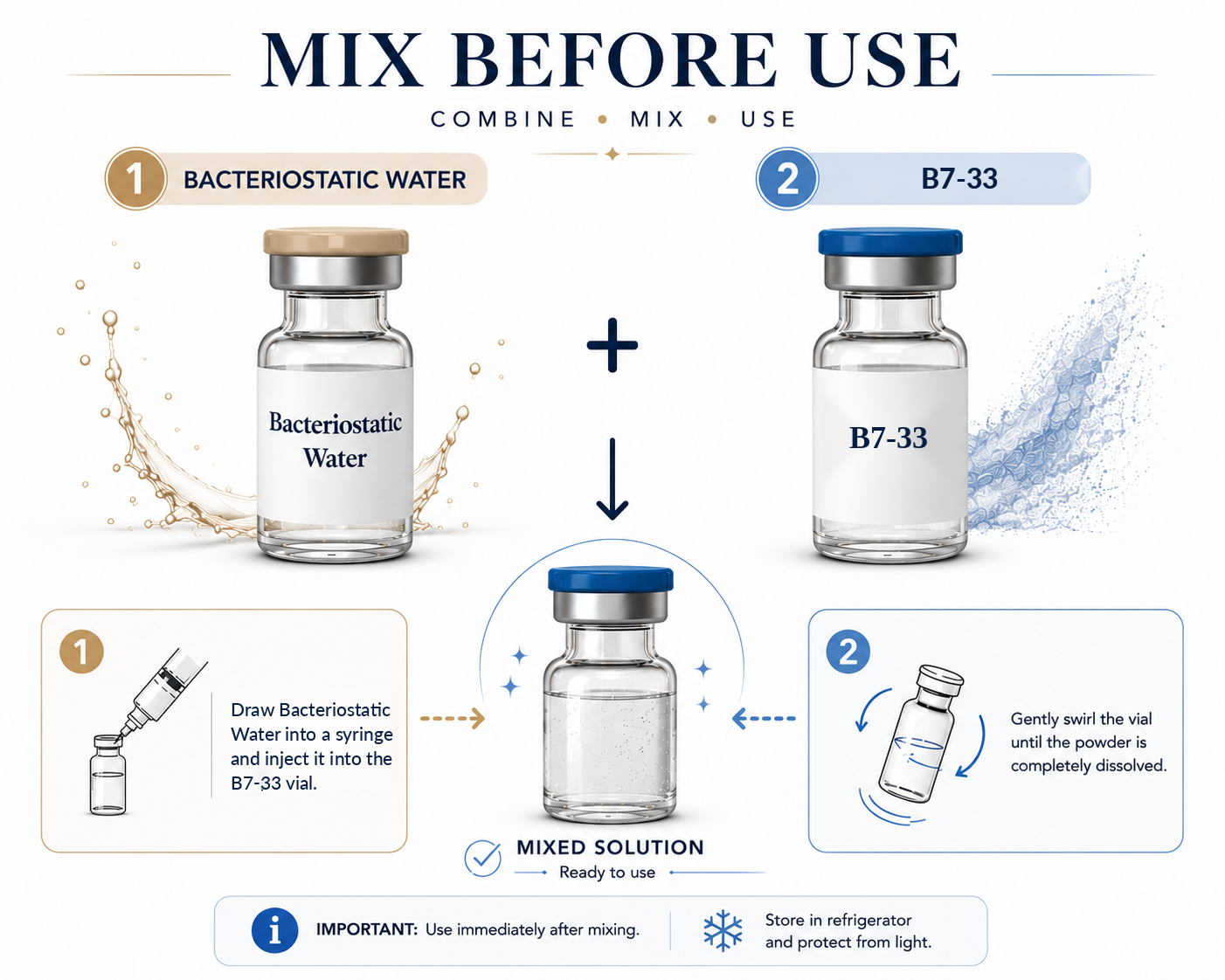
B7-33 and BAC Water Mix

B7-33 Reconstitution Calculator

Enter the amount you want to measure. The vial buttons will highlight which vial strengths create cleaner syringe-unit measurements.

What amount do you need?

Type the target amount, then choose mg or mcg. Example: 2mg or 500mcg.

Syringe size:
Possible vial strengths:
Best Match Good Match Usable Harder to Measure

Example B7-33 Titration Schedule

Protocol ItemGuidance
Dose200–800 mcg per dose
CyclingDaily, for 30-day cycles (or shorter), with a 30-day minimum cycle break between
Possible vial strengths:

What Is It?

B7-33

Single-chain relaxin analogue.

Bacteriostatic Water

Sterile water containing a bacteriostatic preservative, commonly used when preparing multi-use research vials.

How To Mix B7-33

1
Clean

Use alcohol swabs to clean the tops of both vials.

2
Draw BAC Water

Draw the selected amount of bacteriostatic water.

3
Inject Slowly

Add the liquid slowly down the side of the vial.

4
Swirl Gently

Do not shake. Swirl gently until dissolved.

5
Store Properly

Store as directed and protect from heat and light.

Best Practices & Common Mistakes

Best Practices

  • Use sterile technique.
  • Protect from light and heat.
  • Store refrigerated when appropriate.
  • Use clean syringe-unit math before measuring.

Common Mistakes

  • Confusing milligrams with milliliters.
  • Choosing an option with awkward decimal units.
  • Using too little liquid for very small measurements.
  • Shaking the vial aggressively.

B7-33 Storage & Handling

Lyophilized Powder: −20°C (−4°F) for long-term storage (up to 24 months). Refrigeration 2–8°C (36–46°F) for short-term use (up to ~3 months). Original sealed vial in the freezer is safest.
Reconstituted Solution: 2–8°C (36–46°F), use within ~7–14 days. Keep sealed, avoid light, and do not repeat freeze-thaw cycles.

Frequently Asked Questions

B7-33 (CAS 1818415-56-3) is a 24-amino-acid single-chain peptide derived from the B-chain of the hormone H2 relaxin, designed as a simplified relaxin-2 analog. It acts as a "biased" agonist at the RXFP1 receptor, switching on relaxin's anti-fibrotic signaling while avoiding the pathway tied to its vascular and tumor-promoting effects. All evidence to date is preclinical — cells and rodents only.
In animal and cell studies, B7-33's main reported effect is reduced fibrosis (scarring) in heart, lung, and kidney tissue, achieved by triggering MMP-2 and breaking down excess collagen. Because it favors the pERK1/2 pathway over the cAMP route of full relaxin, researchers use it as a tool to study anti-scarring signaling without relaxin's proliferative effects. These are preclinical findings, not demonstrated outcomes in humans.
There is no established human dose for B7-33 — it has never been through human trials — so any figure is a research choice, not a recommendation. The reconstitution math itself is standard: a 5 mg vial + 2 mL bacteriostatic water = 2.5 mg/mL, so a 250 mcg amount = 0.1 mL (10 units on a U-100 insulin syringe). Larger water volumes give lower concentration and smaller draws for the same amount.
Native H2 relaxin (the recombinant drug serelaxin) is a complex two-chain, disulfide-linked molecule that is costly to make and whose cAMP signaling is linked to tumor-promoting effects — and serelaxin itself failed its phase 3 heart-failure trial. B7-33 was engineered as a single-chain shortcut that keeps the anti-fibrotic action while shedding that cAMP arm, making it cheaper to synthesize and cleaner mechanistically. So they are not interchangeable: serelaxin is full-length relaxin, B7-33 is a truncated biased agonist.
B7-33 is not approved anywhere — no FDA approval, no human safety data, and no clinical trials — so despite the strong anti-fibrotic reputation online, its profile in people is simply unknown. It is sold strictly as a research-grade compound, and "research-grade" is never the same as a tested medicine. Storage: keep the lyophilized powder refrigerated and protected from light, and use any reconstituted solution promptly rather than storing it long-term.
Practical takeaway: If your real goal is weight or metabolic health, the most useful next step is discussing approved treatment options with a clinician rather than relying on an unapproved compound.
Important: This tool is for informational and research-reference purposes only. Not intended for human or veterinary use.
← All peptides