
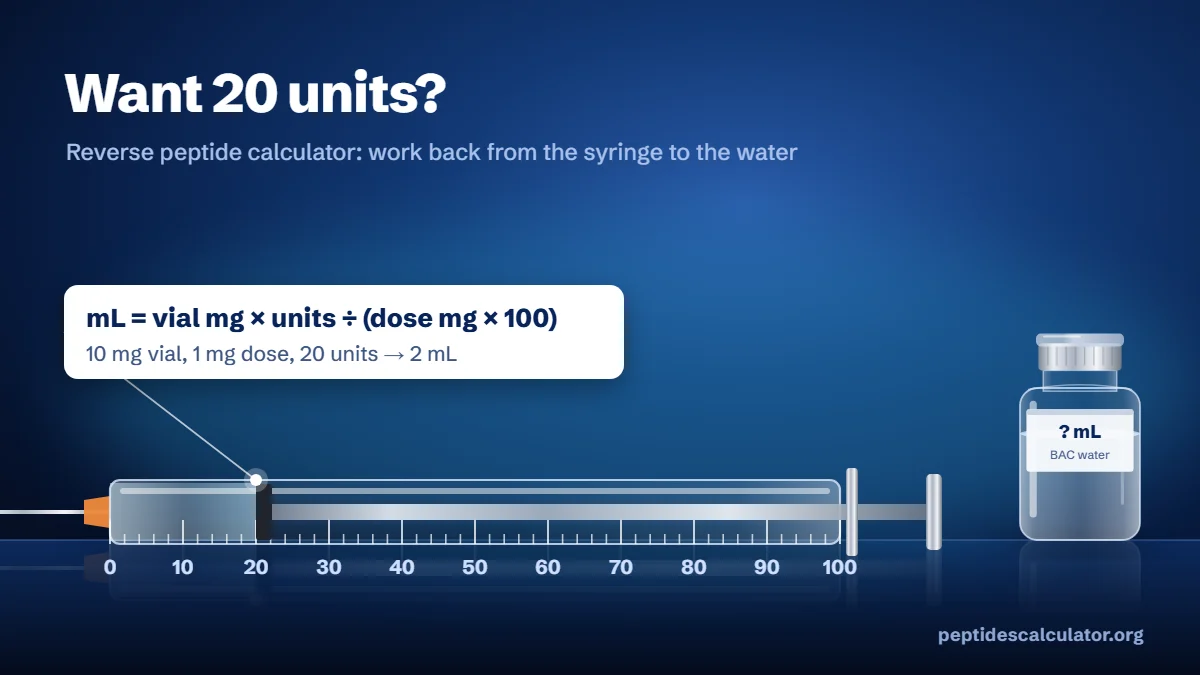
A reverse peptide calculator starts from the number you want to see on the syringe and works back to the water: mL of water = vial mg × target units ÷ (dose mg × 100). Example: a 5 mg vial and a 250 mcg dose. If you want each dose to be exactly 10 units, add 5 × 10 ÷ (0.25 × 100) = 2 mL. Want 20 units instead? Add 4 mL. The dose in mg stays the same either way; only the volume you draw changes.
Open the peptide calculator → Try different water volumes and see the units change.
Why work backwards
The usual question is “I added 2 mL, how many units is my dose?” The reverse question is often more useful before you mix: “how much water makes my dose a round, easy number?” A dose of 10, 20 or 25 units is easier to draw correctly than 7.3 units, and anything under about 5 units is hard to measure at all. Choosing the water first is how you avoid awkward numbers.
The formula, step by step
- Write down the vial size in mg (on the label) and your dose in mg (250 mcg = 0.25 mg).
- Pick the number of units you want each dose to be, for example 10 or 20.
- Water in mL = vial mg × target units ÷ (dose mg × 100).
- Check it fits: most small vials hold about 3 mL, and under about 0.5 mL is hard to mix evenly.
Water needed for round numbers
Common vial and dose pairs, and the water that turns each dose into 10, 20, 25 or 50 units on a U-100 insulin syringe:
| Vial and dose | For 10 units | For 20 units | For 25 units | For 50 units |
|---|---|---|---|---|
| 5 mg vial, 250 mcg (BPC-157) | 2 mL | 4 mL ⚠ | 5 mL ⚠ | 10 mL ⚠ |
| 10 mg vial, 500 mcg | 2 mL | 4 mL ⚠ | 5 mL ⚠ | 10 mL ⚠ |
| 5 mg vial, 1 mg (semaglutide) | 0.5 mL | 1 mL | 1.25 mL | 2.5 mL |
| 10 mg vial, 2 mg (retatrutide) | 0.5 mL | 1 mL | 1.25 mL | 2.5 mL |
| 20 mg vial, 2.5 mg (tirzepatide) | 0.8 mL | 1.6 mL | 2 mL | 4 mL ⚠ |
| 10 mg vial, 1 mg | 1 mL | 2 mL | 2.5 mL | 5 mL ⚠ |
| 2 mg vial, 100 mcg | 2 mL | 4 mL ⚠ | 5 mL ⚠ | 10 mL ⚠ |
⚠ More than about 3 mL, too much for most small vials; pick a smaller unit target. ↓ Under 0.5 mL, hard to mix and measure; pick a larger unit target. The dose examples are illustrations of the math, not recommendations.
What one unit holds
Another way to think about it: each mL of water spreads the vial out further, so one unit holds less. For a quick check of any mix:
| Vial | 1 unit with 1 mL | 1 unit with 2 mL | 1 unit with 3 mL |
|---|---|---|---|
| 2 mg | 20 mcg | 10 mcg | 6.7 mcg |
| 5 mg | 50 mcg | 25 mcg | 16.7 mcg |
| 10 mg | 100 mcg | 50 mcg | 33.3 mcg |
| 20 mg | 200 mcg | 100 mcg | 66.7 mcg |
Water does not change how many doses you get
This surprises people: a 10 mg vial gives twenty 0.5 mg doses whether you add 1 mL or 3 mL. More water only makes each dose a bigger volume. In practice a little is lost in the needle and the vial, so you may get one dose fewer than the arithmetic says. The real limits are the vial’s capacity and how long a mixed vial lasts in the fridge.
The math behind it: the peptide calculator formula explained and why vial strengths differ.
Already mixed?
If the water is already in, use the units-to-mg converter to see how many mg your units are, or our guide on how much BAC water to add if you are still deciding. Background on the water itself: BAC water for peptides. For any combination, the peptide calculator does both directions.