
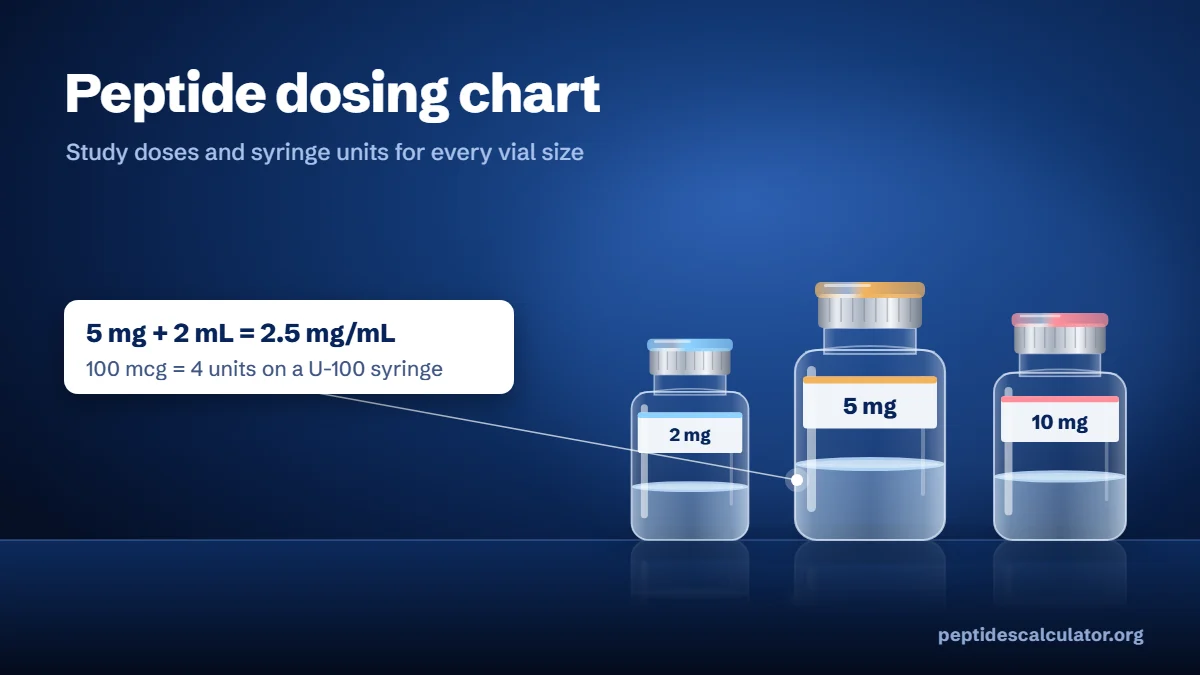
A peptide dosing chart answers one practical question: after you add water to a vial, how many units on the syringe hold the amount you want? The answer depends on only three numbers: the mg of powder in the vial, the mL of water you add, and the amount you need. Below you will find the doses actually used in human studies and on drug labels for 18 popular peptides, published clinic protocols for 10 more, then charts that turn any amount into syringe units for the most common vial sizes.
Open the Peptide Calculator → Enter any vial strength, water volume and amount to get the exact syringe reading.
Doses used in human studies and on drug labels
This table shows what was actually given to people in published trials, or what the official label says for approved drugs. Every row links to the source. Where no human data exist, the table says so instead of repeating forum numbers.
| Peptide | Status | Dose used in human studies or on the label | Source |
|---|---|---|---|
| Semaglutide | Approved (Wegovy, Ozempic) | Wegovy label: 0.25 mg SC once weekly, raised every 4 weeks to 2.4 mg; Wegovy HD 7.2 mg once weekly after ≥4 weeks on 2.4 mg | Pharmacy Times 2026 (Wegovy HD) |
| Tirzepatide | Approved (Zepbound, Mounjaro) | Zepbound label: 2.5 mg SC once weekly, +2.5 mg steps no sooner than every 4 weeks; maintenance 5, 10 or 15 mg (max 15 mg) | Drugs.com tirzepatide monograph |
| Retatrutide | Investigational (phase 3) | Phase 2: 1, 4, 8 or 12 mg SC once weekly for 48 weeks, starting at 2 or 4 mg and raised every 4 weeks. Phase 3 TRIUMPH-1: 4, 9 or 12 mg once weekly, starting at 2 mg | Jastreboff, NEJM 2023; Eli Lilly, May 2026 |
| Tesamorelin | Approved (Egrifta WR), HIV lipodystrophy only | Egrifta WR label: 1.28 mg SC once daily | Egrifta WR FDA label |
| PT-141 (bremelanotide) | Approved (Vyleesi), HSDD in premenopausal women | Vyleesi label: 1.75 mg SC as needed, at least 45 minutes before sexual activity; no more than 1 dose in 24 h and no more than 8 per month | Vyleesi FDA label |
| Sermorelin | Formerly approved (Geref); withdrawn in the US in 2009, not for safety reasons | Children with GH deficiency: 30 mcg/kg SC once daily at bedtime | BioDrugs 1999 review; Federal Register 2013 |
| CJC-1295 DAC | Investigational; never approved | Healthy adults: single or repeated SC doses given weekly or every two weeks; the abstract highlights 30 and 60 mcg/kg | Teichman, J Clin Endocrinol Metab 2006 |
| Ipamorelin | Investigational; never approved | Phase 2 after bowel surgery: 0.03 mg/kg by IV infusion twice daily, up to 7 days | Beck, Int J Colorectal Dis 2014 |
| MK-677 (ibutamoren) | Investigational; oral; never approved | Healthy adults aged 60–81: 25 mg by mouth once daily for 2 years | Nass, Ann Intern Med 2008 |
| Melanotan 2 | Unapproved | Pilot phase 1 (3 men): ascending SC doses; authors recommended 0.025 mg/kg/day for further study, as 0.03 mg/kg caused somnolence and fatigue | Dorr, Life Sci 1996 |
| AOD9604 | Unapproved | Oral tablets 0.25, 0.5 or 1 mg once daily for 24 weeks (phase 2b); IV single doses 25–400 mcg/kg in earlier trials. FDA (2024): trials did not show weight loss beyond placebo | Stier, J Endocrinol Metab 2013; FDA briefing memo, Nov 2024 |
| TB-500 / thymosin β4 | Unapproved; human data only for pharmaceutical thymosin β4 | Phase 1 IV thymosin β4: 42, 140, 420 or 1,260 mg daily for 14 days in healthy adults. Eye drops (RGN-259): 0.1% solution several times a day for 28 days. No human study of injected TB-500 fragment | Ruff, Ann N Y Acad Sci 2010; RGN-259 phase 3, Int J Mol Sci 2023 |
| BPC-157 | Unapproved | Only small uncontrolled reports: 4 mg (2 mL of 2 mg/mL) injected into the knee once (retrospective, 16 patients); 10 mg into the bladder once (12 women). No controlled trial of injected BPC-157 has been published | Lee & Padgett, Altern Ther Health Med 2021; Lee, Altern Ther Health Med 2024 |
| NAD+ | Not approved as a drug | Single IV infusion of 750 mg over 6 hours in 8 healthy men | Grant, Front Aging Neurosci 2019 |
| MOTS-c | Unapproved | No published human dose for MOTS-c itself. A related analogue (CB4211) was given at 25 mg SC once daily for 4 weeks in a small phase 1b trial | CohBar, 2021 |
| GHK-Cu | Cosmetic ingredient; not a drug | Human studies are topical only (face and eye creams for 12 weeks). No published human study of injected GHK-Cu | Pickart & Margolina, Int J Mol Sci 2018 |
| Semax | Registered in Russia (nasal drops); not approved in the US or EU | Russian instructions, 0.1% drops (50 mcg per drop): 2–3 drops in each nostril 4 times a day for 10–14 days (vascular cognitive disorders, TIA) | Semax instructions (Vidal.ru) |
| Selank | Registered in Russia (nasal drops); not approved in the US or EU | Russian instructions, 0.15% drops: 2 drops in each nostril 3 times a day for 14 days | Selank instructions (RLS) |
How to use this table. These are the amounts used in specific studies, in specific people, under medical supervision. They are not a recommendation for you. Doses given in mg/kg or mcg/kg depend on body weight, and most of the products sold online are not the material that was tested. Click a peptide name to open its calculator and convert any amount into syringe units.
Doses reported in clinical practice
For most of the peptides people search for, there is no human dose-finding trial. Some clinics and prescribers publish the protocols they use. The table below collects published protocols from named clinicians, clinics and compounding pharmacies, each with a link and date. These are practice protocols, not doses tested in clinical trials; sources often disagree, and a clinic that publishes a protocol may also sell the treatment.
| Peptide | Published practice protocol | Who publishes it |
|---|---|---|
| BPC-157 | 250–500 mcg SC once or twice daily; cycles of 4–12 weeks, then a break of similar length | Dr. Akash Chandawarkar, MD, Mirror Plastic Surgery (Florida, US) (2026) |
| TB-500 | Loading: 2–2.5 mg SC twice weekly for 4–6 weeks; maintenance: 2–2.5 mg once weekly for 4–8 weeks | Julian Douwes, MD, St. George Hospital (Germany) (2026) |
| GHK-Cu (injection) | 1–2 mg SC once daily, 5–7 days a week, for 4–8 weeks, then a break of similar length | Celeste Cisneros, FNP-BC, Solas Health & Wellness (Texas, US) (2026) |
| CJC-1295 (no DAC) + Ipamorelin | 100 mcg of each SC once nightly, 5 days a week, titrated up to 200–300 mcg of each; 8–12 weeks, then a break of about 4 weeks | Beverly Hills Rejuvenation Center (clinic; no named clinician) (2026) |
| Sermorelin (adults) | 300 mcg SC once nightly, 60–90 minutes after the last meal; length set by the prescriber | Olympia Pharmacy (503A), reviewed by Nicole Snow, PharmD (2026) |
| MOTS-c | 5 mg SC 3–5 times a week; 8–12 weeks on, 4–8 weeks off. Another clinician: 5–15 mg 3–5 times a week in 4–8-week cycles | Brian Lamkin, DO, The Lamkin Clinic (Oklahoma, US) (2026); Julian Douwes, MD (2026) |
| Epitalon | 5–10 mg SC once daily in 10–20-day courses, repeated 1–2 times a year | Julian Douwes, MD (2026) |
| KPV | 250–500 mcg SC per dose, once daily or 2–3 times a week, for about 8 weeks | Beverly Hills Rejuvenation Center (clinic; no named clinician) (2026) |
| Selank | 200 mcg per nostril twice daily for 14–21 days, then 7–14 days off. Another clinic: 240 mcg per serving, up to twice daily | Julian Douwes, MD (2026); Amy Seinfeld, DO, SeinfeldMD (Florida, US) (2026) |
| Semax | 2–3 drops of 0.1% per nostril (about 200–300 mcg) once or twice daily in 14–21-day courses, with an equal break | Julian Douwes, MD (2026) |
Most of these peptides are unapproved, and several have been restricted for compounding in the US. Any of these protocols is used only under a prescriber who knows the patient. Open the calculator for a peptide to turn any amount into syringe units.
How to read these charts
- Find your concentration. Divide the mg in the vial by the mL of water. A 10 mg vial with 2 mL of water is 5 mg/mL.
- Convert the amount to units. On a U-100 insulin syringe, 100 units = 1 mL, so units = amount (mg) ÷ concentration (mg/mL) × 100.
- Check that the number is readable. Under about 3 units the marks are too close together to measure accurately; adding more water fixes that without changing the amount in the vial.
The charts below are dilution arithmetic: they convert any amount into syringe units.
Peptide reconstitution chart: concentration by vial size and water volume
Each cell shows the concentration after mixing, then how many U-100 units hold 100 mcg and 1 mg.
| Vial | 1 mL | 2 mL | 3 mL |
|---|---|---|---|
| 2 mg | 2 mg/mL 100 mcg = 5 u 1 mg = 50 u | 1 mg/mL 100 mcg = 10 u 1 mg = 100 u | 0.667 mg/mL 100 mcg = 15 u 1 mg = 150 u |
| 5 mg | 5 mg/mL 100 mcg = 2 u 1 mg = 20 u | 2.5 mg/mL 100 mcg = 4 u 1 mg = 40 u | 1.667 mg/mL 100 mcg = 6 u 1 mg = 60 u |
| 10 mg | 10 mg/mL 100 mcg = 1 u 1 mg = 10 u | 5 mg/mL 100 mcg = 2 u 1 mg = 20 u | 3.333 mg/mL 100 mcg = 3 u 1 mg = 30 u |
| 15 mg | 15 mg/mL 100 mcg = 0.7 u 1 mg = 6.7 u | 7.5 mg/mL 100 mcg = 1.3 u 1 mg = 13.3 u | 5 mg/mL 100 mcg = 2 u 1 mg = 20 u |
| 20 mg | 20 mg/mL 100 mcg = 0.5 u 1 mg = 5 u | 10 mg/mL 100 mcg = 1 u 1 mg = 10 u | 6.667 mg/mL 100 mcg = 1.5 u 1 mg = 15 u |
| 30 mg | 30 mg/mL 100 mcg = 0.3 u 1 mg = 3.3 u | 15 mg/mL 100 mcg = 0.7 u 1 mg = 6.7 u | 10 mg/mL 100 mcg = 1 u 1 mg = 10 u |
Syringe units chart: common amounts at common concentrations
If you already know your concentration (it is printed on pharmacy vials as mg/mL), read the units straight from this table. Values are U-100 units.
| Amount | 1 mg/mL | 2 mg/mL | 2.5 mg/mL | 5 mg/mL | 10 mg/mL |
|---|---|---|---|---|---|
| 100 mcg | 10 | 5 | 4 | 2 (hard to read) | 1 (hard to read) |
| 250 mcg | 25 | 12.5 | 10 | 5 | 2.5 (hard to read) |
| 500 mcg | 50 | 25 | 20 | 10 | 5 |
| 1 mg | 100 | 50 | 40 | 20 | 10 |
| 2.5 mg | 250 (over 1 mL) | 125 (over 1 mL) | 100 | 50 | 25 |
| 5 mg | 500 (over 1 mL) | 250 (over 1 mL) | 200 (over 1 mL) | 100 | 50 |
The formula behind every peptide chart
- Concentration (mg/mL) = vial strength (mg) ÷ water added (mL)
- Volume to draw (mL) = amount (mg) ÷ concentration (mg/mL)
- U-100 units = volume (mL) × 100
- U-40 units = volume (mL) × 40
- mcg in one U-100 unit = concentration (mg/mL) × 10
Remember that 1 mg = 1,000 mcg. Mixing up mg and mcg is the most common reason a calculation comes out 1,000 times wrong. To go the other way, from units on the syringe back to mg, see the units to mg converter.
Approved GLP-1 doses converted to syringe units
Semaglutide and tirzepatide are the two peptides most people convert. Branded Wegovy and Zepbound pens deliver a fixed dose, so units only matter when the drug comes in a multi-dose vial with a stated mg/mL. The dose steps below are the ones on the FDA labels; the units are arithmetic for two example concentrations.
Semaglutide (Wegovy label steps, once weekly)
| Wegovy label step | 2.5 mg/mL | 5 mg/mL |
|---|---|---|
| 0.25 mg | 10 | 5 |
| 0.5 mg | 20 | 10 |
| 1 mg | 40 | 20 |
| 1.7 mg | 68 | 34 |
| 2.4 mg | 96 | 48 |
The Wegovy label escalates every 4 weeks from 0.25 mg to the 2.4 mg maintenance dose. Since March 2026 the FDA has also approved Wegovy HD (7.2 mg once weekly) for adults who have tolerated 2.4 mg for at least 4 weeks.
Tirzepatide (Zepbound label steps, once weekly)
| Zepbound label step | 10 mg/mL | 20 mg/mL |
|---|---|---|
| 2.5 mg | 25 | 12.5 |
| 5 mg | 50 | 25 |
| 7.5 mg | 75 | 37.5 |
| 10 mg | 100 | 50 |
| 12.5 mg | 125 (over 1 mL) | 62.5 |
| 15 mg | 150 (over 1 mL) | 75 |
The Zepbound label starts at 2.5 mg and increases in 2.5 mg steps no sooner than every 4 weeks; maintenance is 5, 10 or 15 mg, with 15 mg the maximum.
Calculators for the most searched peptides: Retatrutide, Semaglutide, Tirzepatide, BPC-157, TB-500, GHK-Cu, Ipamorelin, CJC-1295 DAC, Melanotan 2, MOTS-c. For several peptides in one vial, switch the calculator on the home page to Blend.
Sources
Each row of the dose table links to its source. Label and approval details: Pharmacy Times 2026 (Wegovy HD); Drugs.com tirzepatide monograph; Egrifta WR FDA label; Vyleesi FDA label.