
Selank Reconstitution Calculator
Enter the amount you want to measure. The vial buttons will highlight which vial strengths create cleaner syringe-unit measurements.
What amount do you need?
Type the target amount, then choose mg or mcg. Example: 2mg or 500mcg.
Syringe size:
Possible vial strengths:
Best Match
Good Match
Usable
Harder to Measure
Example Selank Titration Schedule
| Protocol Item | Guidance |
|---|---|
| Dose | 100–500 mcg per dose |
| Frequency | 1–7× per week |
| Cycle | 6 weeks on, 6 weeks off |
Possible vial strengths:
What Is It?
Selank
Tuftsin analogue studied for anxiolytic models.
Bacteriostatic Water
Sterile water containing a bacteriostatic preservative, commonly used when preparing multi-use research vials.
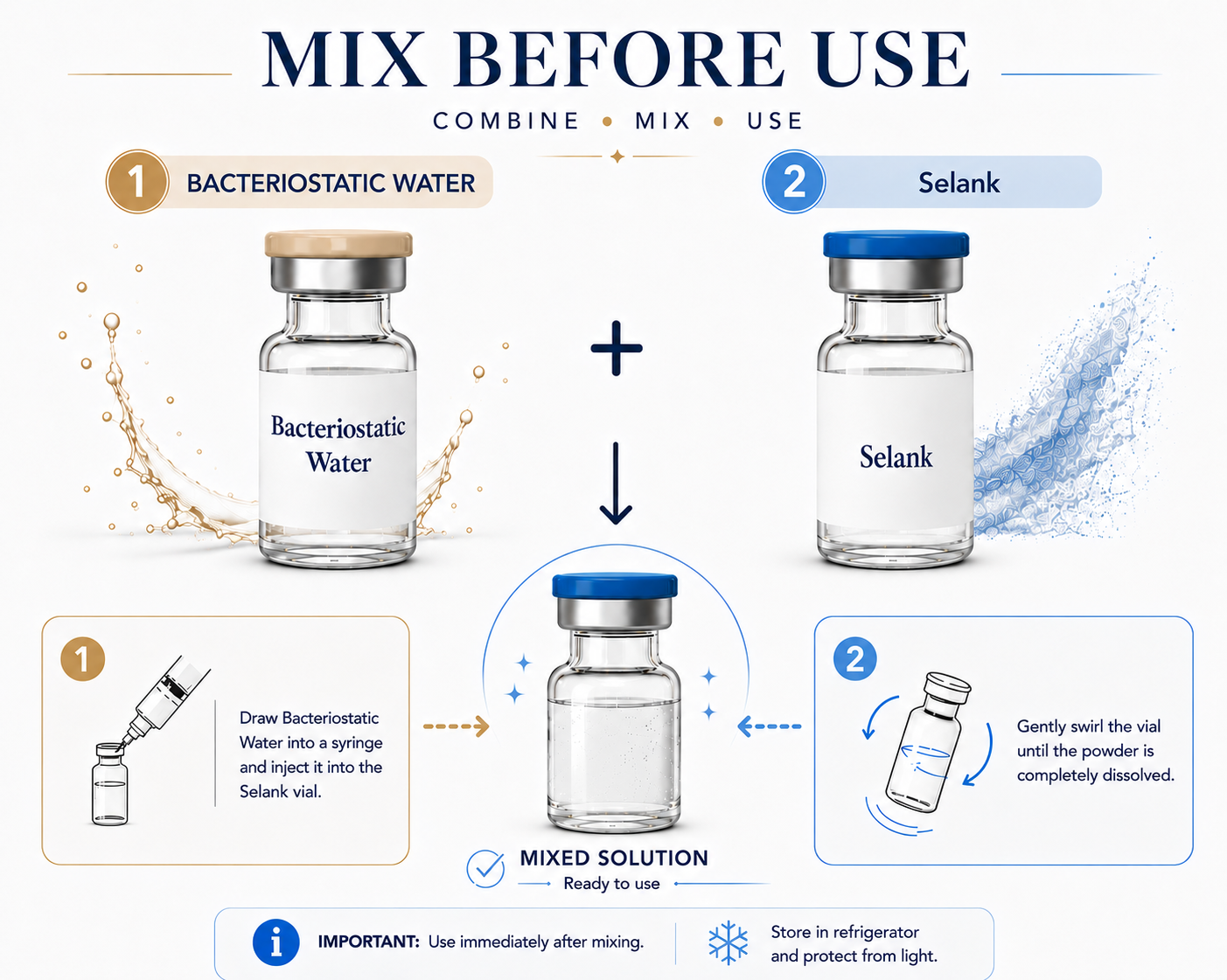
How To Mix Selank
1
CleanUse alcohol swabs to clean the tops of both vials.
2
Draw BAC WaterDraw the selected amount of bacteriostatic water.
3
Inject SlowlyAdd the liquid slowly down the side of the vial.
4
Swirl GentlyDo not shake. Swirl gently until dissolved.
5
Store ProperlyStore as directed and protect from heat and light.
Best Practices & Common Mistakes
Best Practices
- Use sterile technique.
- Protect from light and heat.
- Store refrigerated when appropriate.
- Use clean syringe-unit math before measuring.
Common Mistakes
- Confusing milligrams with milliliters.
- Choosing an option with awkward decimal units.
- Using too little liquid for very small measurements.
- Shaking the vial aggressively.
Selank Storage & Handling
Lyophilized Powder: −20°C (−4°F) for long-term storage (up to 24 months). Refrigeration 2–8°C (36–46°F) for short-term use (up to ~3 months). Original sealed vial in the freezer is safest.
Reconstituted Solution: 2–8°C (36–46°F), use within ~7–14 days. Keep sealed, avoid light, and do not repeat freeze-thaw cycles.
Frequently Asked Questions
They're both Russian "glyproline" peptides sharing a Pro-Gly-Pro stabilizing tail, but they come from different parents and do different things. Selank (Thr-Lys-Pro-Arg-Pro-Gly-Pro) is a tuftsin analog studied mainly as an anxiolytic — calming without the sedation of a benzodiazepine — while Semax (Met-Glu-His-Phe-Pro-Gly-Pro) is an ACTH(4-10) fragment studied for focus and cognition. Because the effects are complementary rather than overlapping, researchers often run them together (calm plus focus), but they're separate molecules and aren't interchangeable.
Only the freeze-dried injectable powder is reconstituted — add bacteriostatic water down the vial wall, swirl gently, and don't shake. As a worked example, a 5 mg vial with about 3.3 mL of bacteriostatic water gives 1.5 mg/mL, so a 300 mcg research dose is 0.2 mL — 20 units on a U-100 insulin syringe. Injectable research protocols tend to run as short daily courses of a couple of weeks rather than continuously, but there's no approved human schedule.
Selank inherits immune activity from its parent peptide tuftsin and layers broad neuro effects on top: it's studied as a positive allosteric modulator of GABA-A receptors at a site separate from the benzodiazepine site, which is why it reads as calming without sedation. Research also points to shifts in serotonin and dopamine metabolism, BDNF, and enkephalin turnover, alongside antiviral and immune signaling. Its plasma half-life is only a few minutes, yet the behavioral effects reportedly last far longer, so dosing isn't tied to that short number.
Only the injectable lyophilized powder goes through reconstitution, so the calculator applies to that form. Nasal sprays usually arrive pre-dissolved — a common format is 10 mg in 10 mL of saline, i.e., 1 mg/mL — or are mixed to order by the vendor, so there's nothing for you to reconstitute; they're dosed per metered spray and kept refrigerated once in solution. Note that N-Acetyl Selank Amidate is a separate, stability-modified version with its own page — this one is plain Selank.
Despite the search term, the research literature describes Selank as lacking the dependence, tolerance, and sedation tied to benzodiazepines, so it isn't associated with a classic withdrawal syndrome. Stopping it generally means anxiety returns to its untreated baseline rather than a rebound crash — though that rests largely on Russian clinical and preclinical work, not FDA review. Because it nudges serotonin signaling, combining it with antidepressants in a research context warrants caution, and none of this replaces clinical guidance.
Practical takeaway: If your real goal is weight or metabolic health, the most useful next step is discussing approved treatment options with a clinician rather than relying on an unapproved compound.
Important: This tool is for informational and research-reference purposes only. Not intended for human or veterinary use.