
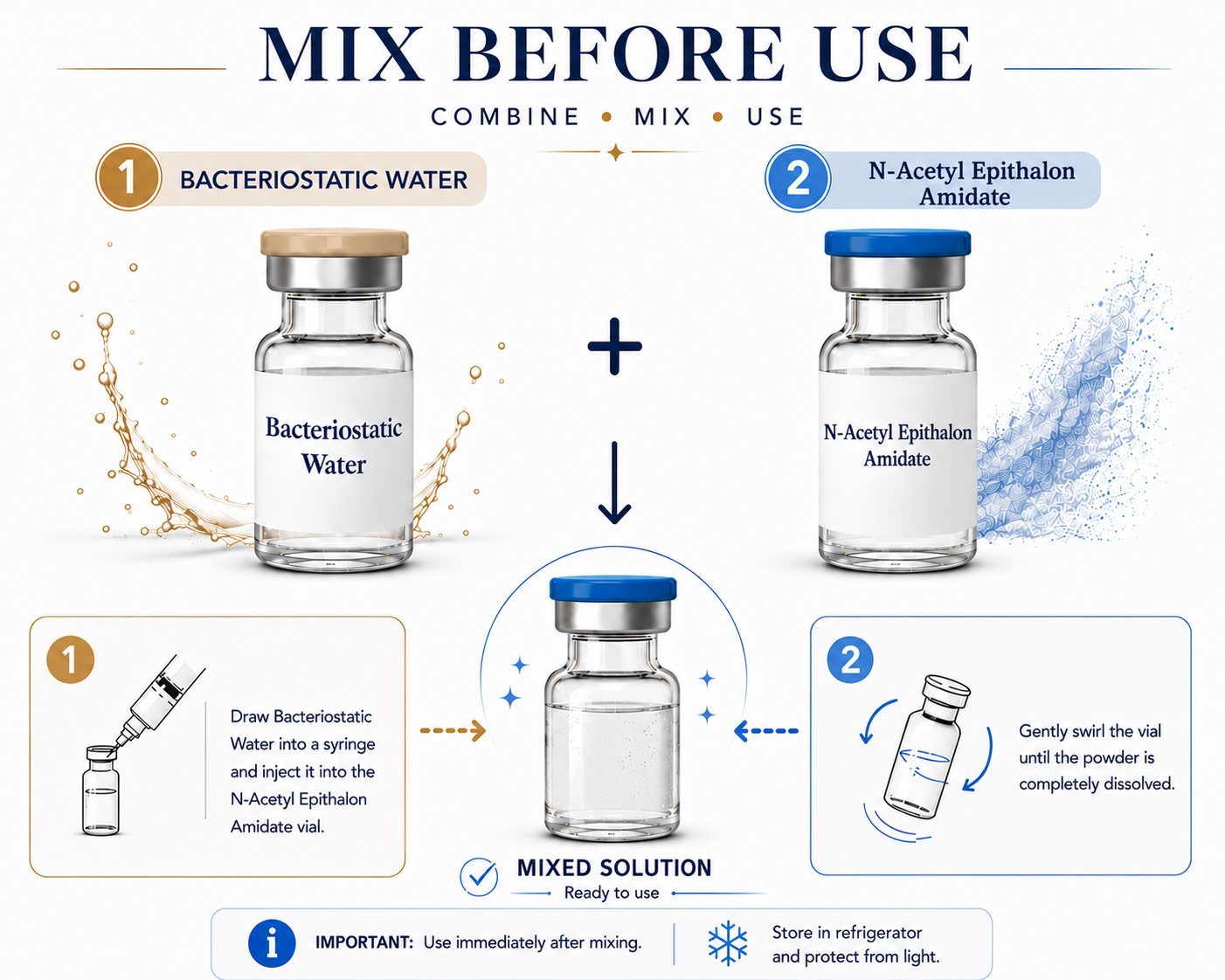
N-Acetyl Epithalon Amidate and BAC Water Mix

N-Acetyl Epithalon Amidate Reconstitution Calculator

Enter the amount you want to measure. The vial buttons will highlight which vial strengths create cleaner syringe-unit measurements.

What amount do you need?

Type the target amount, then choose mg or mcg. Example: 2mg or 500mcg.

Syringe size:
Possible vial strengths:
Best Match Good Match Usable Harder to Measure

Example N-Acetyl Epithalon Amidate Titration Schedule

WeekDaily Dose (mcg)Injection Volume (mL / Units)
Weeks 1–2200 mcg (0.200 mg)0.06 mL (6 units)
Weeks 3–4300 mcg (0.300 mg)0.09 mL (9 units)
Weeks 5–6400 mcg (0.400 mg)0.12 mL (12 units)
Weeks 7–12500 mcg (0.500 mg)0.15 mL (15 units)
Possible vial strengths:

What Is It?

N-Acetyl Epithalon Amidate

Stabilised epithalon variant.

Bacteriostatic Water

Sterile water containing a bacteriostatic preservative, commonly used when preparing multi-use research vials.

How To Mix N-Acetyl Epithalon Amidate

1
Clean

Use alcohol swabs to clean the tops of both vials.

2
Draw BAC Water

Draw the selected amount of bacteriostatic water.

3
Inject Slowly

Add the liquid slowly down the side of the vial.

4
Swirl Gently

Do not shake. Swirl gently until dissolved.

5
Store Properly

Store as directed and protect from heat and light.

Best Practices & Common Mistakes

Best Practices

  • Use sterile technique.
  • Protect from light and heat.
  • Store refrigerated when appropriate.
  • Use clean syringe-unit math before measuring.

Common Mistakes

  • Confusing milligrams with milliliters.
  • Choosing an option with awkward decimal units.
  • Using too little liquid for very small measurements.
  • Shaking the vial aggressively.

N-Acetyl Epithalon Amidate Storage & Handling

Lyophilized Powder: −20°C (−4°F) for long-term storage (up to 24 months). Refrigeration 2–8°C (36–46°F) for short-term use (up to ~3 months). Original sealed vial in the freezer is safest.
Reconstituted Solution: 2–8°C (36–46°F), use within ~7–14 days. Keep sealed, avoid light, and do not repeat freeze-thaw cycles.

Frequently Asked Questions

Same core tetrapeptide (AEDG), but with two chemistry changes — an acetyl group on the N-terminus and an amide cap on the C-terminus — that slow enzymatic breakdown and improve stability. The practical upshot researchers cite is a longer-lasting molecule that survives intranasal delivery better than unmodified Epithalon, which is why it's sold so often as a nasal spray. The intended target (telomerase and pineal signaling) is identical, so the modification is about delivery and durability, not a new mechanism.
Only the lyophilized injectable version is mixed by hand — trickle bacteriostatic water down the inside wall of the vial, swirl (never shake), and let it dissolve fully. For instance, a 30 mg vial with 10 mL of bacteriostatic water yields 3 mg/mL, so a 3 mg research dose is 1.0 mL, which reads as 100 units on a U-100 insulin syringe. Use less water for a more concentrated solution if you'd rather a smaller injection volume.
The nasal spray usually arrives pre-mixed or is prepared to order by the vendor with saline, so there's nothing for you to reconstitute — the calculator applies only to the injectable powder. Dosing there is counted per metered spray rather than in milliliters: a 50 mg bottle delivering about 80 sprays works out to roughly 625 mcg per spray, while a 20 mg bottle is around 250 mcg. Nasal bottles are usually kept refrigerated once mixed, since the peptide is sitting in solution rather than dry.
No — there's no validated, amidate-specific dosing schedule, so researchers generally borrow the Epithalon reference protocol as a starting point rather than anything purpose-built for the modified form. Because the acetylation and amidation change how much survives and how long it lasts, you can't assume a milligram-for-milligram match with plain Epithalon. If you're after what the peptide actually does — telomerase, telomere, and pineal-melatonin effects — that mechanism is covered on the main Epithalon page, since the payload is identical.
Sealed lyophilized powder is the most stable form and keeps best frozen or refrigerated, kept dry and out of light until you reconstitute it. Once mixed — whether an injectable solution or a nasal spray — it should be refrigerated and used within a few weeks, and splitting an injectable batch into aliquots helps avoid repeated freeze-thaw cycles. The whole purpose of the N-acetyl and C-terminal-amide changes is added resistance to enzymatic degradation, but that describes its behavior in solution and tissue — not a license to leave it sitting at room temperature.
Practical takeaway: If your real goal is weight or metabolic health, the most useful next step is discussing approved treatment options with a clinician rather than relying on an unapproved compound.
Important: This tool is for informational and research-reference purposes only. Not intended for human or veterinary use.
← All peptides