
Pinealon Reconstitution Calculator
Enter the amount you want to measure. The vial buttons will highlight which vial strengths create cleaner syringe-unit measurements.
What amount do you need?
Type the target amount, then choose mg or mcg. Example: 2mg or 500mcg.
Syringe size:
Possible vial strengths:
Best Match
Good Match
Usable
Harder to Measure
Example Pinealon Titration Schedule
| Protocol Item | Guidance |
|---|---|
| Dose | 1–5 mg per dose |
| Loading Phase (Year 1) | Month 1: Daily |
| Maintenance (Year 2+) | 10–20 day cycles, about 3× per year, spaced evenly |
Possible vial strengths:
What Is It?
Pinealon
Pineal peptide bioregulator.
Bacteriostatic Water
Sterile water containing a bacteriostatic preservative, commonly used when preparing multi-use research vials.
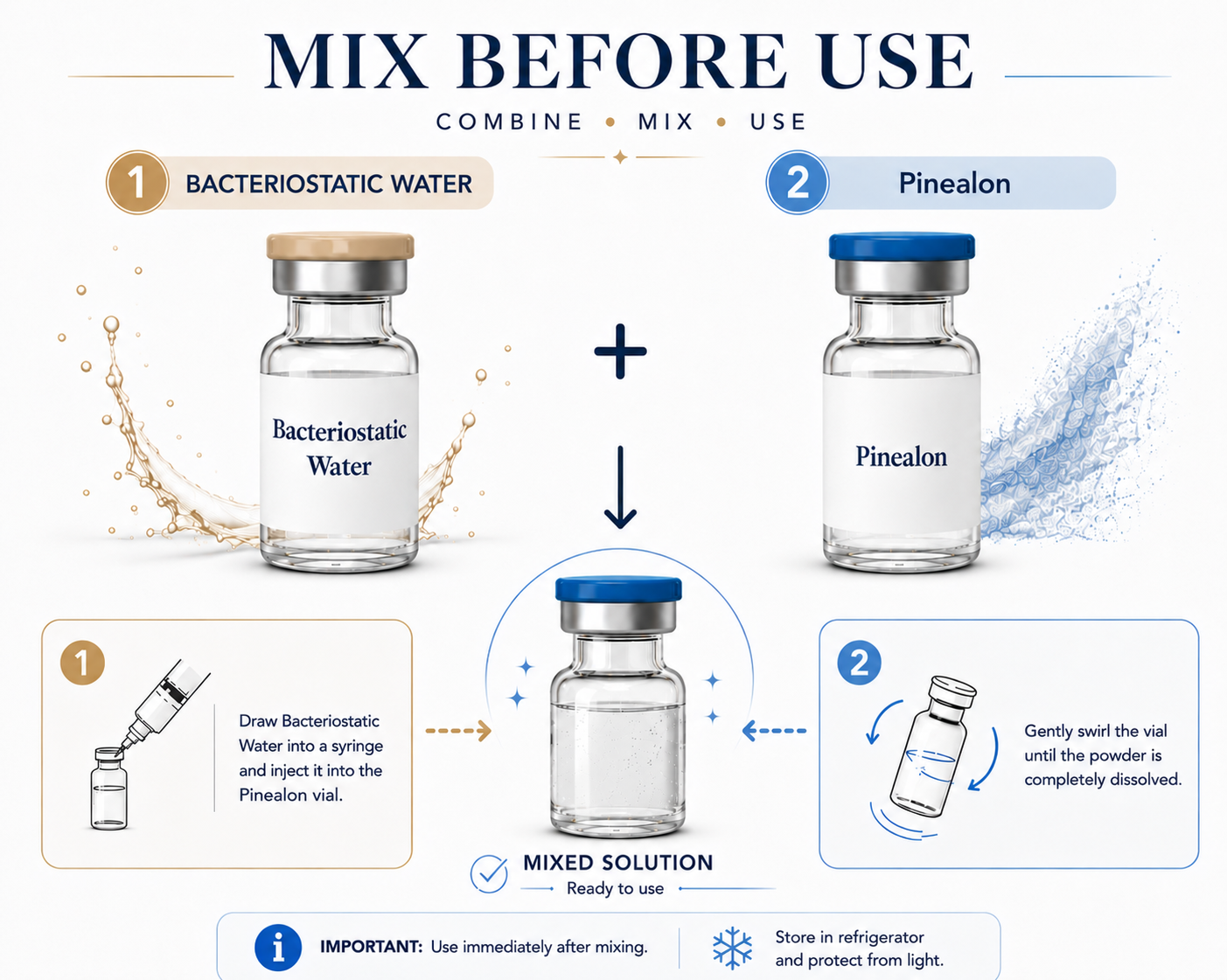
How To Mix Pinealon
1
CleanUse alcohol swabs to clean the tops of both vials.
2
Draw BAC WaterDraw the selected amount of bacteriostatic water.
3
Inject SlowlyAdd the liquid slowly down the side of the vial.
4
Swirl GentlyDo not shake. Swirl gently until dissolved.
5
Store ProperlyStore as directed and protect from heat and light.
Best Practices & Common Mistakes
Best Practices
- Use sterile technique.
- Protect from light and heat.
- Store refrigerated when appropriate.
- Use clean syringe-unit math before measuring.
Common Mistakes
- Confusing milligrams with milliliters.
- Choosing an option with awkward decimal units.
- Using too little liquid for very small measurements.
- Shaking the vial aggressively.
Pinealon Storage & Handling
Lyophilized Powder: −20°C (−4°F) for long-term storage (up to 24 months). Refrigeration 2–8°C (36–46°F) for short-term use (up to ~3 months). Original sealed vial in the freezer is safest.
Reconstituted Solution: 2–8°C (36–46°F), use within ~7–14 days. Keep sealed, avoid light, and do not repeat freeze-thaw cycles.
Frequently Asked Questions
Pinealon is a Khavinson "bioregulator" — a synthetic tripeptide (Glu-Asp-Arg, EDR) studied for neuroprotection and brain aging at the gene level. Despite the "pineal"-sounding name, it wasn't isolated from the pineal gland at all — it comes from brain-cortex (Cortexin) research and acts on neurons themselves. It's sold as an oral/sublingual form and as a research-grade injectable powder.
They're constantly confused, but they're different molecules with different jobs. Pinealon (EDR, a tripeptide) comes from brain cortex and works downstream at the neuron — antioxidant protection and stress-survival signaling. Epitalon (AEDG, a tetrapeptide) comes from the pineal gland and works upstream — melatonin, circadian genes, and telomerase. So if you see Pinealon credited with "boosting melatonin" or "extending telomeres," that claim almost certainly belongs to Epitalon and got pasted onto the wrong peptide.
In animal and Russian studies, Pinealon is described as protecting neurons by raising antioxidant enzymes (SOD2, GPX1), lowering oxidative stress, and boosting survival signaling, with reported gains in memory, attention, and mental performance in older subjects. Its effect on cortical serotonin is the basis for sleep and mood interest — and it's sometimes paired with glycine (an experiment podcaster Andrew Huberman described, while stressing it had little human data and was not a recommendation). All of this is preclinical, single-group research, not proven therapy.
Only the injectable research powder is reconstituted — the oral or sublingual capsule is taken as-is. For a 10 mg vial, adding 5 mL of bacteriostatic water gives 2 mg/mL, so a 400 mcg amount draws to 0.2 mL (20 units on a U-100 syringe); use less water for a stronger solution. If you're pairing it with glycine or Epitalon, prepare and measure each separately rather than combining them in one vial — and note effects here are cumulative over a course, not same-day.
Pinealon is not FDA-approved for any use — it's classified as a bioregulator in Russia but sold as a lab-use compound in the West, with all evidence coming from Khavinson's group and no independent replication or human trials. It's not a controlled substance, and a tiny tripeptide is expected to be low-toxicity, but because it influences serotonin pathways, combining it with serotonergic medications shouldn't be done without physician supervision. Storage: keep the lyophilized powder frozen or cold and out of light, and refrigerate any reconstituted solution, using it within a few weeks.
Practical takeaway: If your real goal is weight or metabolic health, the most useful next step is discussing approved treatment options with a clinician rather than relying on an unapproved compound.
Important: This tool is for informational and research-reference purposes only. Not intended for human or veterinary use.