
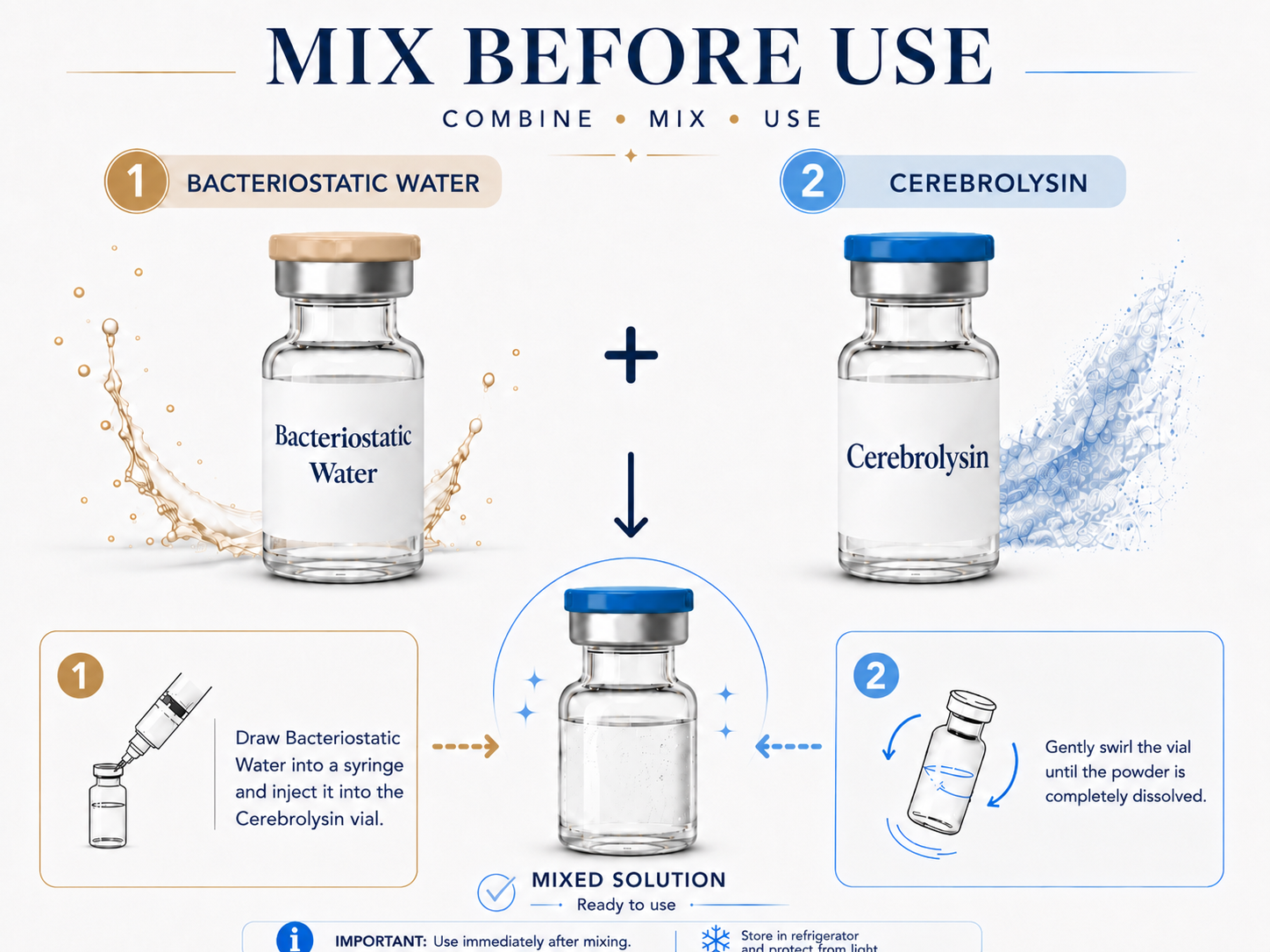
Cerebrolysin and BAC Water Mix

Cerebrolysin Reconstitution Calculator

Enter the amount you want to measure. The vial buttons will highlight which vial strengths create cleaner syringe-unit measurements.

What amount do you need?

Type the target amount, then choose mg or mcg. Example: 2mg or 500mcg.

Syringe size:
Possible vial strengths:
Best Match Good Match Usable Harder to Measure

Example Cerebrolysin Titration Schedule

Use Case / ConditionDose (mL)FrequencyDuration / Cycling Notes
Stroke (Acute Phase)20–50 mLDaily21 days; described as higher-dose early rehab support
Vascular Dementia10–30 mL5×/week4 weeks; repeat 2–4 cycles/year
Alzheimer’s Disease10–30 mL5×/week4 weeks; repeat 2–4 cycles/year
Traumatic Brain Injury (TBI)20–50 mLDaily7–30 days; varies by severity; start early post-injury if possible
Nootropic / Off-label Cognitive Use1–5 mL5×/week4 weeks; described as lower-dose cognitive / mood / neuroprotection cycle
“Standard Cognitive Support” (general)5 mLDaily (IM)Often described as a ~4-week cycle unless otherwise directed
Possible vial strengths:

What Is It?

Cerebrolysin

Porcine brain peptide preparation, 215 mg/mL solution.

Bacteriostatic Water

Sterile water containing a bacteriostatic preservative, commonly used when preparing multi-use research vials.

How To Mix Cerebrolysin

1
Clean

Use alcohol swabs to clean the tops of both vials.

2
Draw BAC Water

Draw the selected amount of bacteriostatic water.

3
Inject Slowly

Add the liquid slowly down the side of the vial.

4
Swirl Gently

Do not shake. Swirl gently until dissolved.

5
Store Properly

Store as directed and protect from heat and light.

Best Practices & Common Mistakes

Best Practices

  • Use sterile technique.
  • Protect from light and heat.
  • Store refrigerated when appropriate.
  • Use clean syringe-unit math before measuring.

Common Mistakes

  • Confusing milligrams with milliliters.
  • Choosing an option with awkward decimal units.
  • Using too little liquid for very small measurements.
  • Shaking the vial aggressively.

Cerebrolysin Storage & Handling

Lyophilized Powder: −20°C (−4°F) for long-term storage (up to 24 months). Refrigeration 2–8°C (36–46°F) for short-term use (up to ~3 months). Original sealed vial in the freezer is safest.
Reconstituted Solution: 2–8°C (36–46°F), use within ~7–14 days. Keep sealed, avoid light, and do not repeat freeze-thaw cycles.

Frequently Asked Questions

Cerebrolysin is not a single peptide but a standardized mixture of low-molecular-weight neuropeptides and free amino acids, produced by enzymatically breaking down purified porcine (pig) brain proteins. Made only by EVER Neuro Pharma in Austria, it's roughly 15–25% peptide fragments and 75–85% amino acids, designed so the peptide portion crosses the blood-brain barrier. Because it's a multi-component biological drug rather than a lab-made single molecule, it behaves differently from typical research peptides.
You don't — this is the key point. Cerebrolysin is sold as a ready-to-use amber solution in sealed glass ampoules (215.2 mg per mL), so there's no powder to mix and no bacteriostatic water involved; you draw the liquid straight from the ampoule. It's also dosed by volume (mL of solution, e.g. 5 mL or 10 mL ampoules), not by reconstituted mg. Critically, it's given by IV infusion or IM injection only and never subcutaneously, so a standard peptide reconstitution calculator doesn't apply here.
Cerebrolysin's peptide fragments are thought to mimic the brain's own neurotrophic factors (BDNF, NGF, GDNF, CNTF), supporting neuron survival, plasticity, and repair — the rationale for its use in stroke, traumatic brain injury, and dementia. The evidence is genuinely mixed: industry-sponsored trials and some meta-analyses show cognitive benefit, but the 2023 Cochrane review found no benefit on survival and flagged more serious adverse events. It is not a proven "IQ booster," and independent confirmation remains limited.
Cerebroprotein Hydrolysate is essentially the same category of product — a porcine brain-derived peptide-and-amino-acid hydrolysate — often marketed as an equivalent or generic of Cerebrolysin, though exact manufacturing can differ by producer. Citicoline is completely different: it's a single small molecule (a phospholipid precursor), taken orally as well as by injection, working by a different mechanism. So Cerebrolysin and cerebroprotein hydrolysate are close cousins, while citicoline just shares the "brain support" shelf.
Cerebrolysin is approved in over 50 countries but is not FDA-approved in the US, where it's a research/unapproved import — one reason "authentic vs fake" sourcing is a real concern. It's generally well tolerated (mild dizziness, headache, or injection-site effects), but it can lower the seizure threshold, so epilepsy is a caution, and it's contraindicated in porcine-protein allergy and severe kidney impairment. Because it's derived from pig brain tissue, it is not halal or kosher. Storage: keep the sealed ampoules at room temperature away from light, and use an opened ampoule promptly rather than storing leftover solution.
Practical takeaway: If your real goal is weight or metabolic health, the most useful next step is discussing approved treatment options with a clinician rather than relying on an unapproved compound.
Important: This tool is for informational and research-reference purposes only. Not intended for human or veterinary use.
← All peptides