Need a Reliable Peptide Supplier? Click HERE!!!SponsoredVisit ↗
Epithalon (Epitalon) and BAC Water Mix

Epithalon (Epitalon) Reconstitution Calculator

Enter the amount you want to measure. The vial buttons will highlight which vial strengths create cleaner syringe-unit measurements.

What amount do you need?

Type the target amount, then choose mg or mcg. Example: 2mg or 500mcg.

Work the dose out from body weight

Syringe size:
Possible vial strengths:
Best Match Good Match Usable Harder to Measure

Example Epithalon (Epitalon) Titration Schedule

ItemDetails
Standard doseAllometric HED ≈190–230 mcg/day; community 1–5 mg
Courses10–20 days, 2–3× per year
Originator dose10–1000× lower (Russian tradition)

2026 'microgram hypothesis': the 5–10 mg tradition was copied from Epithalamin extract dosing (500× potency conflation). Independently replicated in 2025 (Brunel): telomere elongation at 0.1–1 µg/mL. The '1–5 mg per dose' figure is a recurring placeholder that never matched a validated protocol for any bioregulator; sources disagree up to 1000× on real doses.

Possible vial strengths:

What Is It?

Epithalon (Epitalon)

Tetrapeptide studied for telomerase signaling.

Bacteriostatic Water

Sterile water containing a bacteriostatic preservative, commonly used when preparing multi-use research vials.

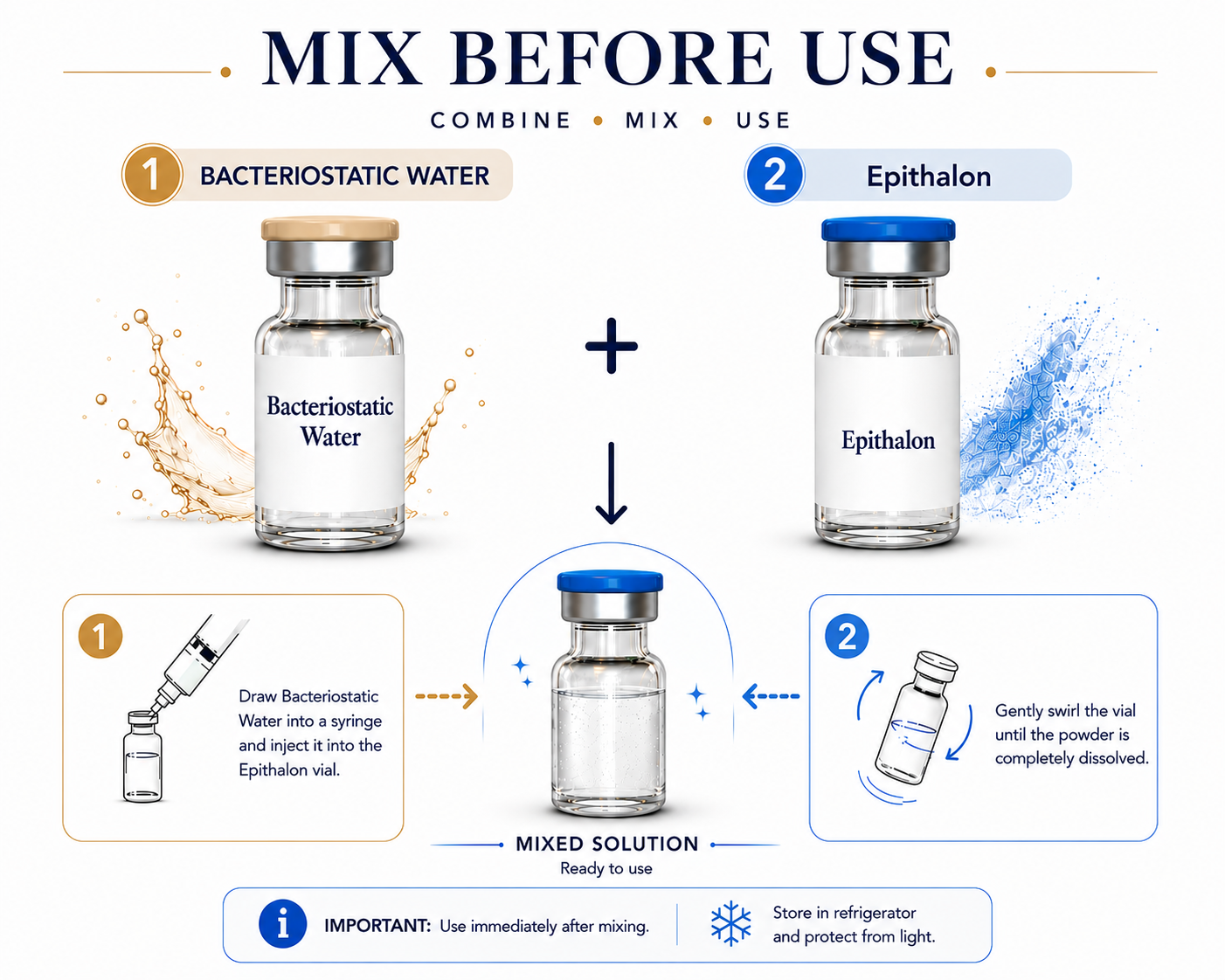
How To Mix Epithalon (Epitalon)

1
Clean

Use alcohol swabs to clean the tops of both vials.

2
Draw BAC Water

Draw the selected amount of bacteriostatic water.

3
Inject Slowly

Add the liquid slowly down the side of the vial.

4
Swirl Gently

Do not shake. Swirl gently until dissolved.

5
Store Properly

Store as directed and protect from heat and light.

Best Practices & Common Mistakes

Best Practices

  • Use sterile technique.
  • Protect from light and heat.
  • Store refrigerated when appropriate.
  • Use clean syringe-unit math before measuring.

Common Mistakes

  • Confusing milligrams with milliliters.
  • Choosing an option with awkward decimal units.
  • Using too little liquid for very small measurements.
  • Shaking the vial aggressively.

Epithalon (Epitalon) Storage & Handling

Lyophilized Powder: −20°C (−4°F) for long-term storage (up to 24 months). Refrigeration 2–8°C (36–46°F) for short-term use (up to ~3 months). Original sealed vial in the freezer is safest.
Reconstituted Solution: 2–8°C (36–46°F), use within ~7–14 days. Keep sealed, avoid light, and do not repeat freeze-thaw cycles.

Frequently Asked Questions

Yes — Epitalon, Epithalon, and Epithalone are three spellings of the same synthetic tetrapeptide, Ala-Glu-Asp-Gly (AEDG), and the variation just comes from transliterating the original Russian name. Don't confuse it with Epithalamin, the bovine pineal-gland extract it was modeled on — much of the human longevity data people cite actually used that extract, not the synthetic peptide. It's also a different molecule from Pinealon (Glu-Asp-Arg), a separate Khavinson peptide aimed at neurons rather than the pineal-telomerase axis.
Only the lyophilized (freeze-dried) injectable powder gets reconstituted — add bacteriostatic water down the vial wall, swirl gently, and don't shake. As a worked example, a 50 mg vial plus 4 mL of bacteriostatic water gives 12.5 mg/mL; a 10 mg research dose is then 0.8 mL, which reads as 80 units on a U-100 insulin syringe. Add more water if you'd prefer a lower concentration and an easier-to-measure dose.
The most commonly cited preclinical protocol is 5–10 mg per day by subcutaneous injection for 10–20 consecutive days, repeated two to three times a year rather than run continuously. That short pulsed schedule reflects how the peptide was studied in the Khavinson work, not a validated human regimen. Since there's no approved dosing, any figure you find online is a research reference point, not a recommendation.
In cell studies, Epithalon raised expression of hTERT — the catalytic subunit of telomerase — and lengthened telomeres, with a 2025 independent replication reproducing the telomere effect in normal human cell lines. It's also studied for restoring pineal melatonin output and normalizing circadian rhythm, since it derives from a pineal-gland peptide. One honest caveat: because telomerase activation could in theory support proliferation of cells that already have dysregulated growth, the theoretical cancer question is the main safety discussion point, and it hasn't been settled in humans.
No — the calculator only applies to the injectable lyophilized powder. Capsules and sublingual tablets are taken as-is, and nasal sprays come either pre-formulated or mixed-to-order by the vendor with saline, so there's nothing for you to reconstitute. N-Acetyl Epithalon Amidate is a stability-modified version (N-acetylated and C-terminal amidated) sold as both a ready nasal spray and an injectable powder — only that injectable powder goes through the same reconstitution steps.
Practical takeaway: If your goal involves weight management, metabolic health, recovery, physical performance, cognitive function, appearance, or general well-being, discuss it with a licensed healthcare professional. They can help you evaluate approved, evidence-based options rather than relying on an unapproved or investigational compound. This calculator is intended only for transparent research-reference calculations and does not determine an appropriate amount, recommend use, or replace professional medical guidance.

About the author

Maria Hrabina is a pharmacist and scientific reviewer with a strong interest in peptide science, pharmacology, and emerging therapeutic compounds.

Her work focuses on understanding how peptide-based compounds interact with biological signaling pathways and how they are being investigated across areas such as metabolic health, dermatology, recovery, regenerative research, and pharmaceutical development.

Maria follows research on a broad range of peptides, from compounds used in approved medicines to experimental molecules still being evaluated in laboratory, preclinical, and clinical studies.

Her approach combines scientific curiosity with critical evaluation of evidence. She believes promising mechanisms and early research deserve attention, but should not be presented as established clinical benefits until they are supported by adequate human data.

Her areas of focus include scientific literature review, mechanisms of action, pharmacology, pharmacokinetics, safety, pharmaceutical formulation, and the overall quality of evidence behind peptide-based compounds.

She is particularly interested in the process of translating an experimental molecule into a reliable pharmaceutical product — including compound characterization, purity, stability, formulation, dose selection, safety assessment, and controlled clinical trials.

Maria believes peptide science has significant long-term potential, but that its progress depends on rigorous research, high manufacturing standards, transparent safety data, and responsible scientific communication.

Through her writing, she aims to help readers understand both sides of peptide research: what makes these compounds scientifically promising and what questions remain before their potential can be considered clinically established.

Areas of interest: Peptide Science · Therapeutic Peptides · Peptide Pharmacology · Metabolic Peptides · Cosmetic Peptides · Drug Development · Pharmacokinetics · Drug Safety · Pharmaceutical Formulation · Emerging Therapies · Evidence-Based Medicine

Important: This tool is for informational and research-reference purposes only. Not intended for human or veterinary use.
← All peptides