
MOTS-c Reconstitution Calculator
Enter the amount you want to measure. The vial buttons will highlight which vial strengths create cleaner syringe-unit measurements.
What amount do you need?
Type the target amount, then choose mg or mcg. Example: 2mg or 500mcg.
Syringe size:
Possible vial strengths:
Best Match
Good Match
Usable
Harder to Measure
Example MOTS-c Titration Schedule
| Protocol Item | Guidance |
|---|---|
| Dose | 500 mcg – 5 mg per dose |
| Frequency | 1–7× per week |
| Cycle Length | ~1 month (may be extended up to 3–4 months) |
| Minimum Break | 1 month minimum cycle break between cycles |
| Notes | Cycle length and intensity depend on response and goal. |
Possible vial strengths:
What Is It?
MOTS-c
Mitochondrial-derived peptide studied in metabolic research.
Bacteriostatic Water
Sterile water containing a bacteriostatic preservative, commonly used when preparing multi-use research vials.
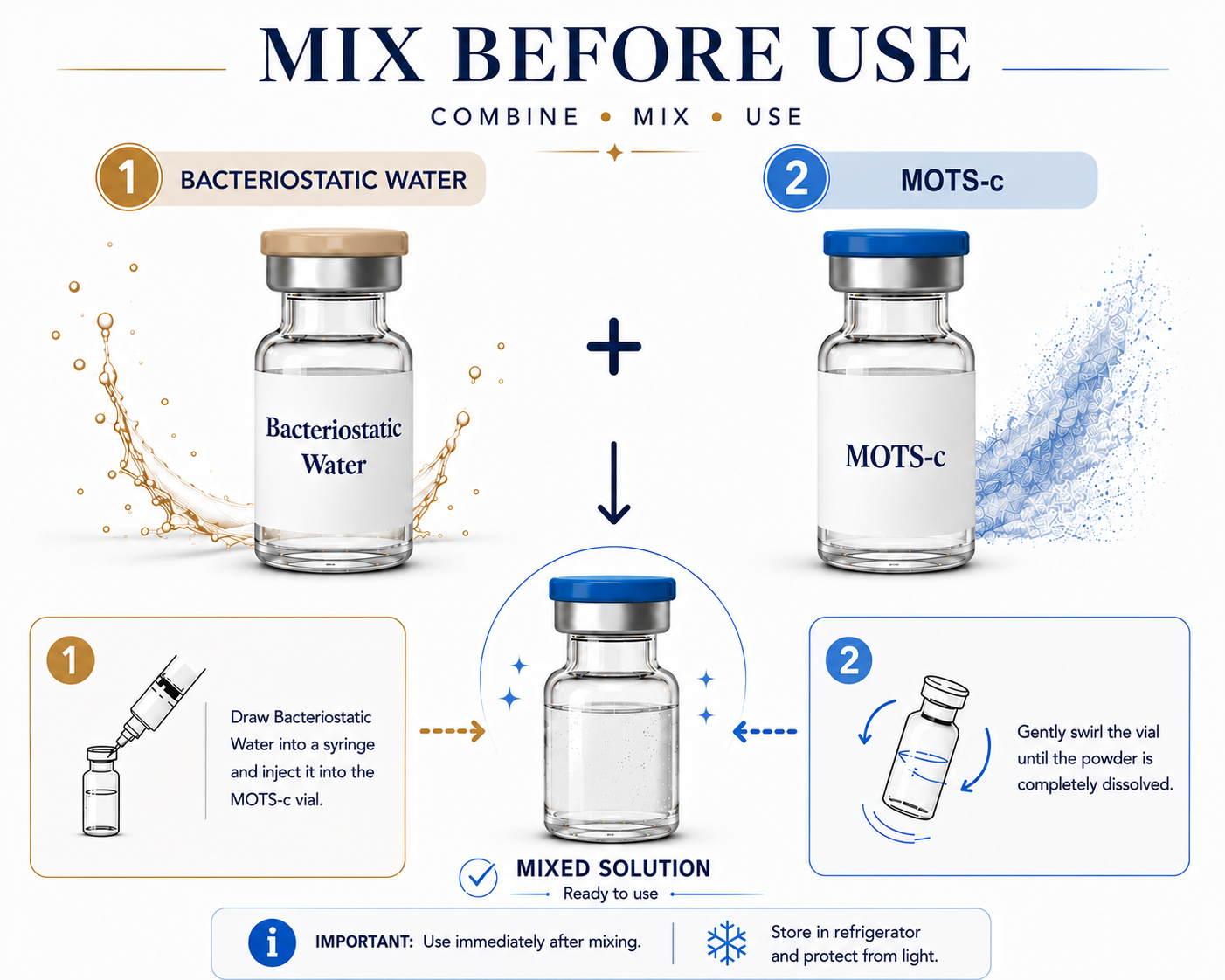
How To Mix MOTS-c
1
CleanUse alcohol swabs to clean the tops of both vials.
2
Draw BAC WaterDraw the selected amount of bacteriostatic water.
3
Inject SlowlyAdd the liquid slowly down the side of the vial.
4
Swirl GentlyDo not shake. Swirl gently until dissolved.
5
Store ProperlyStore as directed and protect from heat and light.
Best Practices & Common Mistakes
Best Practices
- Use sterile technique.
- Protect from light and heat.
- Store refrigerated when appropriate.
- Use clean syringe-unit math before measuring.
Common Mistakes
- Confusing milligrams with milliliters.
- Choosing an option with awkward decimal units.
- Using too little liquid for very small measurements.
- Shaking the vial aggressively.
MOTS-c Storage & Handling
Lyophilized Powder: −20°C (−4°F) for long-term storage (up to 24 months). Refrigeration 2–8°C (36–46°F) for short-term use (up to ~3 months). Original sealed vial in the freezer is safest.
Reconstituted Solution: 2–8°C (36–46°F), use within ~7–14 days. Keep sealed, avoid light, and do not repeat freeze-thaw cycles.
Frequently Asked Questions
MOTS-c is a 16-amino-acid peptide unusually encoded inside mitochondrial DNA rather than the cell nucleus, making it one of a small family called mitochondrial-derived peptides alongside humanin. Your own body produces more of it during exercise, and it acts on the AMPK energy-sensing pathway, which is why researchers describe it as an "exercise mimetic." That endogenous origin is real science; it does not mean the injectable products sold online are the same as what your cells make.
No — as of 2026, MOTS-c is not FDA-approved for any condition and is not legally marketed for human therapeutic use; products sold as "research use only" are exactly that. The FDA's compounding advisory committee is reviewing MOTS-c and several other peptides in 2026 to decide whether licensed compounding pharmacies may prepare them, but that review is not the same as approval. Anti-doping agencies also treat it as a prohibited experimental substance in sport.
Most of the compelling evidence is from mice and cell studies, where MOTS-c improved glucose tolerance, limited weight gain on high-fat diets, and boosted exercise capacity. Human data is still very limited — there are no completed large randomized efficacy trials in the published literature — so the honest position is "biologically promising, clinically unproven." Impressive rodent metabolism results do not reliably translate to safe or effective human outcomes, which is a recurring pattern in this field.
This is unsettled research territory, not a settled answer in either direction. Because MOTS-c influences core energy and stress pathways that are also relevant to how cells grow, scientists are studying its role in cancer biology, but there is no human evidence establishing it as either a treatment or a proven risk. That uncertainty is itself the point: it isn't something to self-manage, and anyone with a cancer history or concern should raise it with an oncologist rather than an online protocol.
There is no established human safety profile, no official dosing guideline, and no long-term data — meaning anyone self-injecting is effectively running an uncontrolled experiment on themselves. On top of that, "research use only" products aren't manufactured or tested to human-injectable standards for purity, dose accuracy, or sterility, so contamination and mislabeled potency are real risks independent of the molecule itself. If you're interested in MOTS-c's metabolic goals, a licensed clinician can discuss evidence-based, approved options instead.
Practical takeaway: If your real goal is weight or metabolic health, the most useful next step is discussing approved treatment options with a clinician rather than relying on an unapproved compound.
Important: This tool is for informational and research-reference purposes only. Not intended for human or veterinary use.