
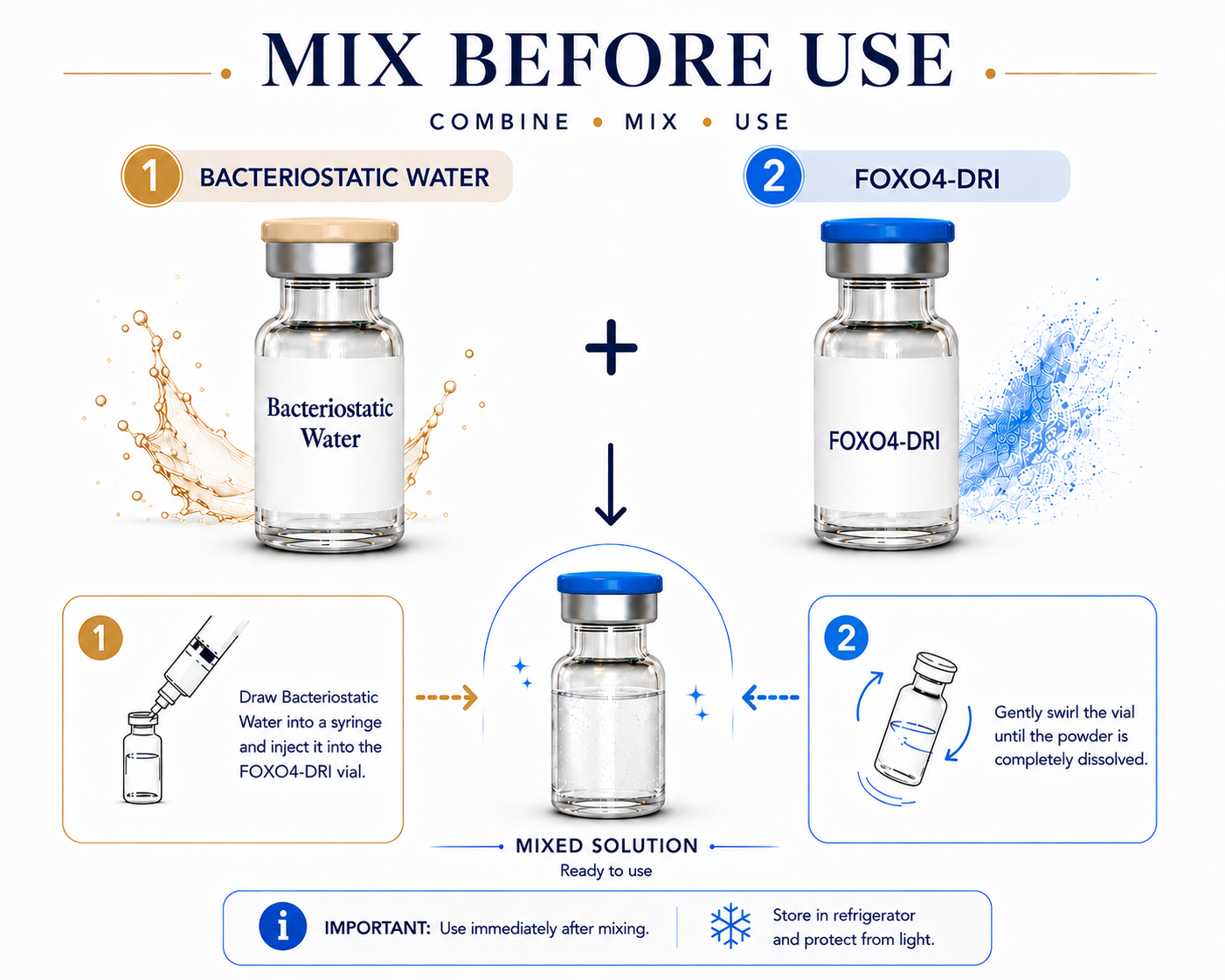
FOXO4-DRI and BAC Water Mix

FOXO4-DRI Reconstitution Calculator

Enter the amount you want to measure. The vial buttons will highlight which vial strengths create cleaner syringe-unit measurements.

What amount do you need?

Type the target amount, then choose mg or mcg. Example: 2mg or 500mcg.

Syringe size:
Possible vial strengths:
Best Match Good Match Usable Harder to Measure

Example FOXO4-DRI Titration Schedule

Protocol ItemGuidance
Dose1–5 mg per dose
CyclingDaily, for 30-day cycles (or shorter), with a 30-day minimum cycle break between
Cycle FrequencyBased on the individual response
Possible vial strengths:

What Is It?

FOXO4-DRI

Senolytic peptide studied for cellular aging.

Bacteriostatic Water

Sterile water containing a bacteriostatic preservative, commonly used when preparing multi-use research vials.

How To Mix FOXO4-DRI

1
Clean

Use alcohol swabs to clean the tops of both vials.

2
Draw BAC Water

Draw the selected amount of bacteriostatic water.

3
Inject Slowly

Add the liquid slowly down the side of the vial.

4
Swirl Gently

Do not shake. Swirl gently until dissolved.

5
Store Properly

Store as directed and protect from heat and light.

Best Practices & Common Mistakes

Best Practices

  • Use sterile technique.
  • Protect from light and heat.
  • Store refrigerated when appropriate.
  • Use clean syringe-unit math before measuring.

Common Mistakes

  • Confusing milligrams with milliliters.
  • Choosing an option with awkward decimal units.
  • Using too little liquid for very small measurements.
  • Shaking the vial aggressively.

FOXO4-DRI Storage & Handling

Lyophilized Powder: −20°C (−4°F) for long-term storage (up to 24 months). Refrigeration 2–8°C (36–46°F) for short-term use (up to ~3 months). Original sealed vial in the freezer is safest.
Reconstituted Solution: 2–8°C (36–46°F), use within ~7–14 days. Keep sealed, avoid light, and do not repeat freeze-thaw cycles.

Frequently Asked Questions

FOXO4-DRI is a synthetic ~46-amino-acid senolytic peptide built with an unusual "D-Retro-Inverso" design — its amino acids are mirror-image (D-form) and run in reverse order, which keeps the same binding shape while making it highly resistant to enzyme breakdown. It was created by Peter de Keizer's lab at Erasmus MC and published in Cell in 2017. Its whole purpose is to selectively clear senescent ("zombie") cells that accumulate with age, and it exists only as a research compound.
Senescent cells survive by using the protein FOXO4 to trap p53 in the nucleus, blocking their own self-destruct signal. FOXO4-DRI slips inside the cell and competes for that binding, displacing FOXO4 so p53 is released, leaves the nucleus, heads to the mitochondria, and triggers apoptosis (via BAX/PUMA). Because healthy cells don't rely on the FOXO4-p53 lock, they're largely spared — mouse work reported roughly 11-fold selectivity for senescent over normal cells.
No — this is the crucial caveat behind the anti-aging hype. Despite headlines about reversing aging, every FOXO4-DRI result comes from cell culture and mice (restored fur, kidney function, and fitness in old animals); there are no registered human clinical trials on ClinicalTrials.gov and no established human dose. So its benefits in people are unproven, and "before and after" claims rest on animal data plus anecdote, not evidence.
Reconstitute the lyophilized powder with sterile or bacteriostatic water and swirl gently — don't shake, as this large 5.3 kDa peptide can aggregate; a 10 mg vial + 3.3 mL gives ~3 mg/mL, so a 1.5 mg amount draws to 0.5 mL (50 units on a U-100 syringe). Mouse studies used 5 mg/kg pulsed (not daily), and no human dose is validated. Unlike the drug combo Dasatinib + Quercetin — broad senolytics that stress many cell types — FOXO4-DRI is a targeted peptide aimed specifically at the FOXO4-p53 escape route.
FOXO4-DRI is not FDA-approved and is strictly a research compound with no human safety data — its pharmacokinetics, long-term effects, and risks in people are simply unknown. The main theoretical concern is its mechanism: it forces activation of the p53 tumor-suppressor pathway, a powerful apoptosis switch, so tampering with it outside controlled study carries real uncertainty (and it should be kept well away from anyone with cancer risk without oversight). Storage: because it's a large D-peptide, keep the powder frozen at -20 °C, reconstitute gently, and use the refrigerated solution within about 7–10 days.
Practical takeaway: If your real goal is weight or metabolic health, the most useful next step is discussing approved treatment options with a clinician rather than relying on an unapproved compound.
Important: This tool is for informational and research-reference purposes only. Not intended for human or veterinary use.
← All peptides