
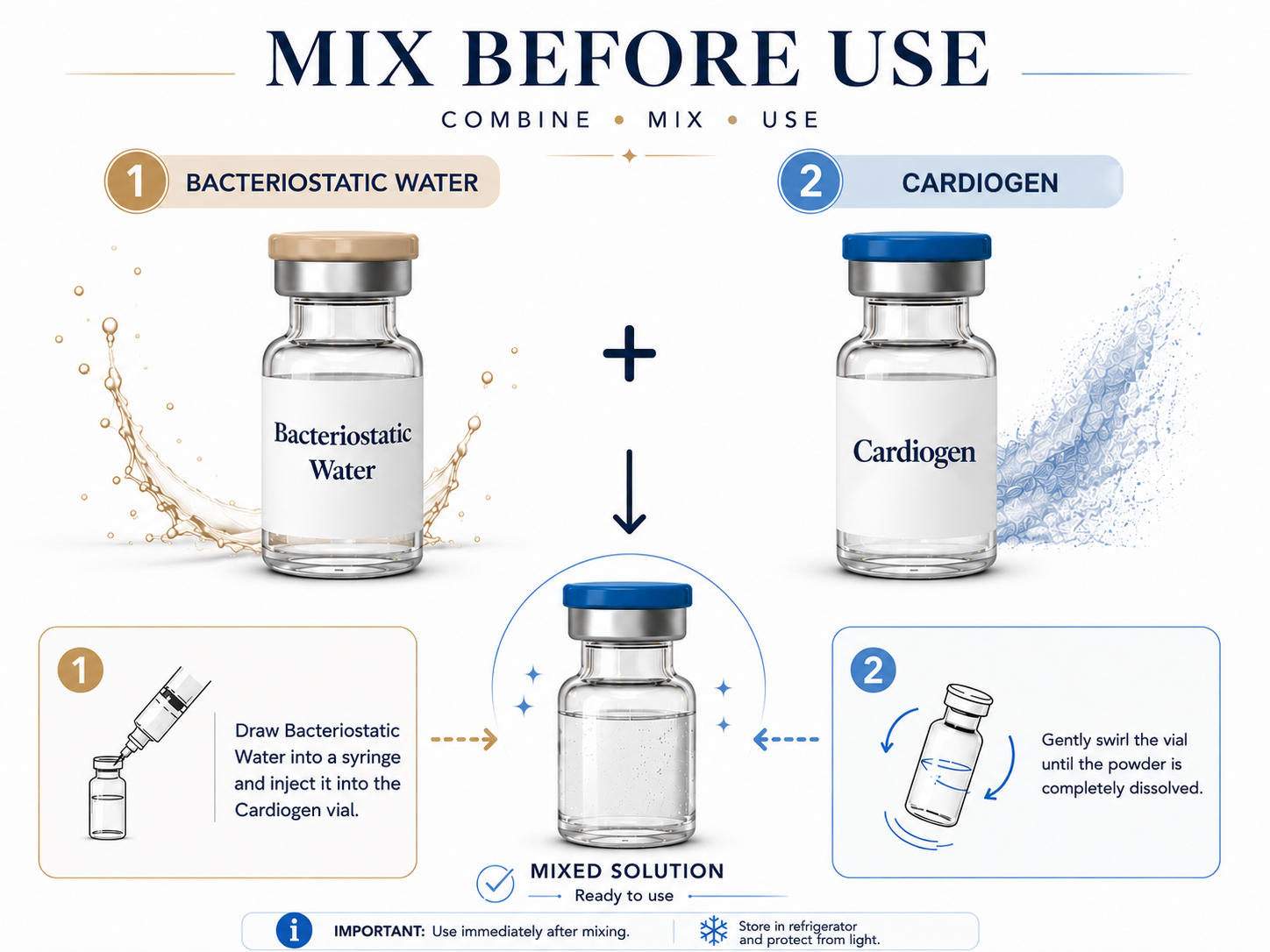
Cardiogen and BAC Water Mix

Cardiogen Reconstitution Calculator

Enter the amount you want to measure. The vial buttons will highlight which vial strengths create cleaner syringe-unit measurements.

What amount do you need?

Type the target amount, then choose mg or mcg. Example: 2mg or 500mcg.

Syringe size:
Possible vial strengths:
Best Match Good Match Usable Harder to Measure

Example Cardiogen Titration Schedule

Protocol ItemGuidance
Dose1–5 mg per dose
Cycling StyleBio-regulators are typically cycled as periodic doses rather than continuous daily consumption.
PhaseSchedule
Loading Phase (Year 1)
Maintenance Phase (Year 2+)
Possible vial strengths:

What Is It?

Cardiogen

Cardiac peptide bioregulator.

Bacteriostatic Water

Sterile water containing a bacteriostatic preservative, commonly used when preparing multi-use research vials.

How To Mix Cardiogen

1
Clean

Use alcohol swabs to clean the tops of both vials.

2
Draw BAC Water

Draw the selected amount of bacteriostatic water.

3
Inject Slowly

Add the liquid slowly down the side of the vial.

4
Swirl Gently

Do not shake. Swirl gently until dissolved.

5
Store Properly

Store as directed and protect from heat and light.

Best Practices & Common Mistakes

Best Practices

  • Use sterile technique.
  • Protect from light and heat.
  • Store refrigerated when appropriate.
  • Use clean syringe-unit math before measuring.

Common Mistakes

  • Confusing milligrams with milliliters.
  • Choosing an option with awkward decimal units.
  • Using too little liquid for very small measurements.
  • Shaking the vial aggressively.

Cardiogen Storage & Handling

Lyophilized Powder: −20°C (−4°F) for long-term storage (up to 24 months). Refrigeration 2–8°C (36–46°F) for short-term use (up to ~3 months). Original sealed vial in the freezer is safest.
Reconstituted Solution: 2–8°C (36–46°F), use within ~7–14 days. Keep sealed, avoid light, and do not repeat freeze-thaw cycles.

Frequently Asked Questions

Cardiogen is a short peptide bioregulator usually described by the sequence Ala-Glu-Asp-Arg, or AEDR. It is discussed in cardiovascular research because it is associated with cardiac tissue signaling, fibroblast activity, and gene-expression models, but it is not an FDA-approved heart medication.
The main research interest around Cardiogen is not a stimulant-like heart effect, but possible regulation of cardiac-cell repair signals. Studies and bioregulator discussions usually focus on cardiomyocyte activity, fibroblast behavior, p53-related apoptosis signaling, and tissue-remodeling markers rather than immediate performance benefits.
A reconstitution calculator only gives math, not a medical protocol. For example, a 20 mg Cardiogen vial mixed with 6 mL of bacteriostatic water gives about 3.33 mg/mL; a 0.5 mg research amount would equal about 0.15 mL, or 15 units on a U-100 insulin syringe.
No. Cardiogen peptide usually refers to AEDR, a short peptide bioregulator, while CardioGen-82 is a rubidium Rb-82 generator used in cardiac PET imaging for myocardial perfusion. A peptide reconstitution calculator is not meant for CardioGen-82, radiopharmaceutical infusion systems, scans, or nuclear medicine dosing.
The biggest safety issue is the evidence gap: Cardiogen is discussed mostly through bioregulator and preclinical-style research, not large modern clinical trials. Heart-related contexts are high-risk, so online reviews, Reddit anecdotes, or “protocol” claims should not be treated as proof of safety or effectiveness.
Practical takeaway: If your real goal is weight or metabolic health, the most useful next step is discussing approved treatment options with a clinician rather than relying on an unapproved compound.
Important: This tool is for informational and research-reference purposes only. Not intended for human or veterinary use.
← All peptides