
BAM-15 Reconstitution Calculator
Enter the amount you want to measure. The vial buttons will highlight which vial strengths create cleaner syringe-unit measurements.
What amount do you need?
Type the target amount, then choose mg or mcg. Example: 2mg or 500mcg.
Syringe size:
Possible vial strengths:
Best Match
Good Match
Usable
Harder to Measure
Example BAM-15 Titration Schedule
BAM-15 Research Protocols: Preclinical & Administration Summary
The table below collates various laboratory animal protocols from published studies. Human-equivalent doses would require careful scaling calculations and are not recommended.
Context / Study Use Reported Dosage / Concentration Route / Formulation Frequency / Duration
General Mouse Study (Diet-Induced Obesity, Insulin Resistance) 0.1% and 0.2% (w/w) Admixed in diet Daily for up to 4 weeks
Aging/Sarcopenia Mouse Study 0.033% (mg/g) Standard chow admixture Daily for 8 weeks
Kidney Injury/Sepsis Mouse Study 1 mg/kg to 5 mg/kg Intraperitoneal (i.p.) injection Single dose or 3h before LPS
Inflammation Mouse Study 1 mg/kg Intraperitoneal (i.p.) injection 3h prior to LPS injection
Stroke/Cognitive Function Mouse Study 2.5 mg/kg Intraperitoneal (i.p.) injection Weekly or as detailed in protocol
Energy Expenditure Mouse Study 5, 10, 20 mg/kg (single dose) Intraperitoneal (i.p.) injection Single dose to measure metabolic changes
Liver & Metabolic Mouse Study 0.1% to 0.2% (w/w) Admixed in diet Daily feeding
Anti-Cancer Research 50 ng/mL (intratumoral) Targeted delivery (e.g., TCV-BAM15) As per protocol
Mitochondrial Function (in vitro) 100 nM to 50 µM Cell culture media Acute treatment (16h in some protocols)
The table below collates various laboratory animal protocols from published studies. Human-equivalent doses would require careful scaling calculations and are not recommended.
Context / Study Use Reported Dosage / Concentration Route / Formulation Frequency / Duration
General Mouse Study (Diet-Induced Obesity, Insulin Resistance) 0.1% and 0.2% (w/w) Admixed in diet Daily for up to 4 weeks
Aging/Sarcopenia Mouse Study 0.033% (mg/g) Standard chow admixture Daily for 8 weeks
Kidney Injury/Sepsis Mouse Study 1 mg/kg to 5 mg/kg Intraperitoneal (i.p.) injection Single dose or 3h before LPS
Inflammation Mouse Study 1 mg/kg Intraperitoneal (i.p.) injection 3h prior to LPS injection
Stroke/Cognitive Function Mouse Study 2.5 mg/kg Intraperitoneal (i.p.) injection Weekly or as detailed in protocol
Energy Expenditure Mouse Study 5, 10, 20 mg/kg (single dose) Intraperitoneal (i.p.) injection Single dose to measure metabolic changes
Liver & Metabolic Mouse Study 0.1% to 0.2% (w/w) Admixed in diet Daily feeding
Anti-Cancer Research 50 ng/mL (intratumoral) Targeted delivery (e.g., TCV-BAM15) As per protocol
Mitochondrial Function (in vitro) 100 nM to 50 µM Cell culture media Acute treatment (16h in some protocols)
Possible vial strengths:
What Is It?
BAM-15
Mitochondrial uncoupler research compound.
Bacteriostatic Water
Sterile water containing a bacteriostatic preservative, commonly used when preparing multi-use research vials.
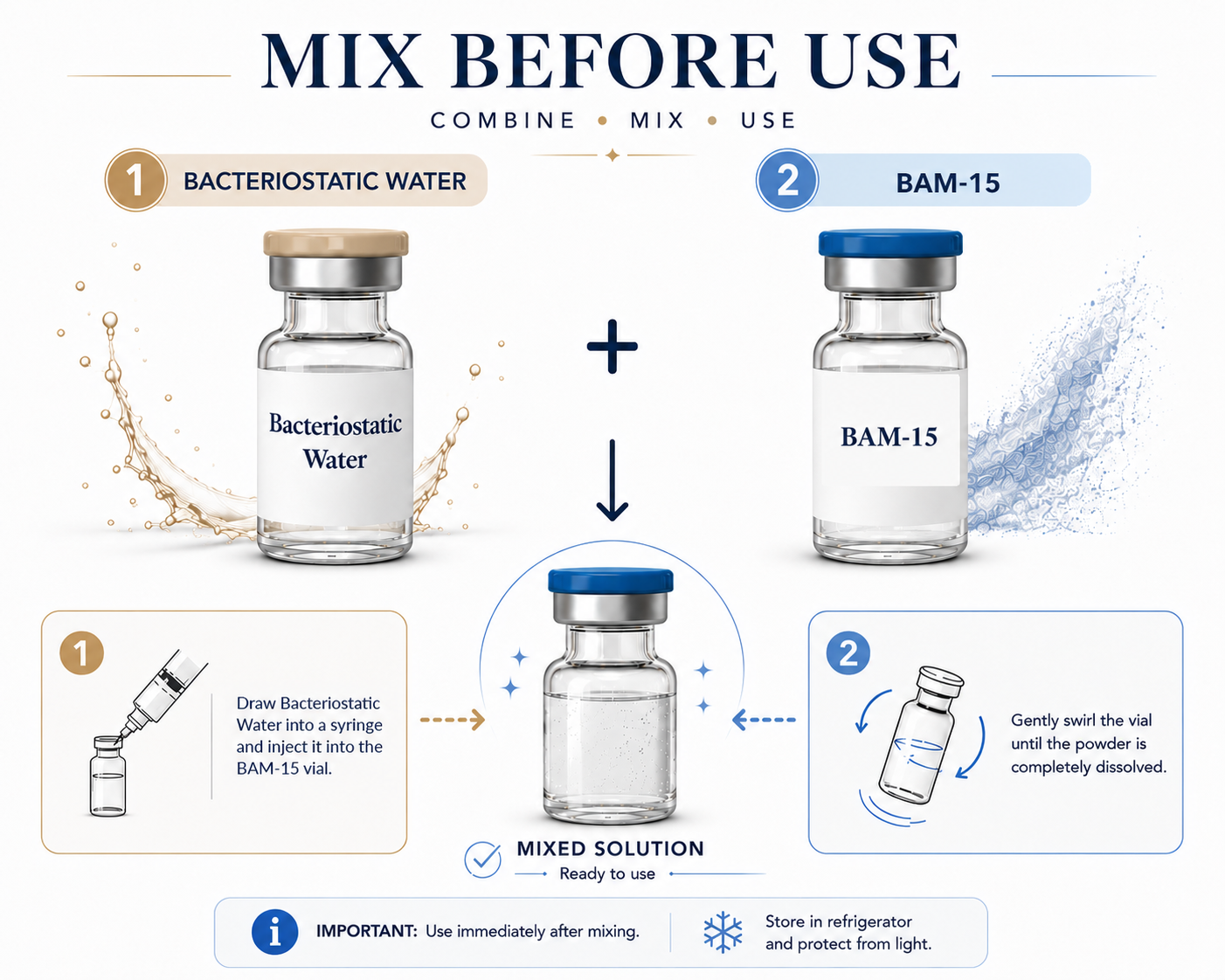
How To Mix BAM-15
1
CleanUse alcohol swabs to clean the tops of both vials.
2
Draw BAC WaterDraw the selected amount of bacteriostatic water.
3
Inject SlowlyAdd the liquid slowly down the side of the vial.
4
Swirl GentlyDo not shake. Swirl gently until dissolved.
5
Store ProperlyStore as directed and protect from heat and light.
Best Practices & Common Mistakes
Best Practices
- Use sterile technique.
- Protect from light and heat.
- Store refrigerated when appropriate.
- Use clean syringe-unit math before measuring.
Common Mistakes
- Confusing milligrams with milliliters.
- Choosing an option with awkward decimal units.
- Using too little liquid for very small measurements.
- Shaking the vial aggressively.
BAM-15 Storage & Handling
Lyophilized Powder: −20°C (−4°F) for long-term storage (up to 24 months). Refrigeration 2–8°C (36–46°F) for short-term use (up to ~3 months). Original sealed vial in the freezer is safest.
Reconstituted Solution: 2–8°C (36–46°F), use within ~7–14 days. Keep sealed, avoid light, and do not repeat freeze-thaw cycles.
Frequently Asked Questions
BAM-15 is not a peptide. It is a small-molecule mitochondrial protonophore, usually discussed in research as a mitochondrial uncoupler that can increase proton leak, oxygen use, and energy expenditure in experimental models.
BAM-15 is often listed beside peptides because many research-compound sites group it with metabolic agents, but chemically it is not a peptide chain. That matters for a reconstitution calculator because BAM-15 does not follow the usual bacteriostatic-water peptide logic.
For BAM-15, the calculator should be treated as concentration math, not as a dosing guide. For example, 50 mg of BAM-15 dissolved into 10 mL of a suitable research solvent gives 5 mg/mL; a 1 mg research amount would equal 0.20 mL, or 20 units on a U-100 syringe if that liquid format is being measured by volume.
BAM-15 is often compared with DNP because both are mitochondrial uncouplers, but that comparison can be misleading. BAM-15 has encouraging preclinical research, yet uncoupling metabolism is still a high-risk mechanism, and there are no established human safety or dosing standards.
No. Reddit posts and user reviews can show what people are talking about, but they cannot prove that BAM-15 is effective or safe for humans. The strongest evidence is still preclinical, and human use claims should be treated very carefully.
Practical takeaway: If your real goal is weight or metabolic health, the most useful next step is discussing approved treatment options with a clinician rather than relying on an unapproved compound.
Important: This tool is for informational and research-reference purposes only. Not intended for human or veterinary use.