
Need a Reliable Peptide Supplier? Click HERE!!!SponsoredVisit ↗
Melanotan 2 and BAC Water Mix

Melanotan 2 Reconstitution Calculator

Enter the amount you want to measure. The vial buttons will highlight which vial strengths create cleaner syringe-unit measurements.

What amount do you need?

Type the target amount, then choose mg or mcg. Example: 2mg or 500mcg.

Work the dose out from body weight

Syringe size:
Possible vial strengths:
Best Match Good Match Usable Harder to Measure

Example Melanotan 2 Titration Schedule

PhaseDoseFrequency
Loading250 mcgDaily ×2–4 weeks
Maintenance0.5–1 mg1–2× per week
Sexual use250–1,000 mcg30–90 min prior

Maintenance at 50–100 mcg underdoses 5–10× and the tan fades within days — real maintenance is 0.5–1 mg once or twice WEEKLY. Documented harms: priapism, rhabdomyolysis (CPK 17,773), renal infarction, nevi changes. FDA Category 2 (compounding barred); the erection signal became the approved drug PT-141 (bremelanotide) — for sexual function the approved option exists.

Possible vial strengths:

What Is It?

Melanotan 2

Melanocortin agonist studied for pigmentation.

Bacteriostatic Water

Sterile water containing a bacteriostatic preservative, commonly used when preparing multi-use research vials.

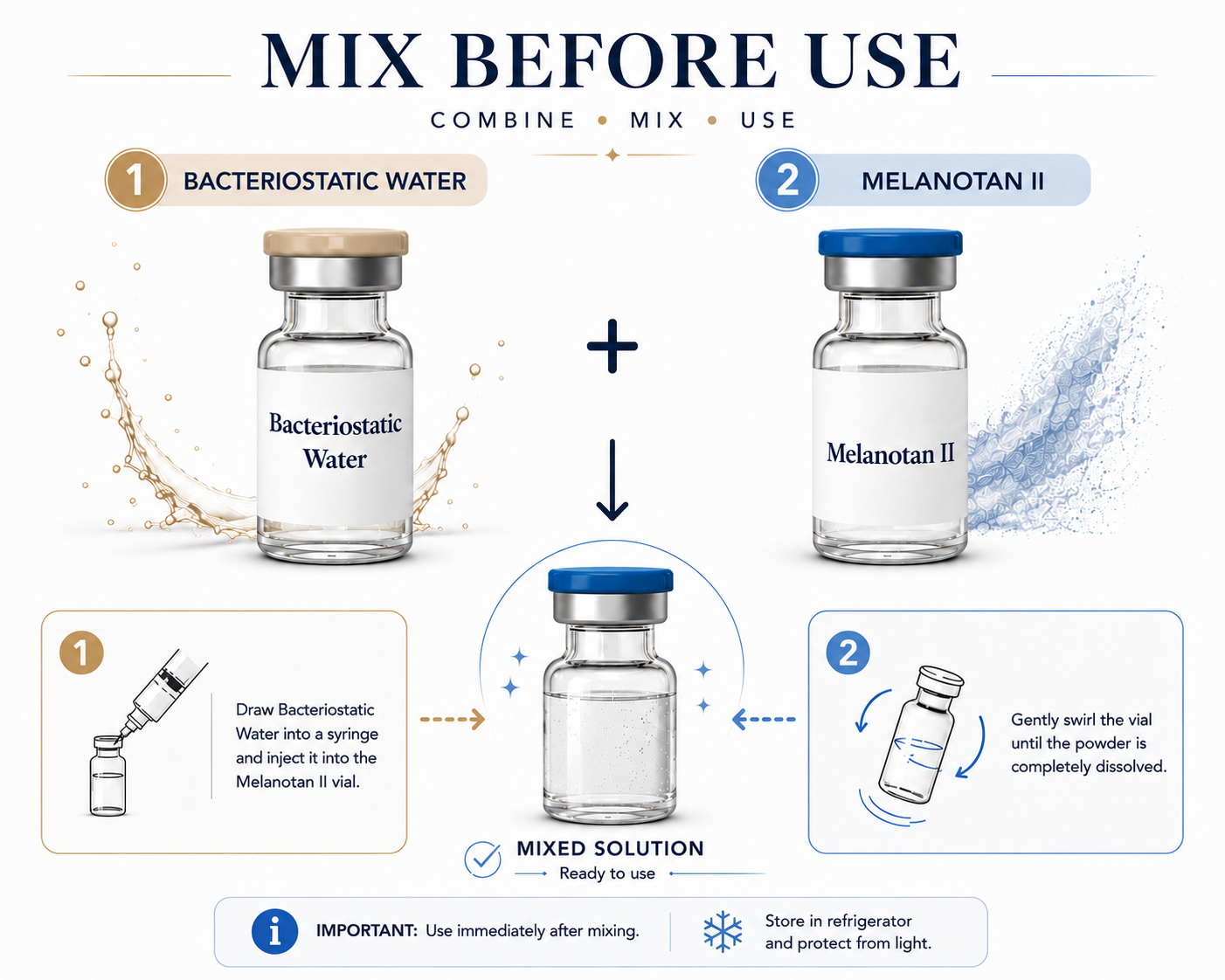
How To Mix Melanotan 2

1
Clean

Use alcohol swabs to clean the tops of both vials.

2
Draw BAC Water

Draw the selected amount of bacteriostatic water.

3
Inject Slowly

Add the liquid slowly down the side of the vial.

4
Swirl Gently

Do not shake. Swirl gently until dissolved.

5
Store Properly

Store as directed and protect from heat and light.

Best Practices & Common Mistakes

Best Practices

  • Use sterile technique.
  • Protect from light and heat.
  • Store refrigerated when appropriate.
  • Use clean syringe-unit math before measuring.

Common Mistakes

  • Confusing milligrams with milliliters.
  • Choosing an option with awkward decimal units.
  • Using too little liquid for very small measurements.
  • Shaking the vial aggressively.

Melanotan 2 Storage & Handling

Lyophilized Powder: −20°C (−4°F) for long-term storage (up to 24 months). Refrigeration 2–8°C (36–46°F) for short-term use (up to ~3 months). Original sealed vial in the freezer is safest.
Reconstituted Solution: 2–8°C (36–46°F), use within ~7–14 days. Keep sealed, avoid light, and do not repeat freeze-thaw cycles.

Frequently Asked Questions

Melanotan 2 (MT-2) is a synthetic, cyclic 7-amino-acid analog of α-MSH, the hormone that signals through melanocortin receptors. Its tanning effect comes from switching on MC1R in the skin, which shifts pigment production toward darker eumelanin — but MT-2 is non-selective and also hits MC3R, MC4R, and MC5R, which is why a single injection can affect appetite, blood pressure, and sexual arousal alongside tanning. It does stimulate pigment somewhat independently of sunlight, though moderate UV during the early "loading" phase deepens and speeds the result — which is also where the skin-cancer concern enters.
It's sold as a lyophilized powder, usually in 10 mg vials, so add bacteriostatic water down the vial wall, swirl gently, and don't shake. As a worked example, a 10 mg vial with about 1.33 mL of bacteriostatic water gives 7.5 mg/mL, so a 500 mcg dose is roughly 0.07 mL — about 7 units on a U-100 insulin syringe. Doses are usually started low, in the low hundreds of micrograms; if such small volumes are hard to measure accurately, using more water gives a lower concentration and an easier-to-draw dose. Keep the reconstituted vial refrigerated and use it within a few weeks.
These three melanocortin peptides get confused constantly but aren't interchangeable. Melanotan 1 (afamelanotide) is a longer, MC1R-selective peptide that's actually FDA-approved as Scenesse — a clinician-inserted implant for the rare disorder EPP — and mostly just affects pigment. PT-141 (bremelanotide) is MC4R-selective, FDA-approved as Vyleesi for low sexual desire in women, and barely tans. Melanotan 2 is the non-selective one that does a bit of everything, and unlike the other two it isn't approved for anything.
The most common effects are nausea and facial flushing, and in men MT-2 can cause spontaneous erections; it also suppresses appetite and can raise blood pressure. The concern that stands out, though, is dermatological: MT-2 darkens existing moles and can trigger new ones, and there are case reports linking its use to mole changes and melanoma diagnoses. Because of that, anyone with a personal or family history of skin cancer is generally advised to avoid it, and having a dermatologist monitor moles is a reasonable precaution for anyone using it.
Melanotan 2 is not approved by the FDA or any other regulator for any use — it's an unapproved investigational compound sold as a research chemical, and its manufacturing quality on the grey market isn't guaranteed. It's specifically banned in Australia and New Zealand, several European countries have acted against vendors selling it as a tanning product, and it's prohibited in competitive sport under WADA. Because this is a genuine health-and-safety question rather than a settled one, it's a decision to make with a clinician rather than from a vendor's website.
Practical takeaway: If your goal involves weight management, metabolic health, recovery, physical performance, cognitive function, appearance, or general well-being, discuss it with a licensed healthcare professional. They can help you evaluate approved, evidence-based options rather than relying on an unapproved or investigational compound. This calculator is intended only for transparent research-reference calculations and does not determine an appropriate amount, recommend use, or replace professional medical guidance.

About the author

Maria Hrabina is a pharmacist and scientific reviewer with a strong interest in peptide science, pharmacology, and emerging therapeutic compounds.

Her work focuses on understanding how peptide-based compounds interact with biological signaling pathways and how they are being investigated across areas such as metabolic health, dermatology, recovery, regenerative research, and pharmaceutical development.

Maria follows research on a broad range of peptides, from compounds used in approved medicines to experimental molecules still being evaluated in laboratory, preclinical, and clinical studies.

Her approach combines scientific curiosity with critical evaluation of evidence. She believes promising mechanisms and early research deserve attention, but should not be presented as established clinical benefits until they are supported by adequate human data.

Her areas of focus include scientific literature review, mechanisms of action, pharmacology, pharmacokinetics, safety, pharmaceutical formulation, and the overall quality of evidence behind peptide-based compounds.

She is particularly interested in the process of translating an experimental molecule into a reliable pharmaceutical product — including compound characterization, purity, stability, formulation, dose selection, safety assessment, and controlled clinical trials.

Maria believes peptide science has significant long-term potential, but that its progress depends on rigorous research, high manufacturing standards, transparent safety data, and responsible scientific communication.

Through her writing, she aims to help readers understand both sides of peptide research: what makes these compounds scientifically promising and what questions remain before their potential can be considered clinically established.

Areas of interest: Peptide Science · Therapeutic Peptides · Peptide Pharmacology · Metabolic Peptides · Cosmetic Peptides · Drug Development · Pharmacokinetics · Drug Safety · Pharmaceutical Formulation · Emerging Therapies · Evidence-Based Medicine

Important: This tool is for informational and research-reference purposes only. Not intended for human or veterinary use.
← All peptides