
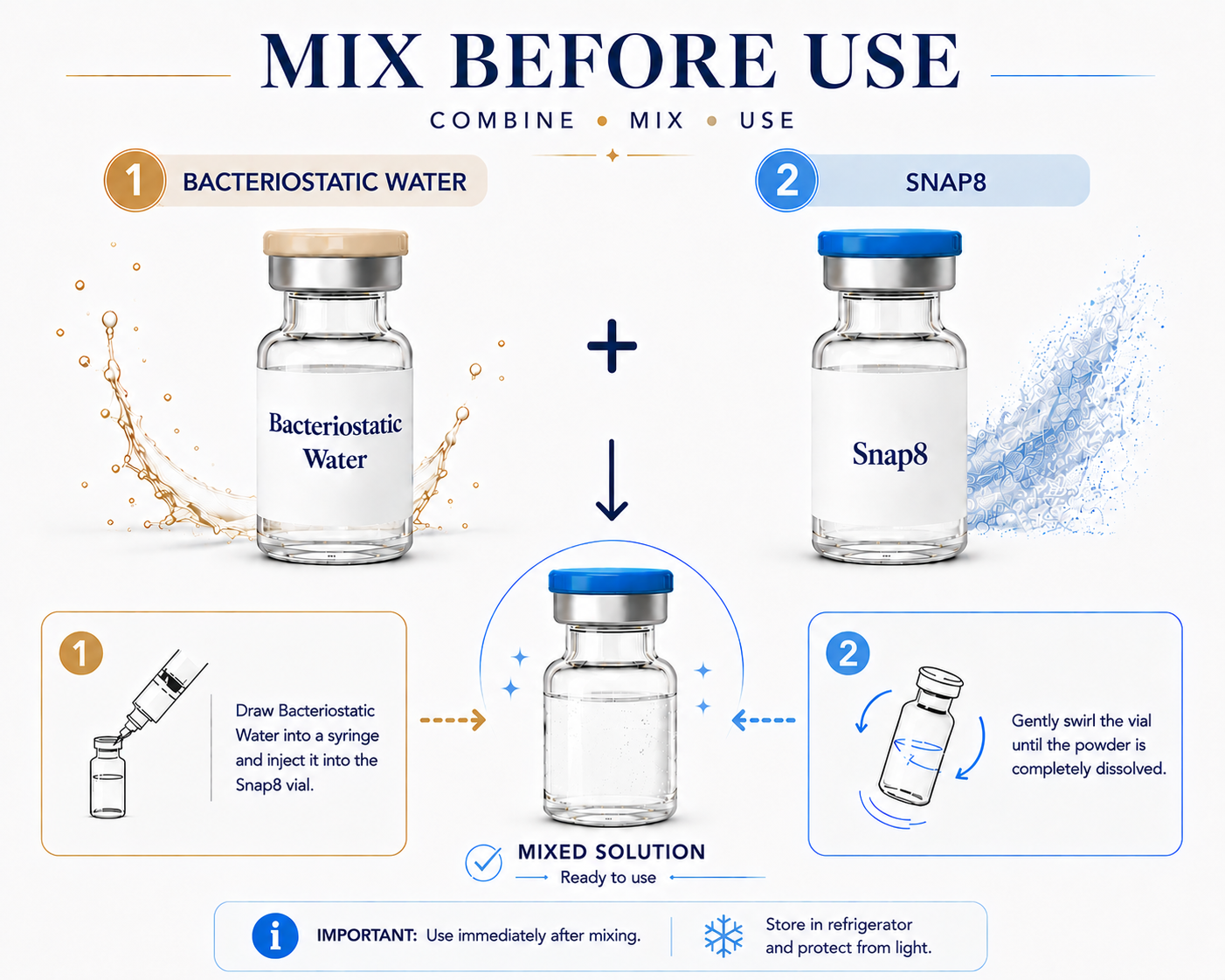
Snap-8 and BAC Water Mix

Snap-8 Reconstitution Calculator

Enter the amount you want to measure. The vial buttons will highlight which vial strengths create cleaner syringe-unit measurements.

What amount do you need?

Type the target amount, then choose mg or mcg. Example: 2mg or 500mcg.

Syringe size:
Possible vial strengths:
Best Match Good Match Usable Harder to Measure

Example Snap-8 Titration Schedule

PhaseWeeksDose (Daily)FrequencyRoute
Initial Phase1–40.33 mg (330 mcg)1× dailySubcutaneous
Mid-Phase5–80.5 mg (500 mcg)1× dailySubcutaneous
Target Phase9–121.0 mg (1000 mcg)1× dailySubcutaneous
Optional Extension13–161.0 mg (1000 mcg)1× dailySubcutaneous
Possible vial strengths:

What Is It?

Snap-8

Acetyl octapeptide studied for cosmetic muscle signaling.

Bacteriostatic Water

Sterile water containing a bacteriostatic preservative, commonly used when preparing multi-use research vials.

How To Mix Snap-8

1
Clean

Use alcohol swabs to clean the tops of both vials.

2
Draw BAC Water

Draw the selected amount of bacteriostatic water.

3
Inject Slowly

Add the liquid slowly down the side of the vial.

4
Swirl Gently

Do not shake. Swirl gently until dissolved.

5
Store Properly

Store as directed and protect from heat and light.

Best Practices & Common Mistakes

Best Practices

  • Use sterile technique.
  • Protect from light and heat.
  • Store refrigerated when appropriate.
  • Use clean syringe-unit math before measuring.

Common Mistakes

  • Confusing milligrams with milliliters.
  • Choosing an option with awkward decimal units.
  • Using too little liquid for very small measurements.
  • Shaking the vial aggressively.

Snap-8 Storage & Handling

Lyophilized Powder: −20°C (−4°F) for long-term storage (up to 24 months). Refrigeration 2–8°C (36–46°F) for short-term use (up to ~3 months). Original sealed vial in the freezer is safest.
Reconstituted Solution: 2–8°C (36–46°F), use within ~7–14 days. Keep sealed, avoid light, and do not repeat freeze-thaw cycles.

Frequently Asked Questions

No — Snap-8 (Acetyl Octapeptide-3) is a topical cosmetic peptide, applied to the skin in a serum or cream, not an injectable one you reconstitute with bacteriostatic water. Despite a lot of "can you inject Snap-8" searches, injection isn't its intended use, and cosmetic-grade peptide isn't formulated or sterilized for that — its whole design is to work at the skin surface. So there's no injection reconstitution here; "mixing" Snap-8 just means dissolving the powder into a topical base.
Snap-8 is a synthetic eight-amino-acid peptide (Acetyl Octapeptide-3), developed as a topical "Botox-alternative" for expression lines. It works by mimicking a fragment of the SNAP-25 protein and competing for a spot in the SNARE complex that nerves use to signal muscles — dialing down the tiny repeated contractions behind crow's feet, forehead lines, and frown lines. It's an extended, roughly 30% more active version of the older peptide Argireline, but because it competes rather than cutting proteins the way real botulinum toxin does, the effect is reversible and much milder.
Because the effect is topical, Snap-8's "dose" is a percentage of your finished product, not an injection volume. The freeze-dried powder is water-soluble, so it's dissolved into a serum base — often water plus a humectant like glycerin, or a hyaluronic acid serum — typically at around 3–10%, with 10% being the concentration used in the wrinkle studies. Add it to the water phase of a formulation rather than to oils, keep the finished serum refrigerated, and use a preservative if you're making a batch to keep for more than a few days.
It's applied to clean skin, usually twice a day, on the areas where expression lines form — the forehead, around the eyes, and between the brows. Two honest caveats set expectations: it only targets dynamic wrinkles from muscle movement, not static lines, deep folds, or volume loss, and results are subtle and gradual over weeks of consistent use rather than the fast, dramatic change of an actual injection. The often-quoted "63% wrinkle reduction" figure comes from manufacturer studies at 10% with twice-daily use, so real-world results vary.
As a topical cosmetic ingredient, Snap-8 has a good safety record — it's generally non-irritating and non-sensitizing, isn't meaningfully absorbed into the body at cosmetic concentrations, and carries no muscle-paralysis risk. The main thing people notice is occasional mild redness or irritation at higher concentrations, so a patch test before regular use is sensible. It layers fine with other topical actives like GHK-Cu or Matrixyl, though as with any DIY skincare, cleanliness and correct preservation matter more than piling on ingredients.
Practical takeaway: If your real goal is weight or metabolic health, the most useful next step is discussing approved treatment options with a clinician rather than relying on an unapproved compound.
Important: This tool is for informational and research-reference purposes only. Not intended for human or veterinary use.
← All peptides