
Lemon Bottle Reconstitution Calculator
Enter the amount you want to measure. The vial buttons will highlight which vial strengths create cleaner syringe-unit measurements.
What amount do you need?
Type the target amount, then choose mg or mcg. Example: 2mg or 500mcg.
Syringe size:
Possible vial strengths:
Best Match
Good Match
Usable
Harder to Measure
Example Lemon Bottle Titration Schedule
Injection Protocols
The dosage and spacing of treatments depend heavily on the target area. A summary of the core protocols found across supplier and clinic guides is provided below:
Parameter Facial Areas (e.g., Chin, Jowls) Body Areas (e.g., Abdomen, Thighs)
Solution per Injection Point 0.2–0.5 mL 1–3 mL
Total per Session 15-20 mL (e.g., for chin) Up to 30 mL per area, 100 mL total
Needle Size 30G–32G 25G–27G
Session Spacing 2–4 weeks 1–2 weeks (7–14 days)
Recommended Sessions 3–5 sessions 2–4 sessions
Injection Technique Microinjections into the subcutaneous layer Fanning or linear threading technique
Onset of Results Typically after 2–3 sessions Visible reduction at 4 weeks, peaking ~12 weeks
The dosage and spacing of treatments depend heavily on the target area. A summary of the core protocols found across supplier and clinic guides is provided below:
Parameter Facial Areas (e.g., Chin, Jowls) Body Areas (e.g., Abdomen, Thighs)
Solution per Injection Point 0.2–0.5 mL 1–3 mL
Total per Session 15-20 mL (e.g., for chin) Up to 30 mL per area, 100 mL total
Needle Size 30G–32G 25G–27G
Session Spacing 2–4 weeks 1–2 weeks (7–14 days)
Recommended Sessions 3–5 sessions 2–4 sessions
Injection Technique Microinjections into the subcutaneous layer Fanning or linear threading technique
Onset of Results Typically after 2–3 sessions Visible reduction at 4 weeks, peaking ~12 weeks
Possible vial strengths:
10ml vial/ampoule; commonly 5 x 10ml pack
What Is It?
Lemon Bottle
Lipolytic cosmetic preparation.
Bacteriostatic Water
Sterile water containing a bacteriostatic preservative, commonly used when preparing multi-use research vials.
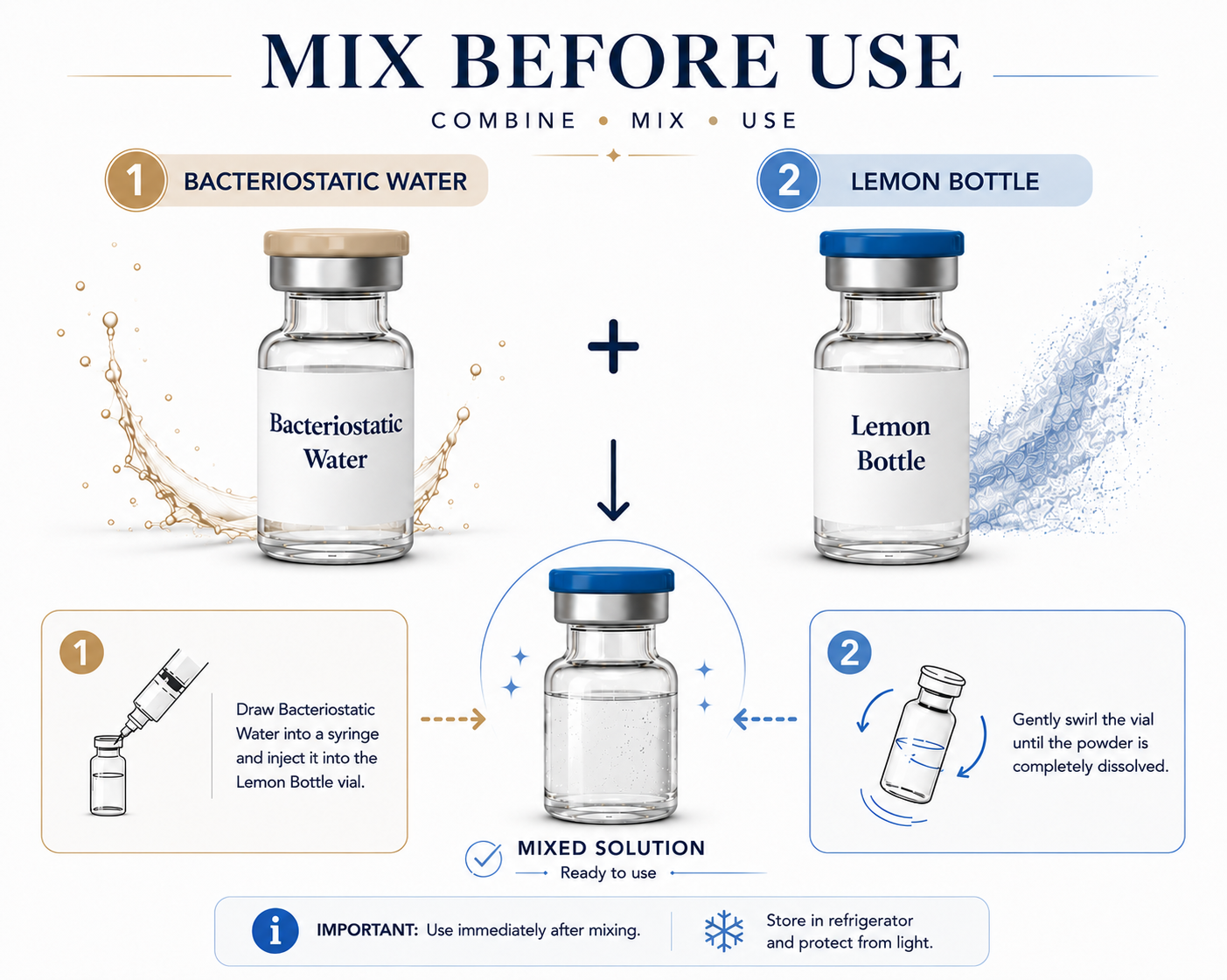
How To Mix Lemon Bottle
1
CleanUse alcohol swabs to clean the tops of both vials.
2
Draw BAC WaterDraw the selected amount of bacteriostatic water.
3
Inject SlowlyAdd the liquid slowly down the side of the vial.
4
Swirl GentlyDo not shake. Swirl gently until dissolved.
5
Store ProperlyStore as directed and protect from heat and light.
Best Practices & Common Mistakes
Best Practices
- Use sterile technique.
- Protect from light and heat.
- Store refrigerated when appropriate.
- Use clean syringe-unit math before measuring.
Common Mistakes
- Confusing milligrams with milliliters.
- Choosing an option with awkward decimal units.
- Using too little liquid for very small measurements.
- Shaking the vial aggressively.
Lemon Bottle Storage & Handling
Lyophilized Powder: −20°C (−4°F) for long-term storage (up to 24 months). Refrigeration 2–8°C (36–46°F) for short-term use (up to ~3 months). Original sealed vial in the freezer is safest.
Reconstituted Solution: 2–8°C (36–46°F), use within ~7–14 days. Keep sealed, avoid light, and do not repeat freeze-thaw cycles.
Frequently Asked Questions
Despite the "peptide" label it's often given online, Lemon Bottle isn't a peptide — it's a South Korean cosmetic injectable marketed for dissolving small pockets of fat, containing riboflavin (vitamin B2), bromelain (a pineapple enzyme), and lecithin. It's sold as a ready-made ampoule, not a research-peptide powder. The "peptide" tag is a marketing and search artifact, not chemistry.
No — there's nothing to reconstitute. Lemon Bottle ships as a pre-mixed liquid in sealed 10 ml ampoules, so there's no lyophilized powder, no bacteriostatic water, and no mg/mL "calculator" step at all; any tool promising reconstitution math for it is describing a product that doesn't exist. That ready-to-use format is part of what worries regulators, since it removes any preparation barrier before someone uses it.
No. Lemon Bottle has no FDA approval, no UK MHRA licence, and no CE mark, and it's treated as an unregulated cosmetic rather than a tested medicine. Switzerland's Swissmedic and the UK's General Pharmaceutical Council have both publicly warned against it, with the GPhC noting these unlicensed products have potentially caused serious harm, and the FDA has issued warning letters to sellers marketing it in the US.
There's no robust, peer-reviewed clinical evidence that Lemon Bottle safely and reliably removes fat; the before-and-after photos circulating on social media are anecdotal and unverified. Because there are no published human trials on injected bromelain, clinicians point out that even a "safe" or "effective" dose is genuinely unknown. Unlike the regulated comparator deoxycholic acid (Kybella), it has never passed the safety and efficacy testing that approval requires.
No — self-injecting at home is where the most serious harm is documented: infections, tissue necrosis, nerve injury, lumps, and lasting scars, sometimes from people copying injection tips traded online. If you want to reduce a small area of fat, the safe route is a consultation with a licensed clinician using a regulated, approved product — not a DIY jab. This page deliberately gives no injection amounts, sites, or technique, because doing it yourself is the specific thing regulators are warning against.
Practical takeaway: If your real goal is weight or metabolic health, the most useful next step is discussing approved treatment options with a clinician rather than relying on an unapproved compound.
Important: This tool is for informational and research-reference purposes only. Not intended for human or veterinary use.