Klow (Acetyl peptide blend) Reconstitution Calculator
Enter the amount you want to measure. The vial buttons will highlight which vial strengths create cleaner syringe-unit measurements.
What amount do you need?
Type the target amount, then choose mg or mcg. Example: 2mg or 500mcg.
Syringe size:
Possible vial strengths:
Best Match
Good Match
Usable
Harder to Measure
Example Klow (Acetyl peptide blend) Titration Schedule
| Protocol Option | Total Daily Dose (Blend) | Volume @ 3.0 mL (≈26.7 mg/mL) | Volume @ 4.0 mL (20 mg/mL) |
|---|---|---|---|
| Conservative start | 200–250 mcg (0.20–0.25 mg) | ~0.0075–0.0094 mL (0.75–0.94U) | 0.010–0.0125 mL (1.0–1.25U) |
| Standard range | 2.5–4.0 mg | ~0.094–0.150 mL (9.4–15U) | 0.125–0.200 mL (12.5–20U) |
| Optional loading phase* | 8.0 mg daily | ~0.300 mL (30U) | 0.400 mL (40U) |
Possible vial strengths:
What Is It?
Klow (Acetyl peptide blend)
Cosmetic peptide blend.
Bacteriostatic Water
Sterile water containing a bacteriostatic preservative, commonly used when preparing multi-use research vials.
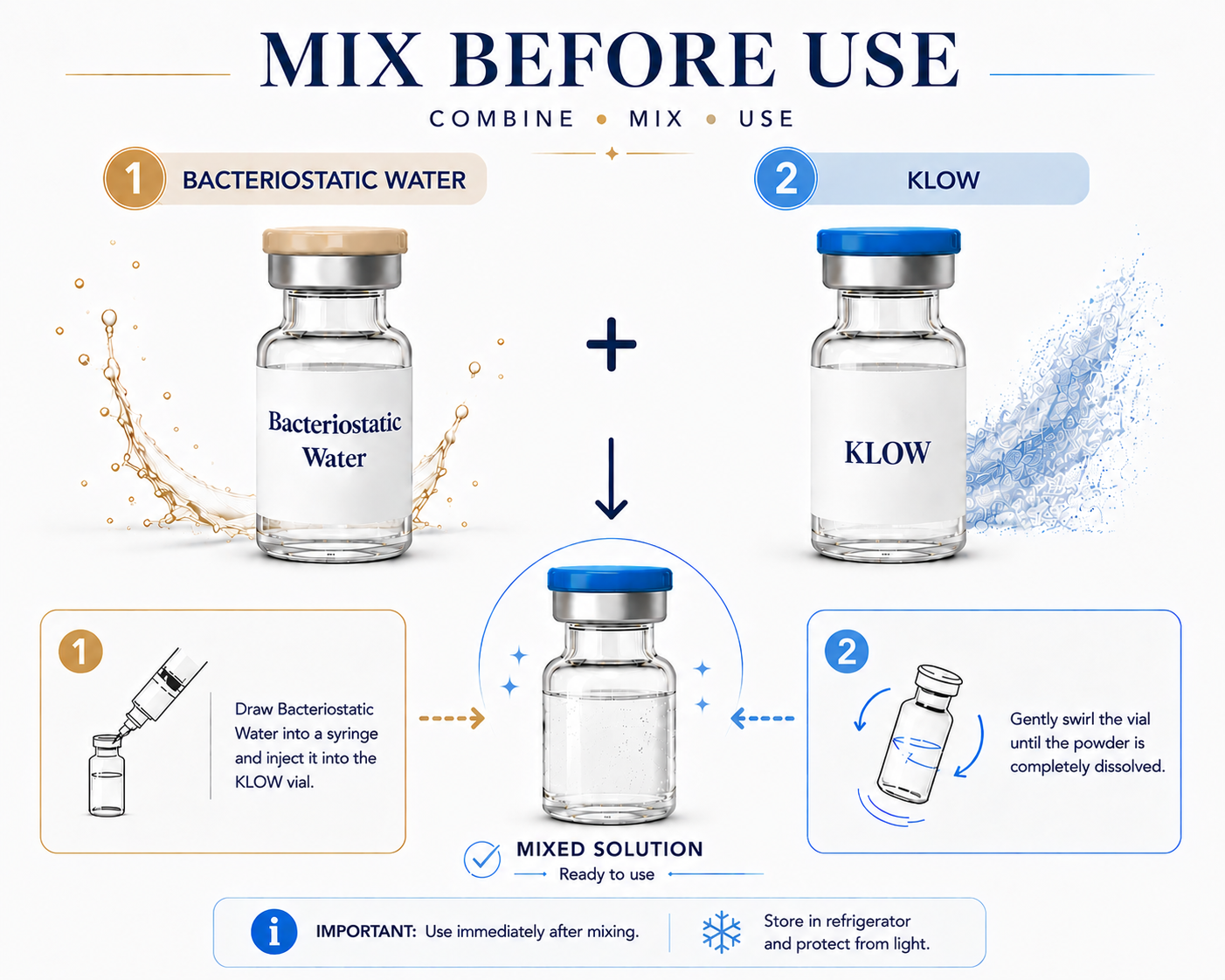
How To Mix Klow (Acetyl peptide blend)
1
CleanUse alcohol swabs to clean the tops of both vials.
2
Draw BAC WaterDraw the selected amount of bacteriostatic water.
3
Inject SlowlyAdd the liquid slowly down the side of the vial.
4
Swirl GentlyDo not shake. Swirl gently until dissolved.
5
Store ProperlyStore as directed and protect from heat and light.
Best Practices & Common Mistakes
Best Practices
- Use sterile technique.
- Protect from light and heat.
- Store refrigerated when appropriate.
- Use clean syringe-unit math before measuring.
Common Mistakes
- Confusing milligrams with milliliters.
- Choosing an option with awkward decimal units.
- Using too little liquid for very small measurements.
- Shaking the vial aggressively.
Klow (Acetyl peptide blend) Storage & Handling
Lyophilized Powder: −20°C (−4°F) for long-term storage (up to 24 months). Refrigeration 2–8°C (36–46°F) for short-term use (up to ~3 months). Original sealed vial in the freezer is safest.
Reconstituted Solution: 2–8°C (36–46°F), use within ~7–14 days. Keep sealed, avoid light, and do not repeat freeze-thaw cycles.
Frequently Asked Questions
KLOW is a four-peptide research blend sold in an 80 mg vial, combining GHK-Cu (50 mg), BPC-157 (10 mg), TB-500 (10 mg), and KPV (10 mg) in a fixed 50:10:10:10 ratio. Each targets a different pathway: GHK-Cu is a copper peptide tied to collagen and skin remodeling, BPC-157 and TB-500 are the tissue-repair backbone studied in tendon, gut, and cell-migration models, and KPV is a small anti-inflammatory fragment of α-MSH. Because there are no trials on the combination itself, everything attributed to it is extrapolated from research on the four components individually.
Add bacteriostatic water slowly down the inside wall of the vial and swirl gently until dissolved — don't spray it directly onto the powder or shake it. As an example, 4 mL of BAC water into the 80 mg vial gives 20 mg/mL of total blend, so a 0.15 mL draw (15 units on a U-100 syringe) delivers about 3 mg of combined peptides. Don't be alarmed if the solution turns blue — that's the copper in GHK-Cu, not contamination. Keep the reconstituted vial refrigerated and use it within roughly 28 days.
The two blends share the same three-peptide core — GHK-Cu, BPC-157, and TB-500 — so the entire difference is one component: KLOW adds KPV, and GLOW doesn't. That makes GLOW a 70 mg, three-peptide blend leaned toward skin and structural repair, while KLOW is the 80 mg, four-peptide version with an added anti-inflammatory angle from KPV, which blocks the NF-κB inflammatory switch. In short, KLOW is essentially GLOW plus KPV, and the choice comes down to whether an inflammatory component matters for what's being studied.
Because all four are pre-mixed in one vial at a fixed ratio, every draw delivers them in the same 50:10:10:10 proportion — you can dial the total volume up or down, but not one peptide independently of the others. That's the tradeoff of any blend: convenient, but you're locked into the ratio. The practical catch is that GHK-Cu makes up most of the mass, so pushing the volume higher to chase more BPC-157 or TB-500 also raises your copper exposure. For dosing each peptide on its own terms, the individual GHK-Cu, BPC-157, TB-500, and KPV pages are the better reference.
None of the four peptides is FDA-approved, and the blend itself has never been through clinical trials, so its safety picture is pieced together from the individual components rather than the mix. Commonly reported effects are mild and local — injection-site redness that fades quickly, and some first-week drowsiness people attribute to GHK-Cu — while the main longer-term watch-item is copper accumulation from the GHK-Cu with extended use. Two frequent misconceptions worth clearing up: KLOW is a recovery-and-repair blend, not a weight-loss product, and the KPV in it doesn't cause tanning despite coming from the same parent hormone as Melanotan.
Practical takeaway: If your real goal is weight or metabolic health, the most useful next step is discussing approved treatment options with a clinician rather than relying on an unapproved compound.
Important: This tool is for informational and research-reference purposes only. Not intended for human or veterinary use.