
Klow8 Reconstitution Calculator
Enter the amount you want to measure. The vial buttons will highlight which vial strengths create cleaner syringe-unit measurements.
What amount do you need?
Type the target amount, then choose mg or mcg. Example: 2mg or 500mcg.
Syringe size:
Possible vial strengths:
Best Match
Good Match
Usable
Harder to Measure
Example Klow8 Titration Schedule
| Protocol Option | Total Daily Dose (Blend) | Volume @ 3.0 mL (≈26.7 mg/mL) | Volume @ 4.0 mL (20 mg/mL) |
|---|---|---|---|
| Conservative start | 200–250 mcg (0.20–0.25 mg) | ~0.0075–0.0094 mL (0.75–0.94U) | 0.010–0.0125 mL (1.0–1.25U) |
| Standard range | 2.5–4.0 mg | ~0.094–0.150 mL (9.4–15U) | 0.125–0.200 mL (12.5–20U) |
| Optional loading phase* | 8.0 mg daily | ~0.300 mL (30U) | 0.400 mL (40U) |
Possible vial strengths:
What Is It?
Klow8
Variant of klow cosmetic blend.
Bacteriostatic Water
Sterile water containing a bacteriostatic preservative, commonly used when preparing multi-use research vials.
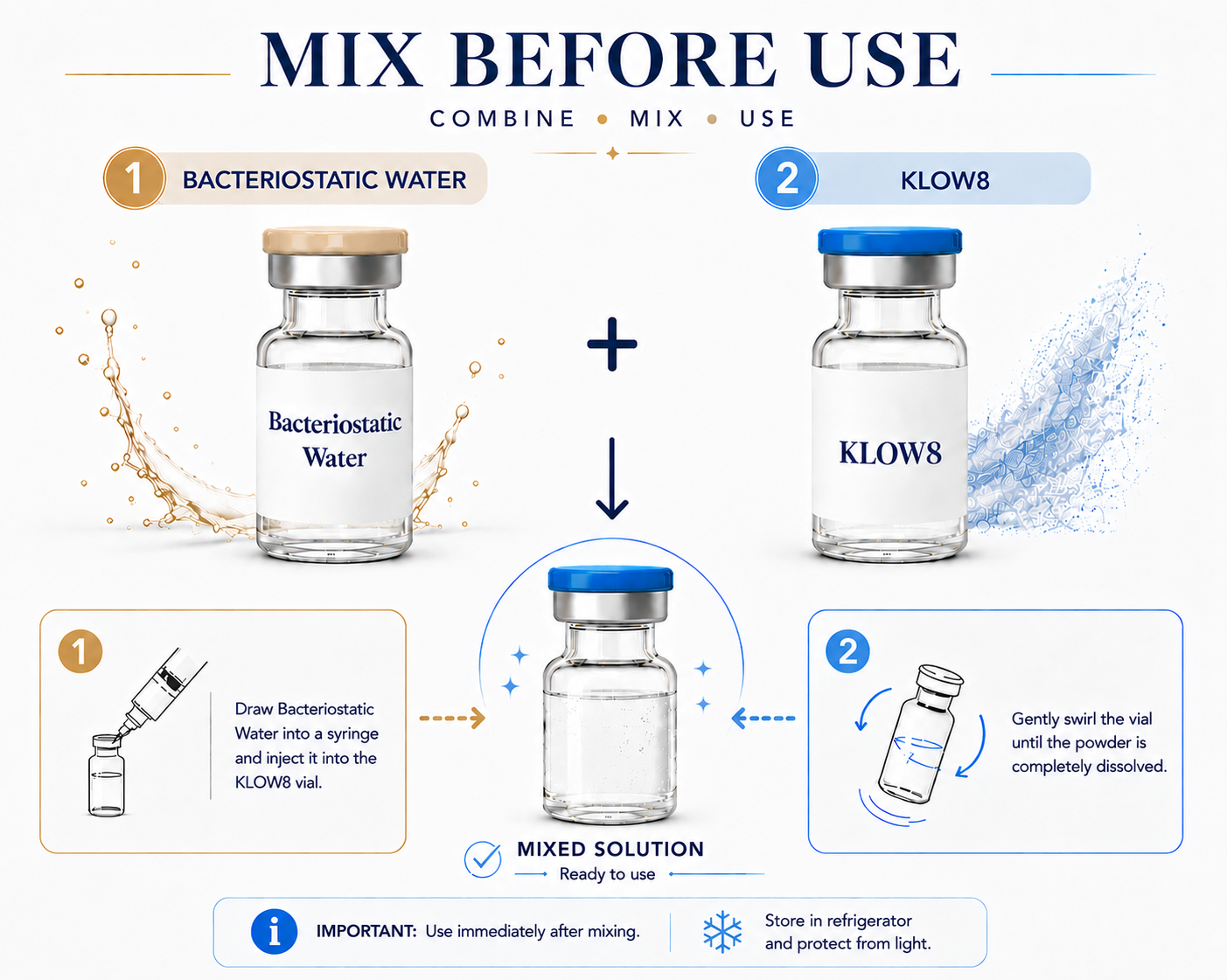
How To Mix Klow8
1
CleanUse alcohol swabs to clean the tops of both vials.
2
Draw BAC WaterDraw the selected amount of bacteriostatic water.
3
Inject SlowlyAdd the liquid slowly down the side of the vial.
4
Swirl GentlyDo not shake. Swirl gently until dissolved.
5
Store ProperlyStore as directed and protect from heat and light.
Best Practices & Common Mistakes
Best Practices
- Use sterile technique.
- Protect from light and heat.
- Store refrigerated when appropriate.
- Use clean syringe-unit math before measuring.
Common Mistakes
- Confusing milligrams with milliliters.
- Choosing an option with awkward decimal units.
- Using too little liquid for very small measurements.
- Shaking the vial aggressively.
Klow8 Storage & Handling
Lyophilized Powder: −20°C (−4°F) for long-term storage (up to 24 months). Refrigeration 2–8°C (36–46°F) for short-term use (up to ~3 months). Original sealed vial in the freezer is safest.
Reconstituted Solution: 2–8°C (36–46°F), use within ~7–14 days. Keep sealed, avoid light, and do not repeat freeze-thaw cycles.
Frequently Asked Questions
Like the individual peptides in it, KLOW is typically given as a small subcutaneous injection into fatty tissue — the lower abdomen a couple of inches from the navel, or the side of the thigh or the love-handle area, rotating sites to avoid irritation. A short insulin needle goes into a pinched fold of skin at roughly a 45–90° angle. Some people notice a brief sting or mild redness that usually settles within an hour, and the GHK-Cu content is the part most often blamed for any stinging. None of this makes it a casual procedure to attempt without proper guidance and sterile technique.
There's no single "correct" volume — the amount of water you add simply sets how concentrated each draw is, which is exactly what a reconstitution calculator works out for you. For example, 2 mL of BAC water into the 80 mg vial gives 40 mg/mL of total blend, so a 0.1 mL draw (10 units on a U-100 syringe) delivers 4 mg of the combined peptides. Add more water and the same volume delivers less; add less and it delivers more. Most people pick a volume that makes their intended dose land on an easy-to-read mark on the syringe.
Because it's four peptides working on different timelines, changes tend to arrive in waves rather than all at once. The BPC-157 and TB-500 repair effects — recovery from nagging injuries, tissue and gut comfort — are usually what people report first, often within the early weeks, while the GHK-Cu skin and collagen changes are slower and typically come up around the one-to-two-month mark or later. If several weeks pass with nothing at all, degraded product is a common culprit, since GHK-Cu especially is sensitive to heat and light. Individual responses vary widely, and none of these effects are guaranteed.
Community protocols usually describe running KLOW in blocks of roughly four to eight weeks, followed by a break of a few weeks before considering another round, rather than taking it continuously. The main reason for building in an off-period is the GHK-Cu: since it's more than half the blend by mass, using it non-stop for long stretches is where copper accumulation becomes a realistic concern. A common pattern is a more frequent "loading" phase early on, tapering to fewer injections per week for maintenance. None of this is a validated medical schedule — it's what users report, and it's worth discussing with a clinician first.
It comes down to overlap. Something on a completely different pathway, like NAD+, doesn't duplicate any of KLOW's four peptides, so people combine them without the same redundancy concern — though there's no formal data on the pairing. The combination to avoid is running KLOW alongside GLOW or separate GHK-Cu, BPC-157, or TB-500 injections, because you'd then be dosing those shared peptides twice and, with GHK-Cu, adding to your copper load. As a general rule, stacking onto a distinct mechanism is lower-risk than piling more of the same peptides on top of a blend that already contains them.
Practical takeaway: If your real goal is weight or metabolic health, the most useful next step is discussing approved treatment options with a clinician rather than relying on an unapproved compound.
Important: This tool is for informational and research-reference purposes only. Not intended for human or veterinary use.