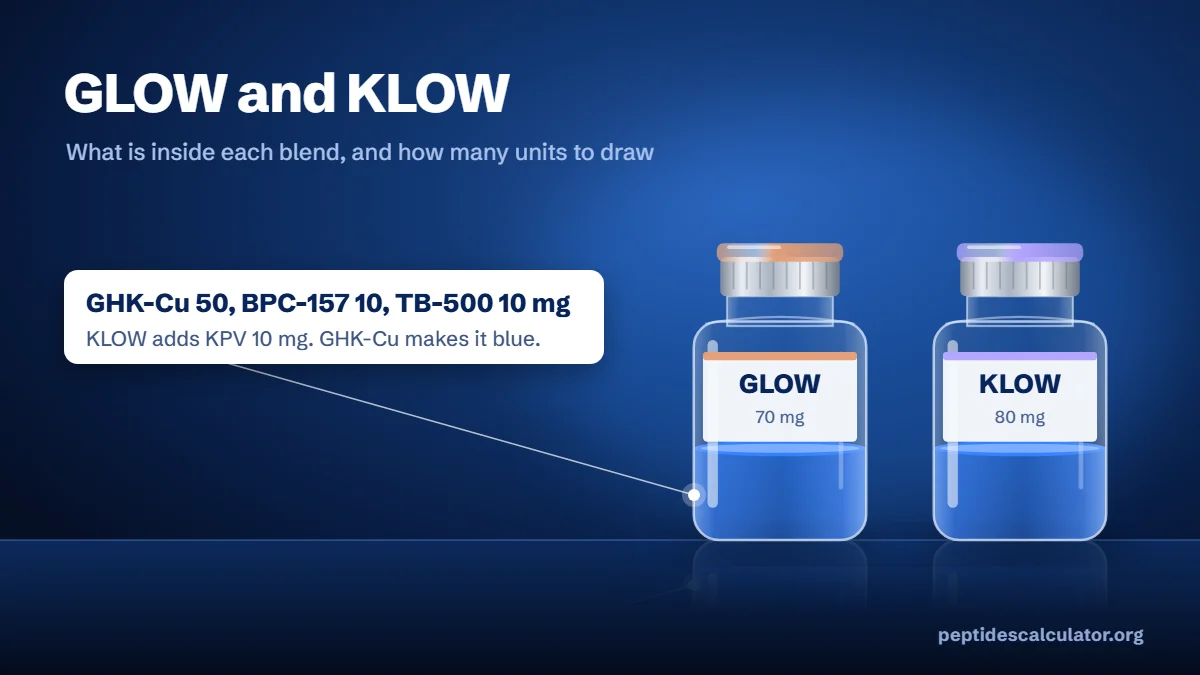
GLOW and KLOW are not single peptides. They are blends sold in one vial: GLOW combines GHK-Cu, BPC-157 and TB-500, and KLOW is the same blend plus KPV. The names are marketing labels, not standard formulations, so the amounts can differ between sellers; the most common labels are below. This page answers three practical questions: what is in the vial, how much of each peptide is in a given number of units, and what is actually known about the blend.
Open the KLOW calculator → Enter your vial and water volume to see each peptide per unit.
What is in GLOW and KLOW
| Peptide | GLOW (70 mg) | KLOW (80 mg) |
|---|---|---|
| GHK-Cu | 50 mg | 50 mg |
| BPC-157 | 10 mg | 10 mg |
| TB-500 | 10 mg | 10 mg |
| KPV | — | 10 mg |
| Total | 70 mg | 80 mg |
GHK-Cu makes up about 70% of GLOW and about 60% of KLOW by weight. Always check the label of your own vial: if the numbers differ, the method below still works with your figures.
GLOW vs KLOW: the difference
- GLOW = GHK-Cu (copper peptide, studied mainly in skin creams) + BPC-157 + TB-500 (both sold for tissue repair).
- KLOW = GLOW + KPV, a three-amino-acid fragment of α-MSH studied for inflammation in cell and animal models.
- "KLOW8" usually means the 80 mg KLOW vial.
How much of each peptide is in 10 units
Each peptide has its own concentration: its mg divided by the mL of water. On a U-100 syringe, 10 units = 0.1 mL. For a KLOW vial (GLOW is the same without the KPV column):
| Water added | GHK-Cu | BPC-157 | TB-500 | KPV |
|---|---|---|---|---|
| 2 mL | 2.5 mg | 500 mcg | 500 mcg | 500 mcg |
| 3 mL | 1.67 mg | 333 mcg | 333 mcg | 333 mcg |
| 4 mL | 1.25 mg | 250 mcg | 250 mcg | 250 mcg |
Double the numbers for 20 units, halve them for 5. A 70–80 mg vial in only 1–2 mL is a very concentrated solution; most people use 3 mL or more so that small draws are easier to read.
How many units? Sizing a draw by GHK-Cu
Because every unit contains all the peptides in the label ratio, you can only aim for one of them. GHK-Cu is the largest component, so draws are usually sized by it. A published clinic protocol for GHK-Cu injections uses 1–2 mg once daily, 5–7 days a week, for 4–8 weeks (C. Cisneros, FNP-BC). In a GLOW or KLOW vial mixed with 3 mL:
| GHK-Cu wanted | U-100 units (3 mL) | BPC-157, TB-500 and KPV each | Copper in that draw |
|---|---|---|---|
| 1 mg | 6 | 200 mcg | 158 mcg |
| 1.5 mg | 9 | 300 mcg | 237 mcg |
| 2 mg | 12 | 400 mcg | 316 mcg |
At these draws BPC-157 (200–400 mcg) and KPV land near the 250–500 mcg that clinics publish for those peptides on their own, but TB-500 stays far below the 2–2.5 mg twice-weekly loading protocol published for TB-500 alone. Our peptide dosing chart lists the study doses and clinic protocols for each peptide with sources. These are clinic protocols, not doses tested in trials.
The copper in GLOW and KLOW
About 16% of GHK-Cu's weight is copper, so a 50 mg GHK-Cu vial holds roughly 8 mg of copper and a 2 mg draw about 0.3 mg. For scale, the adult dietary allowance is 0.9 mg of copper a day and the upper limit for intake from food and supplements is 10 mg a day. Those limits are for copper you swallow; injected copper skips the gut, so they are only a rough yardstick.
What is known about the blend
- No study in humans or animals has tested GHK-Cu, BPC-157 and TB-500 together, or with KPV.
- GHK-Cu human data come from topical creams and serums for skin; there is no published human study of injected GHK-Cu.
- BPC-157 and TB-500 have very limited human data; in July 2026 an FDA advisory committee voted to recommend allowing BPC-157, TB-500 and KPV in US pharmacy compounding, a non-binding vote; since October 30, 2026 an interim HHS policy allows prescription compounding of each as a single-peptide product, which excludes ready-made blends like GLOW and KLOW (details).
- None of the four is an approved medicine. "Before and after" results online are anecdotes, not trial outcomes.
For the two-peptide version see our BPC-157 + TB-500 blend guide.
Common mistakes with GLOW and KLOW
- Dividing the total 70 or 80 mg by the water and treating it as one concentration.
- Assuming every seller uses the same amounts; read your label.
- Using 1–2 mL of water, which makes 1 mg of GHK-Cu only 2–4 units.
Sources
- Superpower, reviewed by W. Maish, MD. GLOW peptide blend: GHK-Cu, BPC-157 and TB-500, and how KLOW differs (no study of the blend; composition varies by seller), 2026.
- NIH Office of Dietary Supplements. Copper fact sheet for health professionals (RDA 900 mcg/day, UL 10 mg/day).
- Pickart L, Margolina A. Regenerative and protective actions of the GHK-Cu peptide. Int J Mol Sci 2018.
- American Med Spa Association. FDA advisory committee recommends adding six of seven peptides to compounding list, July 2026.