
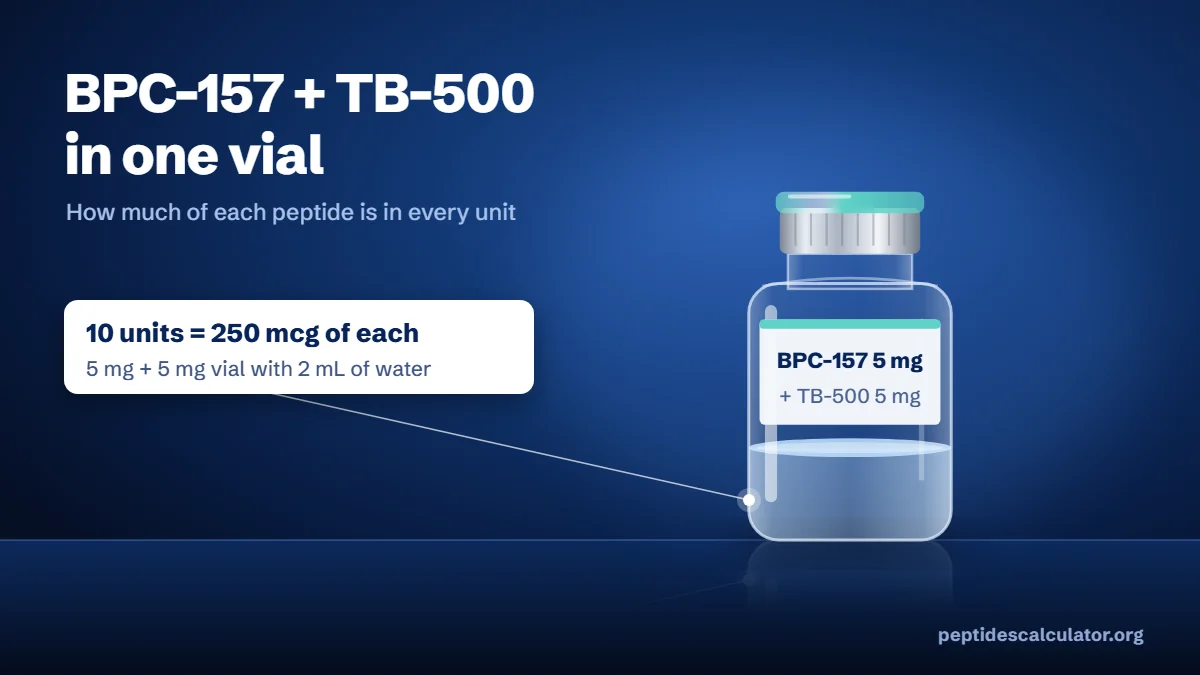
A BPC-157 + TB-500 blend, often sold as a "Wolverine stack", is one vial that holds both peptides as powder, for example "BPC-157 5 mg / TB-500 5 mg". Once you add water, every unit you draw contains both peptides in the same ratio as the label. This page shows how to work out how much of each peptide is in any number of units.
Open the Peptide Calculator → Switch it to Blend mode, enter both amounts and your water volume, and it shows each peptide per unit.
How blend math works
Treat each peptide as if it were alone in the vial. Each one has its own concentration:
- BPC-157 concentration = BPC-157 mg ÷ mL of water
- TB-500 concentration = TB-500 mg ÷ mL of water
- Amount in your draw = units ÷ 100 × concentration (on a U-100 syringe)
Example: 5 mg + 5 mg with 2 mL of water gives 2.5 mg/mL of each. 10 units (0.1 mL) holds 250 mcg of BPC-157 and 250 mcg of TB-500. The total "10 mg" on the vial is not a concentration you can use; always split it by peptide.
Blend chart: what 10 units contains
Each cell shows how much of each peptide is in 10 units on a U-100 syringe. Double it for 20 units, halve it for 5.
| Blend vial (BPC-157 + TB-500) | 1 mL | 2 mL | 3 mL |
|---|---|---|---|
| 5 mg + 5 mg | BPC 500 mcg TB 500 mcg | BPC 250 mcg TB 250 mcg | BPC 167 mcg TB 167 mcg |
| 10 mg + 10 mg | BPC 1000 mcg TB 1000 mcg | BPC 500 mcg TB 500 mcg | BPC 333 mcg TB 333 mcg |
| 10 mg + 5 mg | BPC 1000 mcg TB 500 mcg | BPC 500 mcg TB 250 mcg | BPC 333 mcg TB 167 mcg |
Units for a target amount of BPC-157
Because both peptides come out together, you can only aim for one of them; the other follows the vial ratio. With 2 mL of water:
| Vial (2 mL water) | BPC-157 wanted | U-100 units | TB-500 that comes with it |
|---|---|---|---|
| 5 mg + 5 mg | 250 mcg | 10 | 250 mcg |
| 5 mg + 5 mg | 500 mcg | 20 | 500 mcg |
| 10 mg + 10 mg | 250 mcg | 5 | 250 mcg |
| 10 mg + 10 mg | 500 mcg | 10 | 500 mcg |
| 10 mg + 5 mg | 250 mcg | 5 | 125 mcg |
| 10 mg + 5 mg | 500 mcg | 10 | 250 mcg |
If you need a different ratio, a blend vial cannot give it. Separate vials of BPC-157 and TB-500 let you measure each one on its own.
How many units? Published protocols in a 5 mg + 5 mg vial
Most people with a blend vial want to know how many units to draw. No trial has set a dose for this combination, but clinics publish the protocols they use for each peptide separately. Here is what those protocols come to in a 5 mg + 5 mg vial mixed with 2 mL of water (2.5 mg/mL of each):
| Published protocol | Amount | Units of the blend | What else is in that draw |
|---|---|---|---|
| BPC-157, once or twice daily (Dr. A. Chandawarkar, MD) | 250–500 mcg | 10–20 | 250–500 mcg of TB-500, every time |
| TB-500 loading, twice weekly for 4–6 weeks (Dr. J. Douwes, MD) | 2–2.5 mg | 80–100 | 2–2.5 mg of BPC-157 in one shot |
The catch: the two protocols do not fit the same vial. Drawing 10–20 units daily for BPC-157 gives 1.75–3.5 mg of TB-500 a week, below the 4–5 mg a week of the TB-500 loading protocol. Drawing 80–100 units twice a week for TB-500 gives 2–2.5 mg of BPC-157 per shot, several times the BPC-157 protocol. If you want to follow both protocols as published, separate vials are the only way. These are clinic protocols, not doses tested in trials.
Mixing a blend vial
- Read the label: note the mg of each peptide, not just the total.
- Add bacteriostatic water slowly down the side of the vial and swirl; do not shake.
- Write the per-peptide concentration on the vial, for example "BPC 2.5 / TB 2.5 mg/mL".
- Keep the mixed vial at 2–8 °C, away from light.
What is known about these two peptides
Neither BPC-157 nor TB-500 is an approved medicine, and the combination has never been tested in a human trial. Human data for BPC-157 are limited to a few small reports, and the human data on thymosin β4 come from pharmaceutical forms (IV and eye drops), not the TB-500 fragment sold online. In July 2026 an FDA advisory committee voted 8–6 to recommend allowing both in US pharmacy compounding; the votes were non-binding. Since October 30, 2026 an interim HHS policy lets licensed pharmacies compound each of them on prescription, but only as a single-peptide product, so ready-made blends are not covered (details). Study doses and published clinic protocols for each peptide, with sources, are in our peptide dosing chart.
Common blend mistakes
- Dividing the total mg (for example 10 mg) by the water instead of each peptide's own mg.
- Assuming the label ratio is 1:1; some vials are 10 mg + 5 mg.
- Using too little water, so that a small amount of BPC-157 is under 3 units and hard to read. For other conversions see the units to mg converter.
Sources
- American Med Spa Association. FDA advisory committee recommends adding six of seven peptides to compounding list (July 2026 votes).
- Vasireddi N, et al. Emerging use of BPC-157 in orthopaedic sports medicine: a systematic review. HSS J 2025.
- Thymosin β4 (RGN-259) phase 3 trial. Int J Mol Sci 2023.