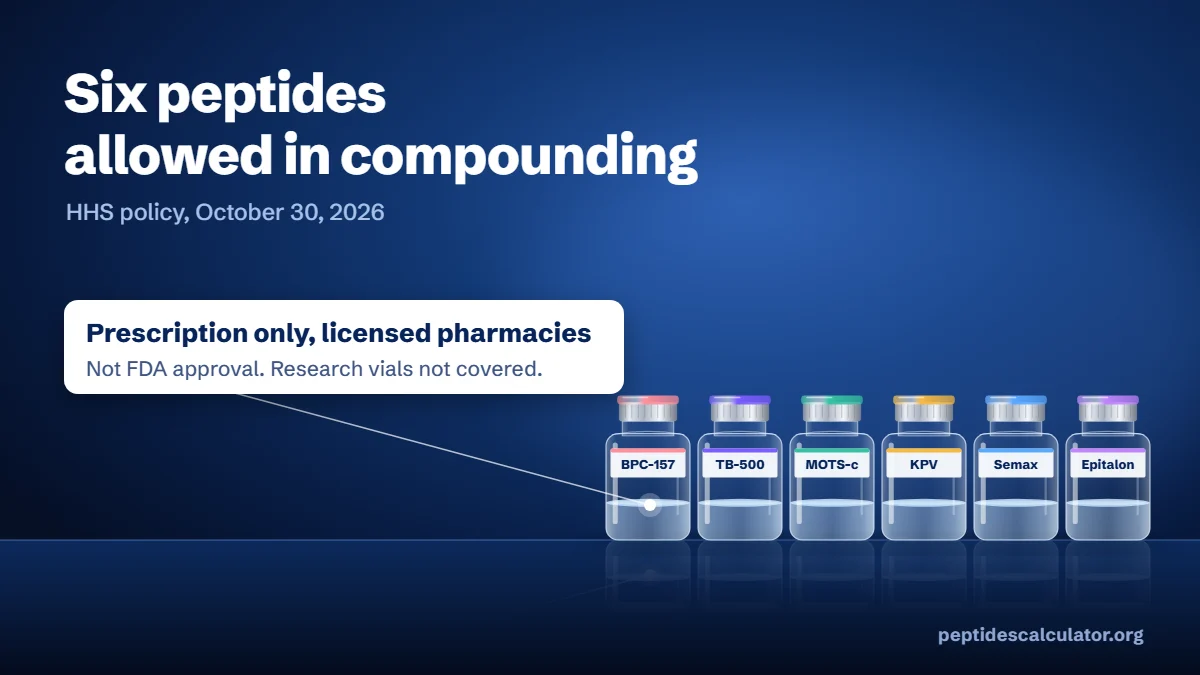
On October 30, 2026, the US Department of Health and Human Services (HHS) said it will not take enforcement action against licensed pharmacies, federal facilities or licensed physicians that compound six peptides for individual patients with a prescription: BPC-157, TB-500, MOTS-c, KPV, Semax and Epitalon. It is a temporary policy, not an FDA approval, and it comes with strict conditions.
Update, November 12: doctors push back
On November 9, 2026, the American Medical Association adopted a policy urging HHS and the FDA to “immediately rescind” any move that makes it easier to compound unapproved peptides, and promised to push state boards toward enforcement against compounding pharmacies and telehealth sellers. The AMA did not name the HHS policy, and its vote has no legal force: the policy described below is still in place. Public comments on it (docket HHS-OASH-2026-0496) close on November 13, 2026.
Which peptides, and in what forms
The policy covers each peptide only in specific chemical forms and routes:
| Peptide | Forms covered |
|---|---|
| BPC-157 | injection under the skin or into muscle, by mouth, on the skin |
| TB-500 | injection under the skin or into muscle |
| MOTS-c | injection under the skin or into muscle |
| KPV | by mouth, on the skin |
| Semax | nasal spray or drops |
| Epitalon | injection, in intermittent courses |
A seventh peptide reviewed in July, emideltide (better known as DSIP), was rejected by the FDA advisory committee and is not included.
What a pharmacy has to do
- Compound for a named patient, on a prescription, with only one of the six peptides per product.
- Buy the raw peptide from an FDA-registered manufacturer, with a certificate of analysis that names the original maker.
- For oral forms, have documentation that the formulation is actually absorbed by mouth.
- Label it “This is a compounded drug product. Not for resale.” and package it only with an FDA-cleared syringe.
- Report serious side effects and quality problems to the FDA (MedWatch) and state regulators.
What has not changed
- None of the six is FDA-approved, and the FDA has not reviewed their safety or effectiveness. The evidence for healing claims (BPC-157, TB-500) is still mostly from animals.
- The FDA's own drug center disagreed. Its experts had recommended against compounding all six, citing poorly defined chemistry, missing safety data and contamination risk. HHS went ahead after its advisory committee voted in favour in July.
- “Research use only” vials sold online are not covered. The policy is about prescription compounding by licensed pharmacies, not about other sellers. Larger outsourcing facilities (503B) are not covered either.
- It can change. HHS can withdraw it if safety or quality problems appear, state rules may be stricter, and the FDA still has to write a formal rule on whether to add these peptides to the official compounding list. No end date was given.
What it means if you use one of these peptides
A legal route now exists: a prescription from a clinician, filled by a state-licensed compounding pharmacy. You can ask the pharmacy for the certificate of analysis, which research sellers rarely provide in a verifiable form. Doses, however, are no better established than before.
For the math, note that a compounded product may arrive as a ready-made solution with the strength printed on the label in mg/mL. In that case there is nothing to mix: use the label concentration directly in our calculator or our units-to-mg guide. If it comes as powder, see our BAC water guide.
How to comment
HHS is taking public comments until November 13, 2026, in docket HHS-OASH-2026-0496 on Regulations.gov.
Sources
- Federal Register. Enforcement discretion policy regarding 503A compounding using certain peptide bulk drug substances (October 30, 2026).
- Venable LLP. HHS announces interim enforcement discretion for section 503A compounding with certain peptide bulk drug substances (November 6, 2026; peptides, routes and conditions).
- BioXconomy. HHS greenlights sale of six unapproved peptides despite FDA guidance (November 4, 2026).
- NCPA. FDA grants enforcement discretion for compounding six peptides (October 29, 2026).
- Becker’s Hospital Review. New AMA policy targets unapproved peptide compounding (November 10, 2026).