
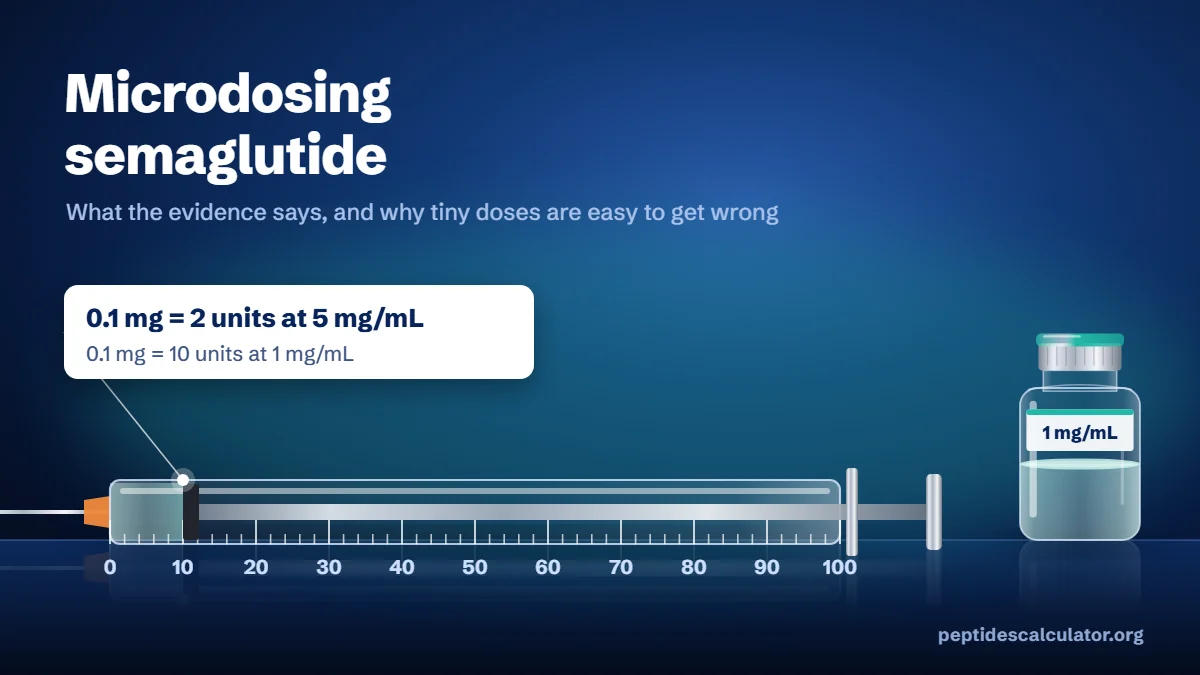
“Microdosing” semaglutide means taking much less than the label doses, usually 0.05–0.25 mg a week instead of working up to 1.7–2.4 mg, hoping for appetite control with fewer side effects. It is a social-media term, not a medical one, and no trial has tested it as people practise it. The closest real data come from a 2018 dose-finding trial, where even the smallest dose produced about 6% weight loss in a year. Below: what that evidence says, a units chart for small amounts, and why tiny doses are surprisingly easy to get wrong.
Open the semaglutide calculator → Enter your vial and amount to get exact units.
What “microdosing” actually means
There is no agreed definition. Some telehealth companies call it a quarter of a standard dose; others mean staying on the 0.25 mg starting dose for months, or spacing injections out. Obesity specialists at Cedars-Sinai pointed out in May 2026 that what people call microdosing is usually just slow titration, which doctors already adjust to each patient. The difference is who decides: a prescriber watching side effects and progress, or a dose picked from a forum post.
What the evidence shows
The most useful data are older than the trend. In a 52-week Phase 2 trial published in The Lancet in 2018, 957 adults with obesity took semaglutide daily at 0.05 to 0.4 mg. The smallest dose, 0.05 mg a day, adds up to only 0.35 mg a week, close to what people now call microdosing:
| Daily dose in the trial | Same amount per week | Weight change at 52 weeks |
|---|---|---|
| 0.05 mg daily | 0.35 mg | −6.0% |
| 0.4 mg daily | 2.8 mg | −13.8% |
| Liraglutide 3 mg daily | — | −7.8% |
| Placebo | — | −2.3% |
So small doses are not useless: 6% is real, and in the same range doctors quote for very low doses (about 5–6%). But it is less than half of what full doses achieve, and that trial used daily injections of a precisely made product under supervision. A June 2026 preprint looked at health records of people kept on 0.25 mg for long periods and found fewer side effects than with low-dose tirzepatide, but less weight loss; the authors say it only generates hypotheses and is not peer-reviewed. Claims that microdosing gives the heart or anti-inflammatory benefits of full doses are not proven.
Units chart for small amounts
Rule: units = mg ÷ mg/mL × 100 on a U-100 insulin syringe. Look at how small the numbers get at common compounded strengths:
| Weekly amount | Units at 1 mg/mL | Units at 2.5 mg/mL | Units at 5 mg/mL |
|---|---|---|---|
| 0.05 mg | 5 | 2 ⚠ | 1 ⚠ |
| 0.1 mg | 10 | 4 ⚠ | 2 ⚠ |
| 0.125 mg | 12.5 | 5 | 2.5 ⚠ |
| 0.15 mg | 15 | 6 | 3 ⚠ |
| 0.2 mg | 20 | 8 | 4 ⚠ |
| 0.25 mg | 25 | 10 | 5 |
| 0.5 mg | 50 | 20 | 10 |
⚠ Under 5 units. A U-100 syringe is marked in 1-unit steps (half-units on some 0.3 mL syringes), so at 0.05 mg from a 5 mg/mL vial you would be aiming for 1 unit, where a tiny error doubles or halves the dose. That is why people using very small amounts dilute the vial more: 1 mg/mL turns 0.1 mg into 10 units, which can be measured. A 2 mg vial with 2 mL of bacteriostatic water gives exactly 1 mg/mL.
The real risks of going small on your own
- Measuring error. The smaller the dose, the larger the error from one misread line, as the chart shows.
- Uncertain products. Compounded and “research” semaglutide varies in quality; with tiny doses, a vial that is weaker or stronger than its label matters even more.
- Stopping and restarting. Spacing doses out or pausing means stomach side effects can come back when you restart, the same reason labels restart titration after a long gap.
- No medical follow-up. Gallbladder problems, pancreatitis and dehydration are rare but can happen at any dose. People with diabetes or a history of eating disorders should not change doses without their doctor.
When a low dose makes sense
Staying lower for longer is a normal clinical choice: if someone loses weight steadily on 0.25 or 0.5 mg with few side effects, many prescribers do not push higher. That is ordinary titration with a doctor, not a hack. For the full label schedule in units, see our semaglutide dosage chart in units; for any vial and amount, use the semaglutide calculator.
See also the GLP-1 dosage chart and the units-to-mg converter.
Sources
- O’Neil PM, et al. Efficacy and safety of semaglutide compared with liraglutide and placebo for weight loss in patients with obesity. Lancet 2018;392:637–649.
- Cedars-Sinai. Can microdosing GLP-1s promote health and weight loss? (May 26, 2026).
- Murugadoss K, et al. Sustained low-dose semaglutide is linked to broad-spectrum cardiometabolic benefits… Preprints.org, June 2026 (not peer-reviewed).