
Adipotide (FTPP) Reconstitution Calculator
Enter the amount you want to measure. The vial buttons will highlight which vial strengths create cleaner syringe-unit measurements.
What amount do you need?
Type the target amount, then choose mg or mcg. Example: 2mg or 500mcg.
Syringe size:
Possible vial strengths:
Best Match
Good Match
Usable
Harder to Measure
Example Adipotide (FTPP) Titration Schedule
| Body Weight (lbs) | Daily Dose (mcg) | Basis |
|---|---|---|
| 100–150 | 455–680 mcg | 4.53 mcg/lb |
| 151–200 | 685–905 mcg | 4.53 mcg/lb |
| 201–250 | 910–1150 mcg | 4.53 mcg/lb |
Possible vial strengths:
What Is It?
Adipotide (FTPP)
Pro-apoptotic peptide studied for adipose tissue.
Bacteriostatic Water
Sterile water containing a bacteriostatic preservative, commonly used when preparing multi-use research vials.
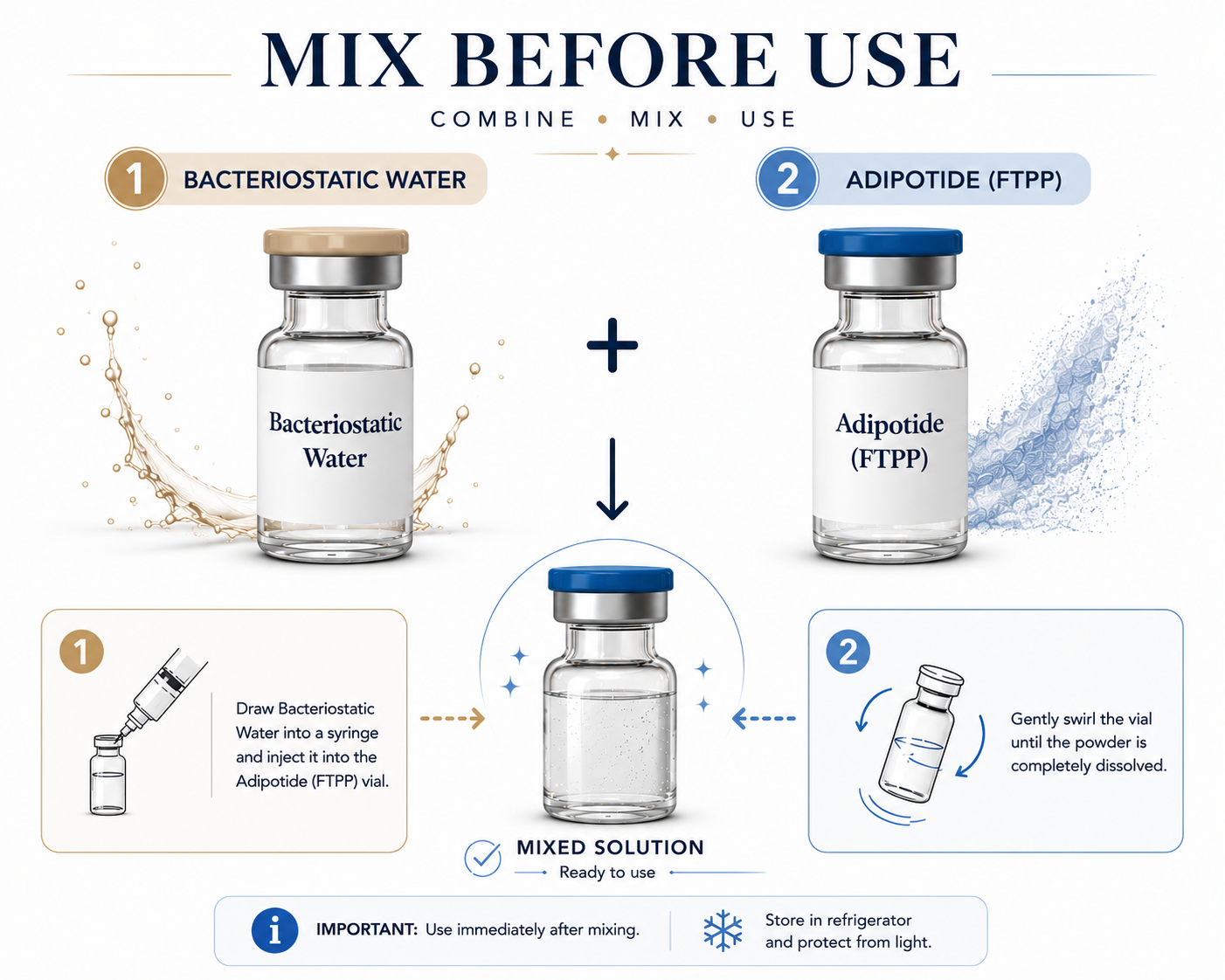
How To Mix Adipotide (FTPP)
1
CleanUse alcohol swabs to clean the tops of both vials.
2
Draw BAC WaterDraw the selected amount of bacteriostatic water.
3
Inject SlowlyAdd the liquid slowly down the side of the vial.
4
Swirl GentlyDo not shake. Swirl gently until dissolved.
5
Store ProperlyStore as directed and protect from heat and light.
Best Practices & Common Mistakes
Best Practices
- Use sterile technique.
- Protect from light and heat.
- Store refrigerated when appropriate.
- Use clean syringe-unit math before measuring.
Common Mistakes
- Confusing milligrams with milliliters.
- Choosing an option with awkward decimal units.
- Using too little liquid for very small measurements.
- Shaking the vial aggressively.
Adipotide (FTPP) Storage & Handling
Lyophilized Powder: −20°C (−4°F) for long-term storage (up to 24 months). Refrigeration 2–8°C (36–46°F) for short-term use (up to ~3 months). Original sealed vial in the freezer is safest.
Reconstituted Solution: 2–8°C (36–46°F), use within ~7–14 days. Keep sealed, avoid light, and do not repeat freeze-thaw cycles.
Frequently Asked Questions
Adipotide, also called FTPP (fat-targeted proapoptotic peptide), is an experimental compound that works very differently from GLP-1 drugs. Instead of curbing appetite, it's designed to cut off the blood supply to fat tissue, triggering those cells to die off. It is not a GLP-1, not an incretin, and not an approved medicine.
Only minimally. Adipotide showed weight loss in animal studies, but its development largely stopped because primate studies showed signs of kidney toxicity (damage to the kidney's filtering tubules). It never became an established human therapy. This is a key difference from GLP-1 compounds — the concern here is potential organ harm, not just digestive side effects.
If you're preparing a research vial, the mixing math is the same as any lyophilized peptide: add bacteriostatic water slowly down the side of the vial and swirl gently — never shake. The water volume sets the concentration; e.g. a 10 mg vial with 2 mL gives 5 mg/mL. Enter your vial size and target amount in the calculator for the syringe units.
The calculator only converts a mass you enter into a syringe volume — it doesn't recommend a dose. There's no established safe human dose for Adipotide, because it never completed proper human dosing studies. Any figures circulating online are unofficial. Use the tool for the measurement math only, and treat the amount itself as unsettled.
Keep the reconstituted solution refrigerated at 2–8°C (36–46°F), protected from light, and use it within roughly one to two weeks. Sealed lyophilized powder stores longest frozen at −20°C. Avoid heat and repeated freeze-thaw cycles, which degrade the peptide.
Practical takeaway: If your real goal is weight or metabolic health, the most useful next step is discussing approved treatment options with a clinician rather than relying on an unapproved compound.
Important: This tool is for informational and research-reference purposes only. Not intended for human or veterinary use.