Need a Reliable Peptide Supplier? Click HERE!!!SponsoredVisit ↗
Chonluten and BAC Water Mix

Chonluten Reconstitution Calculator

Enter the amount you want to measure. The vial buttons will highlight which vial strengths create cleaner syringe-unit measurements.

What amount do you need?

Type the target amount, then choose mg or mcg. Example: 2mg or 500mcg.

Work the dose out from body weight

Syringe size:
Possible vial strengths:
Best Match Good Match Usable Harder to Measure

Example Chonluten Titration Schedule

ItemDetails
Standard dose200–500 mcg once daily
Courses10–20 days, 2–3× per year
Originator dose10–1000× lower (Russian tradition)

Zero PubMed-indexed human studies; the 16-week ramp to 4 mg/day is a vendor 'extended range' 20× above the standard intensive course. The '1–5 mg per dose' figure is a recurring placeholder that never matched a validated protocol for any bioregulator; sources disagree up to 1000× on real doses.

Possible vial strengths:

What Is It?

Chonluten

Bronchial bioregulator peptide.

Bacteriostatic Water

Sterile water containing a bacteriostatic preservative, commonly used when preparing multi-use research vials.

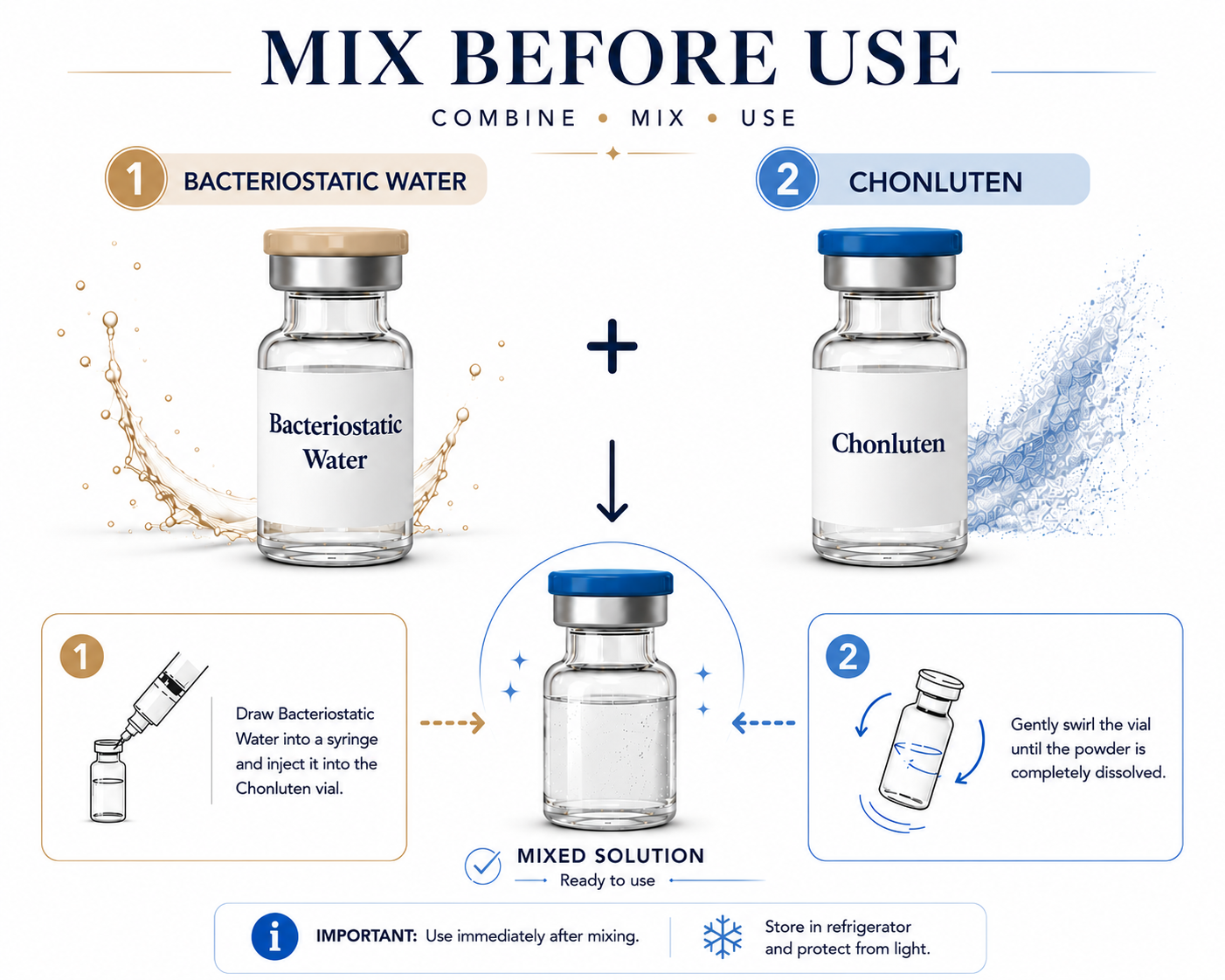
How To Mix Chonluten

1
Clean

Use alcohol swabs to clean the tops of both vials.

2
Draw BAC Water

Draw the selected amount of bacteriostatic water.

3
Inject Slowly

Add the liquid slowly down the side of the vial.

4
Swirl Gently

Do not shake. Swirl gently until dissolved.

5
Store Properly

Store as directed and protect from heat and light.

Best Practices & Common Mistakes

Best Practices

  • Use sterile technique.
  • Protect from light and heat.
  • Store refrigerated when appropriate.
  • Use clean syringe-unit math before measuring.

Common Mistakes

  • Confusing milligrams with milliliters.
  • Choosing an option with awkward decimal units.
  • Using too little liquid for very small measurements.
  • Shaking the vial aggressively.

Chonluten Storage & Handling

Lyophilized Powder: −20°C (−4°F) for long-term storage (up to 24 months). Refrigeration 2–8°C (36–46°F) for short-term use (up to ~3 months). Original sealed vial in the freezer is safest.
Reconstituted Solution: 2–8°C (36–46°F), use within ~7–14 days. Keep sealed, avoid light, and do not repeat freeze-thaw cycles.

Frequently Asked Questions

Chonluten is a Khavinson "bioregulator" — a synthetic tripeptide (Glu-Asp-Gly, EDG) developed in Russia to target the mucous lining of the bronchi and lungs at the gene level. It's described as acting on respiratory epithelial cells to calm stress and inflammation genes and normalize mucus-producing cells. It's sold as an oral/sublingual capsule and as a research-grade injectable powder.
Both are Khavinson respiratory peptides but they hit different targets: Chonluten (EDG, a tripeptide) works mainly on stress-response and antioxidant genes (c-Fos, HSP70, SOD, COX-2, TNF-α) in the bronchial mucosa, while Bronchogen (AEDL, a tetrapeptide) switches on epithelial-differentiation and mucin genes (NKX2-1, MUC5AC). They're often paired in Russian COPD protocols precisely because they cover complementary parts of the airway, not because they're interchangeable.
In animal and cell studies, Chonluten is reported to reduce airway inflammation, curb excess mucus by normalizing goblet-cell activity, and restore cilia movement for clearance — with Khavinson's group also floating it for post-infection and viral lung damage. The mechanism is framed as epigenetic, dialing down stress and inflammatory genes in respiratory tissue. This is preclinical, largely Russian data, so it is not a proven treatment for asthma, COPD, or any lung disease.
Only the injectable research powder is mixed — the oral or sublingual capsule (around 200–400 mcg per dose) is taken directly. For a 20 mg vial, adding 5 mL of bacteriostatic water gives 4 mg/mL, so a 400 mcg amount draws to 0.1 mL (10 units on a U-100 syringe). Khavinson respiratory protocols run in short pulses (roughly 1–2 mg/day for ~10 days, twice a year), and no injectable human dose is formally established, so treat any number as a research figure.
Chonluten is not approved for human use in any major jurisdiction — it's a research compound or Russian-market supplement, and all safety observations come from Khavinson's own group rather than independent review. A small tripeptide is expected to be low-toxicity, but breathing problems (asthma flares, chronic bronchitis, COPD) can be dangerous to self-manage, so they warrant real respiratory care rather than an unproven peptide. Storage: keep the lyophilized powder cold and dry away from light, and once reconstituted, keep it refrigerated and use it within a few days.
Practical takeaway: If your goal involves weight management, metabolic health, recovery, physical performance, cognitive function, appearance, or general well-being, discuss it with a licensed healthcare professional. They can help you evaluate approved, evidence-based options rather than relying on an unapproved or investigational compound. This calculator is intended only for transparent research-reference calculations and does not determine an appropriate amount, recommend use, or replace professional medical guidance.

About the author

Maria Hrabina is a pharmacist and scientific reviewer with a strong interest in peptide science, pharmacology, and emerging therapeutic compounds.

Her work focuses on understanding how peptide-based compounds interact with biological signaling pathways and how they are being investigated across areas such as metabolic health, dermatology, recovery, regenerative research, and pharmaceutical development.

Maria follows research on a broad range of peptides, from compounds used in approved medicines to experimental molecules still being evaluated in laboratory, preclinical, and clinical studies.

Her approach combines scientific curiosity with critical evaluation of evidence. She believes promising mechanisms and early research deserve attention, but should not be presented as established clinical benefits until they are supported by adequate human data.

Her areas of focus include scientific literature review, mechanisms of action, pharmacology, pharmacokinetics, safety, pharmaceutical formulation, and the overall quality of evidence behind peptide-based compounds.

She is particularly interested in the process of translating an experimental molecule into a reliable pharmaceutical product — including compound characterization, purity, stability, formulation, dose selection, safety assessment, and controlled clinical trials.

Maria believes peptide science has significant long-term potential, but that its progress depends on rigorous research, high manufacturing standards, transparent safety data, and responsible scientific communication.

Through her writing, she aims to help readers understand both sides of peptide research: what makes these compounds scientifically promising and what questions remain before their potential can be considered clinically established.

Areas of interest: Peptide Science · Therapeutic Peptides · Peptide Pharmacology · Metabolic Peptides · Cosmetic Peptides · Drug Development · Pharmacokinetics · Drug Safety · Pharmaceutical Formulation · Emerging Therapies · Evidence-Based Medicine

Important: This tool is for informational and research-reference purposes only. Not intended for human or veterinary use.
← All peptides