
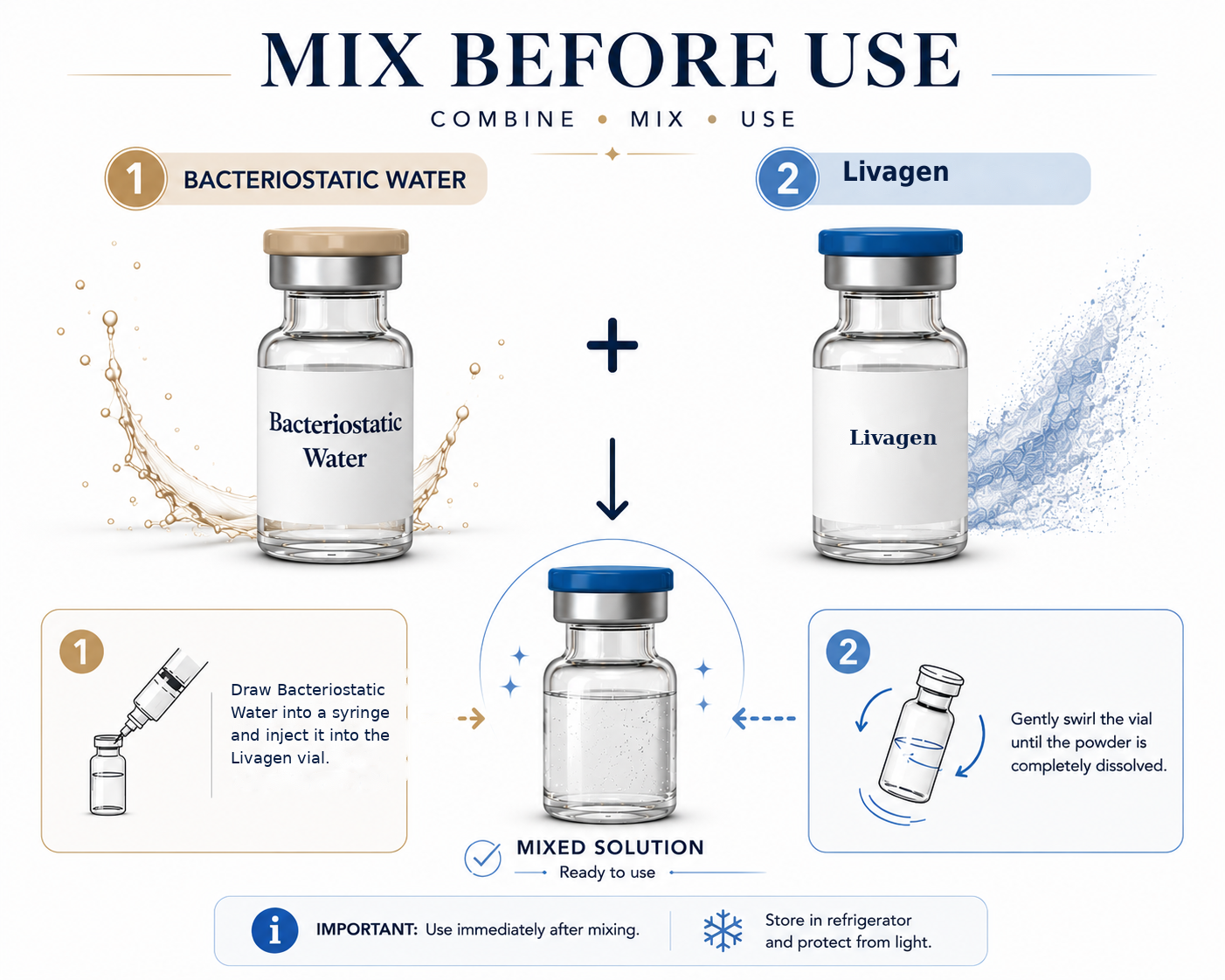
Livagen and BAC Water Mix

Livagen Reconstitution Calculator

Enter the amount you want to measure. The vial buttons will highlight which vial strengths create cleaner syringe-unit measurements.

What amount do you need?

Type the target amount, then choose mg or mcg. Example: 2mg or 500mcg.

Syringe size:
Possible vial strengths:
Best Match Good Match Usable Harder to Measure

Example Livagen Titration Schedule

Protocol ItemGuidance
Dose1–5 mg per dose
Cycling StyleBio-regulators are typically cycled as periodic doses rather than continuous daily consumption.
PhaseSchedule
Loading Phase (Year 1)
Maintenance Phase (Year 2+)
Possible vial strengths:

What Is It?

Livagen

Tetrapeptide bioregulator.

Bacteriostatic Water

Sterile water containing a bacteriostatic preservative, commonly used when preparing multi-use research vials.

How To Mix Livagen

1
Clean

Use alcohol swabs to clean the tops of both vials.

2
Draw BAC Water

Draw the selected amount of bacteriostatic water.

3
Inject Slowly

Add the liquid slowly down the side of the vial.

4
Swirl Gently

Do not shake. Swirl gently until dissolved.

5
Store Properly

Store as directed and protect from heat and light.

Best Practices & Common Mistakes

Best Practices

  • Use sterile technique.
  • Protect from light and heat.
  • Store refrigerated when appropriate.
  • Use clean syringe-unit math before measuring.

Common Mistakes

  • Confusing milligrams with milliliters.
  • Choosing an option with awkward decimal units.
  • Using too little liquid for very small measurements.
  • Shaking the vial aggressively.

Livagen Storage & Handling

Lyophilized Powder: −20°C (−4°F) for long-term storage (up to 24 months). Refrigeration 2–8°C (36–46°F) for short-term use (up to ~3 months). Original sealed vial in the freezer is safest.
Reconstituted Solution: 2–8°C (36–46°F), use within ~7–14 days. Keep sealed, avoid light, and do not repeat freeze-thaw cycles.

Frequently Asked Questions

Livagen is a Khavinson "bioregulator" — a synthetic tetrapeptide (Lys-Glu-Asp-Ala, KEDA, ~462 Da) built to target liver tissue at the gene level. Its signature effect in the lab is chromatin decondensation: it physically "opens" tightly packed DNA in aged hepatocytes and lymphocytes, reportedly restoring access to genes that fell silent with age. It's sold as an oral/sublingual capsule and as a research-grade injectable powder.
Both are Khavinson liver peptides, but they differ in sequence and scope: Livagen (KEDA, a tetrapeptide) is focused specifically on hepatocyte gene regulation and chromatin opening, while Ovagen (Glu-Asp-Leu, a tripeptide) is a dual-organ regulator covering the liver-gut axis. They share a target organ but supposedly hit different gene sets, which is why some protocols pair them rather than swap one for the other. Livagen is also a close cousin of Vilon (KE) — same N-terminal start, but Vilon is immune-targeted.
In rodent and cell studies, Livagen raised protein synthesis in aged hepatocytes, boosted T-cell markers (CD3+, CD4+, CD8+) and neutrophil activity, and shifted digestive-enzyme activity along the gut-liver axis — effects that were strongest in older, not younger, tissue. The proposed thread is epigenetic: opening age-condensed chromatin so liver and immune genes can fire again. This is preclinical, largely Russian research, so it is not a demonstrated treatment for any liver disease.
Only the injectable research powder needs mixing — the oral or sublingual capsule is taken as-is. For a 20 mg vial, adding 2 mL of bacteriostatic water gives 10 mg/mL, so a 1 mg amount draws to 0.1 mL (10 units on a U-100 syringe); use less water for a more concentrated solution and smaller draws. There's no established injectable human dose, and Khavinson protocols are pulsed (short courses, not daily indefinitely), so any figure is a research choice.
Livagen has no FDA approval and isn't a medicine in Western jurisdictions — it's a research compound or supplement, sourced largely through Russian channels, with no independent safety validation. Even though a tiny tetrapeptide is expected to be low-toxicity, a struggling liver is a serious matter: hepatitis, fatty liver, and cirrhosis need real diagnosis and monitoring, not an unproven peptide, so loop in a clinician before anything. Storage: the lyophilized powder is best kept frozen or at fridge temperature in a dry, dark place, with reconstituted solution used within a short window.
Practical takeaway: If your real goal is weight or metabolic health, the most useful next step is discussing approved treatment options with a clinician rather than relying on an unapproved compound.
Important: This tool is for informational and research-reference purposes only. Not intended for human or veterinary use.
← All peptides