
Lotiglipron Reconstitution Calculator
Enter the amount you want to measure. The vial buttons will highlight which vial strengths create cleaner syringe-unit measurements.
What amount do you need?
Type the target amount, then choose mg or mcg. Example: 2mg or 500mcg.
Work the dose out from body weight
Syringe size:
Possible vial strengths:
Best Match
Good Match
Usable
Harder to Measure
Example Lotiglipron Titration Schedule
| Parameter | Details |
|---|---|
| Phase 1 doses | 10–180 mg oral once daily |
| Cycle | 28–42 days (Phase 1) |
Discontinued June 2023: transaminase elevations (some ALT/AST >8× ULN) in 6.6%/6.0% of patients versus 1.6% on placebo. Historical data only.
Possible vial strengths:
What Is It?
Lotiglipron
Oral non-peptide GLP-1 receptor agonist.
Bacteriostatic Water
Sterile water containing a bacteriostatic preservative, commonly used when preparing multi-use research vials.
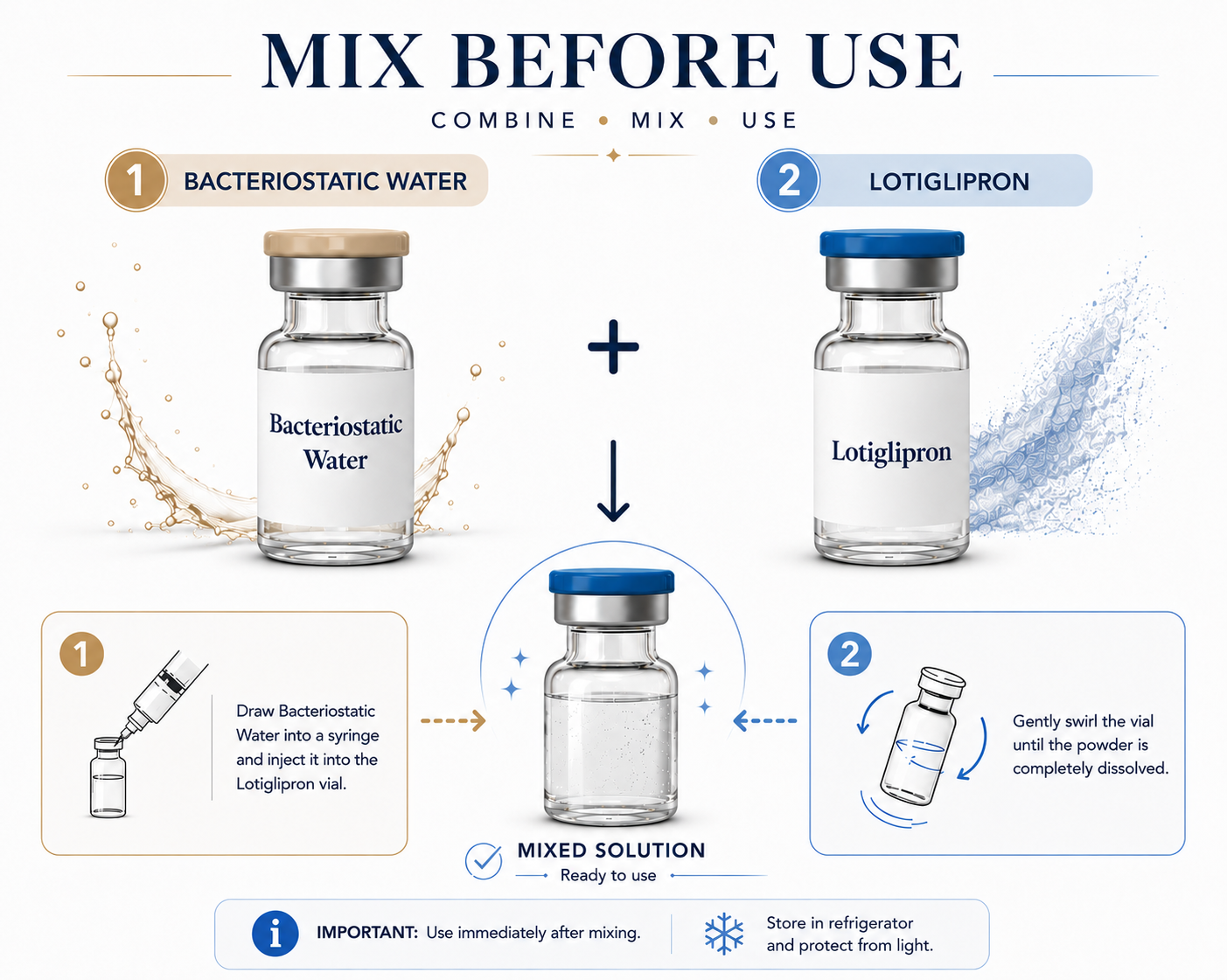
How To Mix Lotiglipron
1
CleanUse alcohol swabs to clean the tops of both vials.
2
Draw BAC WaterDraw the selected amount of bacteriostatic water.
3
Inject SlowlyAdd the liquid slowly down the side of the vial.
4
Swirl GentlyDo not shake. Swirl gently until dissolved.
5
Store ProperlyStore as directed and protect from heat and light.
Best Practices & Common Mistakes
Best Practices
- Use sterile technique.
- Protect from light and heat.
- Store refrigerated when appropriate.
- Use clean syringe-unit math before measuring.
Common Mistakes
- Confusing milligrams with milliliters.
- Choosing an option with awkward decimal units.
- Using too little liquid for very small measurements.
- Shaking the vial aggressively.
Lotiglipron Storage & Handling
Lyophilized Powder: −20°C (−4°F) for long-term storage (up to 24 months). Refrigeration 2–8°C (36–46°F) for short-term use (up to ~3 months). Original sealed vial in the freezer is safest.
Reconstituted Solution: 2–8°C (36–46°F), use within ~7–14 days. Keep sealed, avoid light, and do not repeat freeze-thaw cycles.
Reconstituted Solution: 2–8°C (36–46°F), use within ~7–14 days. Keep sealed, avoid light, and do not repeat freeze-thaw cycles.
Frequently Asked Questions
Lotiglipron is not a peptide vial compound; it is an oral small-molecule GLP-1 receptor agonist investigated by Pfizer. A calculator page can still explain concentration math for research solutions, but it should not present lotiglipron as a standard bacteriostatic-water peptide reconstitution product.
Pfizer discontinued lotiglipron after pharmacokinetic data and laboratory findings showed elevated transaminases in clinical studies. Those liver enzyme findings made lotiglipron different from a simple “failed weight-loss pill” story, because the program was stopped before it could become an approved medicine.
Lotiglipron and danuglipron were both Pfizer oral GLP-1 receptor agonist candidates, but they were separate molecules with different development paths. Pfizer stopped lotiglipron first in 2023, while danuglipron continued longer before Pfizer later discontinued that program too.
Lotiglipron’s listed formula is C31H31ClN4O5, with a molecular weight of about 575.1 g/mol, which supports describing it as a small molecule rather than a peptide. That matters because small-molecule solubility, solvent choice, and lab handling are not the same as lyophilized peptide reconstitution.
For research math only, concentration equals compound amount divided by final solution volume. For example, if 10 mg of lotiglipron reference material were dissolved to a final volume of 8 mL, the concentration would be 1.25 mg/mL; a 0.5 mg research aliquot would equal 0.40 mL. This is lab concentration math, not a dosing or administration guide.
Practical takeaway: If your goal involves weight management, metabolic health, recovery, physical performance, cognitive function, appearance, or general well-being, discuss it with a licensed healthcare professional. They can help you evaluate approved, evidence-based options rather than relying on an unapproved or investigational compound. This calculator is intended only for transparent research-reference calculations and does not determine an appropriate amount, recommend use, or replace professional medical guidance.
Important: This tool is for informational and research-reference purposes only. Not intended for human or veterinary use.