
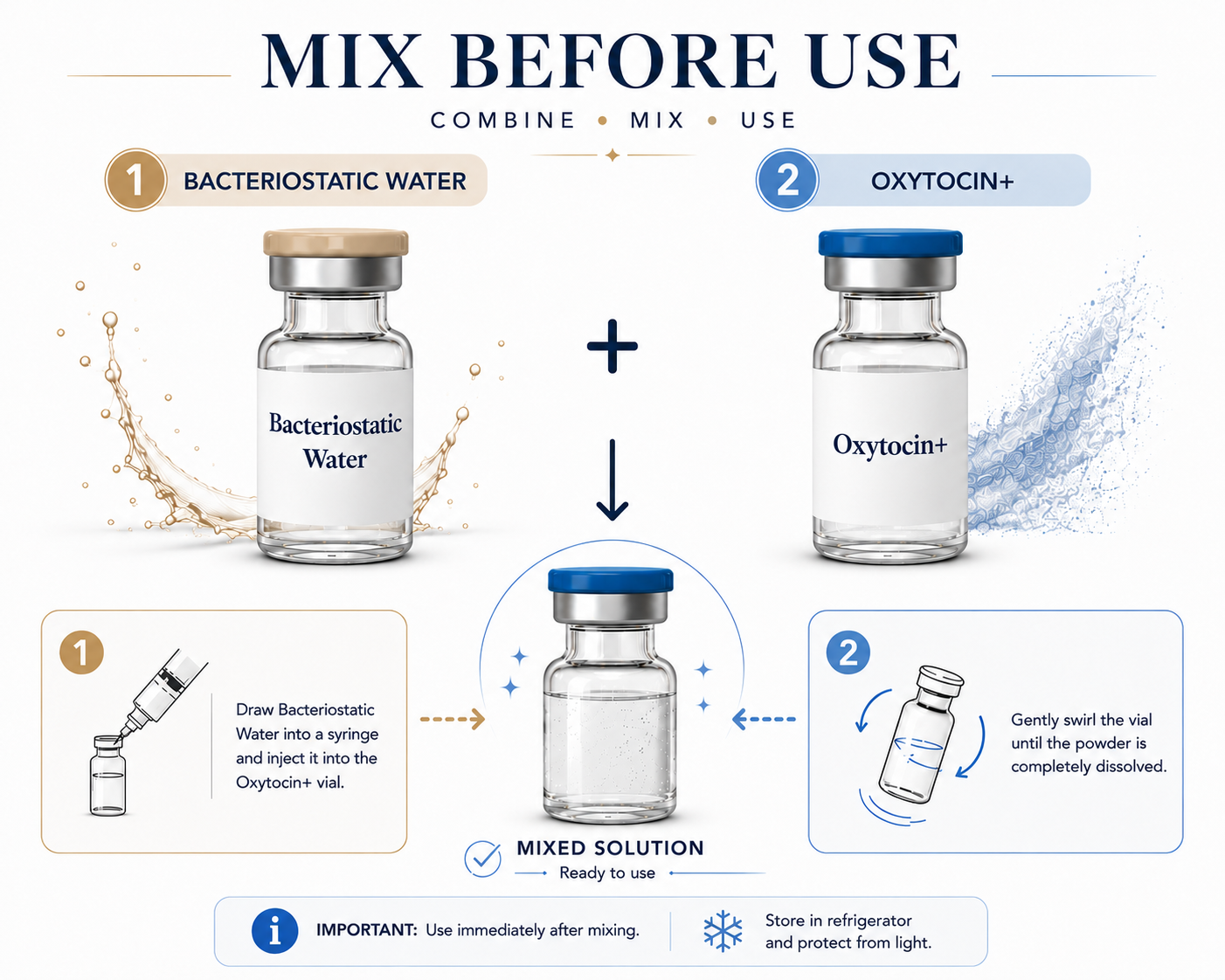
Oxytocin and BAC Water Mix

Oxytocin Reconstitution Calculator

Enter the amount you want to measure. The vial buttons will highlight which vial strengths create cleaner syringe-unit measurements.

What amount do you need?

Type the target amount, then choose mg or mcg. Example: 2mg or 500mcg.

Syringe size:
Possible vial strengths:
Best Match Good Match Usable Harder to Measure

Example Oxytocin Titration Schedule

Protocol ItemGuidance
Dose10–200 IUs per dose
FrequencyDosing may be daily or multiple times per week, depending on the goal.
CyclingCycles may run for weeks to months, followed by a break to assess response and maintain efficacy.
Modified Versions (Acetate/Amidate)The source notes limited research on dosing/cycling for modified versions; similar schemes to the original compound are commonly used. Often recommended to start with a more conservative dosing and cycling approach when researching more potent compounds.
Possible vial strengths:

What Is It?

Oxytocin

Posterior pituitary nonapeptide.

Bacteriostatic Water

Sterile water containing a bacteriostatic preservative, commonly used when preparing multi-use research vials.

How To Mix Oxytocin

1
Clean

Use alcohol swabs to clean the tops of both vials.

2
Draw BAC Water

Draw the selected amount of bacteriostatic water.

3
Inject Slowly

Add the liquid slowly down the side of the vial.

4
Swirl Gently

Do not shake. Swirl gently until dissolved.

5
Store Properly

Store as directed and protect from heat and light.

Best Practices & Common Mistakes

Best Practices

  • Use sterile technique.
  • Protect from light and heat.
  • Store refrigerated when appropriate.
  • Use clean syringe-unit math before measuring.

Common Mistakes

  • Confusing milligrams with milliliters.
  • Choosing an option with awkward decimal units.
  • Using too little liquid for very small measurements.
  • Shaking the vial aggressively.

Oxytocin Storage & Handling

Lyophilized Powder: −20°C (−4°F) for long-term storage (up to 24 months). Refrigeration 2–8°C (36–46°F) for short-term use (up to ~3 months). Original sealed vial in the freezer is safest.
Reconstituted Solution: 2–8°C (36–46°F), use within ~7–14 days. Keep sealed, avoid light, and do not repeat freeze-thaw cycles.

Frequently Asked Questions

Oxytocin is a natural nine-amino-acid peptide hormone (a nonapeptide) made in the hypothalamus and released by the posterior pituitary gland, acting on oxytocin receptors throughout the brain and body. It's widely known as the "bonding" or "love" hormone for its role in social connection, trust, childbirth, and breastfeeding. The manufactured version is a prescription drug (Pitocin), and it's also sold in compounded and research forms.
Pitocin (and Syntocinon) is simply synthetic oxytocin — the exact same molecule under a brand name, not a different drug. Vasopressin is a close structural cousin — also a nonapeptide, differing by just two amino acids — but it controls water balance and blood pressure, not bonding. Dopamine and serotonin are often lumped with oxytocin as "happy chemicals," but those are small-molecule neurotransmitters, whereas oxytocin is a peptide hormone. (And oxytocin is unrelated to the painkiller oxycodone despite the similar name.)
Oxytocin drives uterine contractions and milk let-down, but it's equally known for social effects — bonding, trust, and calm — and it's released naturally through touch, hugging, cuddling, sex, and even petting a dog. It works in both men and women. Beyond that, intranasal oxytocin is being researched for social and mood effects (in autism, anxiety, and libido contexts), though those brain-directed uses show a tricky, non-linear dose-response and remain investigational rather than proven.
No — labor induction with oxytocin is strictly a hospital procedure. Clinical Pitocin is a high-alert IV medication given by careful titration with fetal and uterine monitoring, because too much can cause dangerously strong contractions (tachysystole), uterine rupture, or fetal distress. It should never be self-administered, and "foods" or supplements can't safely replicate a medical induction. Veterinary use (such as oxytocin for a dog in labor) is likewise a job for a vet, dosed by weight under supervision.
Clinical oxytocin (Pitocin) comes as a ready-made injection dosed in international units (IU), not a home-mixed powder; only a research-grade lyophilized peptide is reconstituted, and its IU-based dosing makes conversions tricky. As a rough example, a 2 mg vial + 5 mL bacteriostatic water = 0.4 mg/mL, so 100 mcg = 0.25 mL (25 units on a U-100 syringe). On buying: injectable Pitocin and compounded nasal sprays/troches are prescription-only, while low-dose OTC "oxytocin" mists are unregulated supplements with no guaranteed content. Storage matters — oxytocin is heat-sensitive, so keep it refrigerated and protect it from light.
Practical takeaway: If your real goal is weight or metabolic health, the most useful next step is discussing approved treatment options with a clinician rather than relying on an unapproved compound.
Important: This tool is for informational and research-reference purposes only. Not intended for human or veterinary use.
← All peptides