
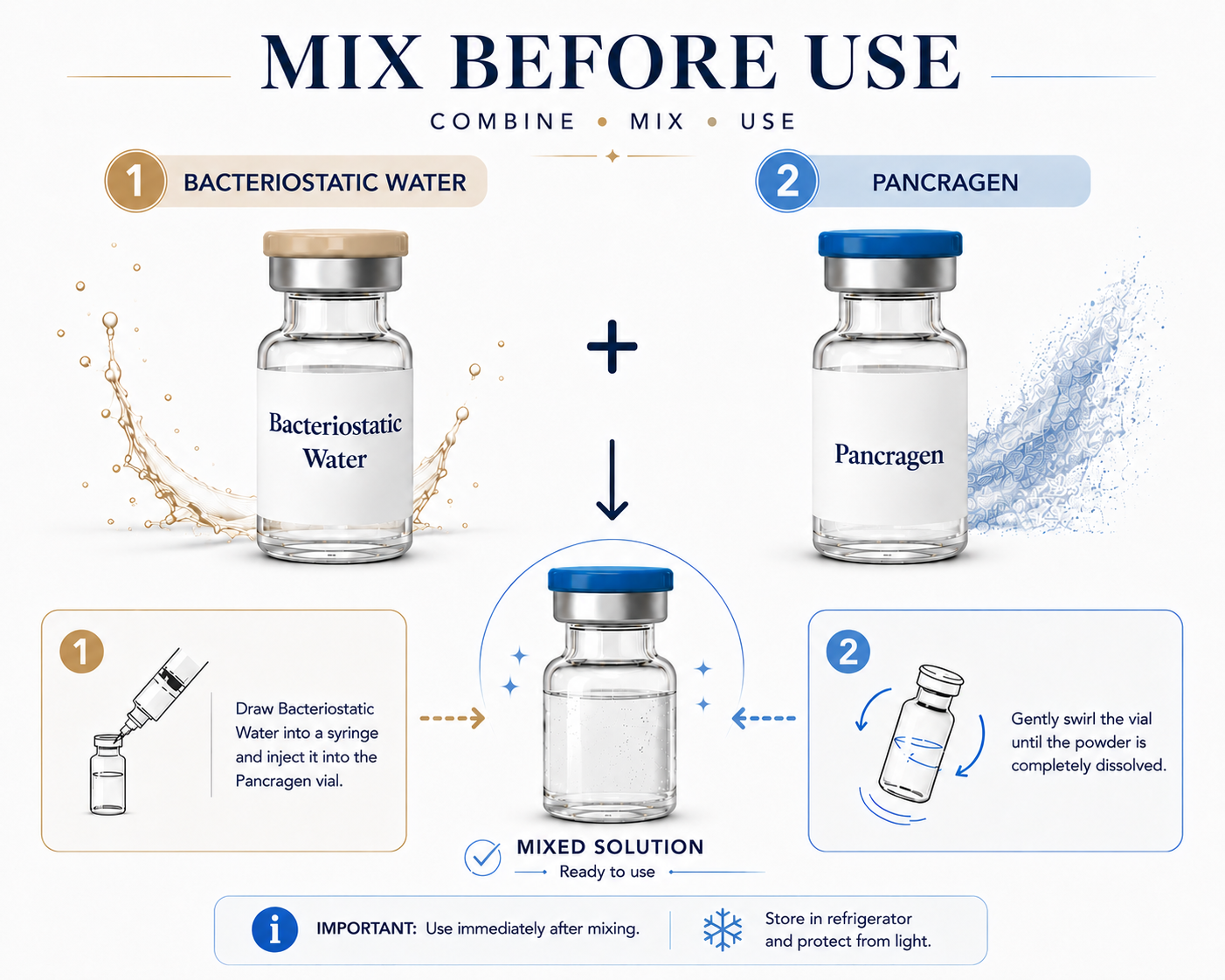
Pancragen and BAC Water Mix

Pancragen Reconstitution Calculator

Enter the amount you want to measure. The vial buttons will highlight which vial strengths create cleaner syringe-unit measurements.

What amount do you need?

Type the target amount, then choose mg or mcg. Example: 2mg or 500mcg.

Syringe size:
Possible vial strengths:
Best Match Good Match Usable Harder to Measure

Example Pancragen Titration Schedule

Protocol ItemGuidance
Dose1–5 mg per dose
Cycling (General)Typically cycled as periodic doses rather than continuous daily consumption
PhaseTiming
Loading PhaseYear 1
Maintenance PhaseYear 2+
Possible vial strengths:

What Is It?

Pancragen

Pancreatic short peptide bioregulator.

Bacteriostatic Water

Sterile water containing a bacteriostatic preservative, commonly used when preparing multi-use research vials.

How To Mix Pancragen

1
Clean

Use alcohol swabs to clean the tops of both vials.

2
Draw BAC Water

Draw the selected amount of bacteriostatic water.

3
Inject Slowly

Add the liquid slowly down the side of the vial.

4
Swirl Gently

Do not shake. Swirl gently until dissolved.

5
Store Properly

Store as directed and protect from heat and light.

Best Practices & Common Mistakes

Best Practices

  • Use sterile technique.
  • Protect from light and heat.
  • Store refrigerated when appropriate.
  • Use clean syringe-unit math before measuring.

Common Mistakes

  • Confusing milligrams with milliliters.
  • Choosing an option with awkward decimal units.
  • Using too little liquid for very small measurements.
  • Shaking the vial aggressively.

Pancragen Storage & Handling

Lyophilized Powder: −20°C (−4°F) for long-term storage (up to 24 months). Refrigeration 2–8°C (36–46°F) for short-term use (up to ~3 months). Original sealed vial in the freezer is safest.
Reconstituted Solution: 2–8°C (36–46°F), use within ~7–14 days. Keep sealed, avoid light, and do not repeat freeze-thaw cycles.

Frequently Asked Questions

Pancragen is a Khavinson "bioregulator" — a short tetrapeptide (Lys-Glu-Asp-Trp, ~576 Da) originally derived from pancreatic tissue and developed in Russia to support pancreatic function. It comes in two very different forms: an oral capsule sold as a dietary supplement, and a research-grade injectable powder sold for laboratory use. The proposed idea is that this tiny peptide reaches pancreatic cells and influences how they regulate glucose.
No — these are completely unrelated despite the near-identical spelling. PancraGEN (Interpace Diagnostics) is a DNA-based lab test that analyzes pancreatic cyst fluid for cancer-risk gene mutations like KRAS and TP53; it is a diagnostic, not a peptide, and nothing about it is reconstituted or injected. Note also that Interpace stopped accepting specimens for that test in May 2025. If you're looking for the cyst-fluid cancer test, this reconstitution page isn't it.
The headline studies are from Khavinson's group: in aged monkeys, Pancragen reportedly improved glucose tolerance and normalized insulin, and a small Russian trial used an oral 500 mcg dose in elderly prediabetic patients. Mechanistically it's described as acting on pancreatic gene expression, turning up cell-maturation transcription factors. Importantly, this body of evidence is largely Russian and not independently confirmed in Western trials — Pancragen is not a treatment for diabetes and shouldn't replace one.
Only one of the two forms is reconstituted: the oral capsule is swallowed and never mixed, while the research-grade injectable powder is the one you reconstitute. For that powder the math is standard — a 20 mg vial + 4 mL bacteriostatic water = 5 mg/mL, so a 500 mcg amount = 0.1 mL (10 units on a U-100 syringe). Keep in mind the only human clinical dosing was oral (500 mcg twice daily); an injectable human dose isn't established.
Pancragen has no FDA approval — the oral version is sold as a dietary supplement and the injectable as a research-only compound, neither tested to drug standards. Reported side effects from user protocols are mild (transient fatigue, headache, minor GI changes), but there is no rigorous Western safety data, and anyone with a real pancreatic or glucose disorder needs proper medical care, not a supplement. Storage: keep capsules cool and dry; store the lyophilized injectable powder refrigerated and protected from light, and use any reconstituted solution promptly.
Practical takeaway: If your real goal is weight or metabolic health, the most useful next step is discussing approved treatment options with a clinician rather than relying on an unapproved compound.
Important: This tool is for informational and research-reference purposes only. Not intended for human or veterinary use.
← All peptides