
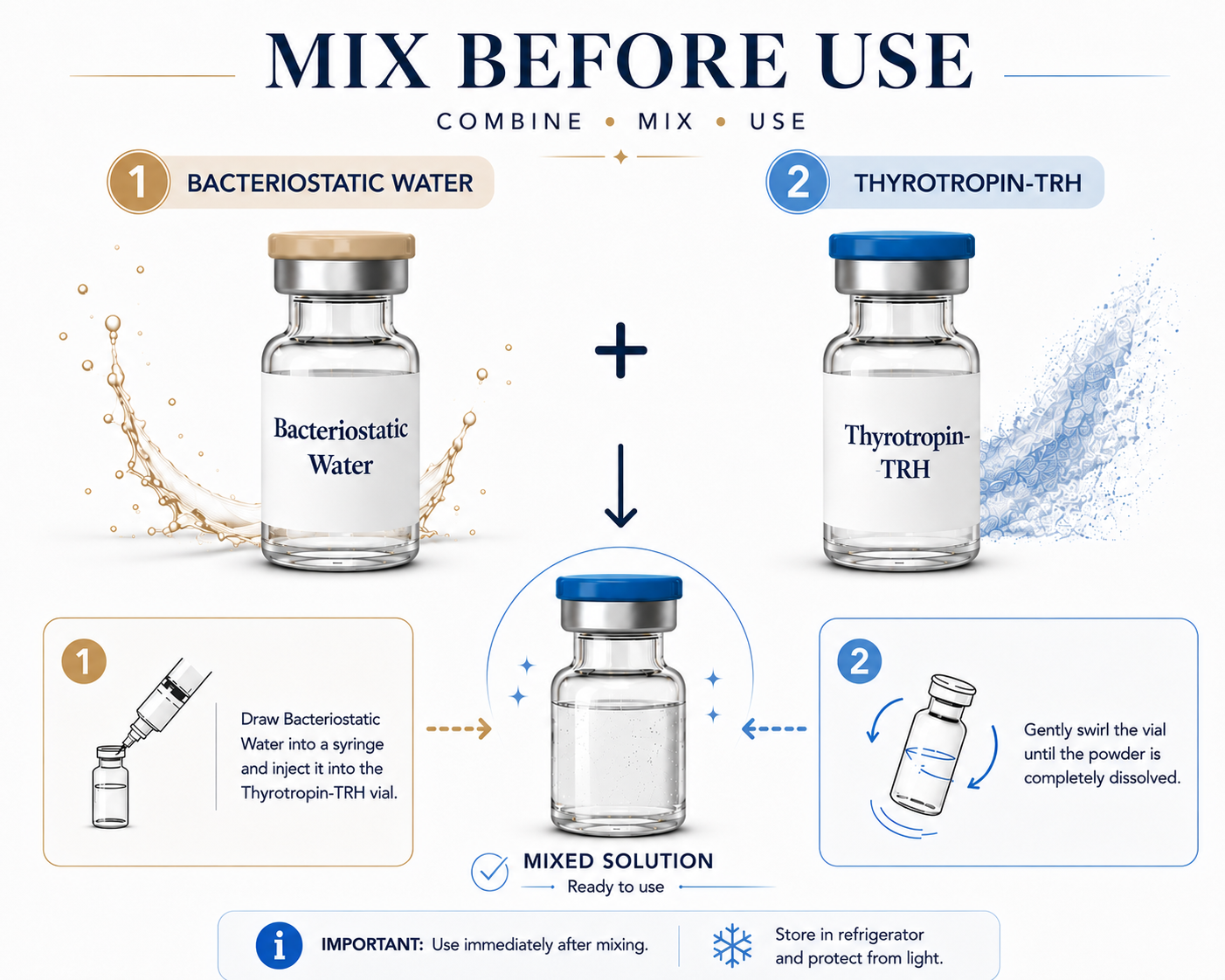
Thyrotropin (TRH) and BAC Water Mix

Thyrotropin (TRH) Reconstitution Calculator

Enter the amount you want to measure. The vial buttons will highlight which vial strengths create cleaner syringe-unit measurements.

What amount do you need?

Type the target amount, then choose mg or mcg. Example: 2mg or 500mcg.

Syringe size:
Possible vial strengths:
Best Match Good Match Usable Harder to Measure

Example Thyrotropin (TRH) Titration Schedule

WeekDaily Dose (mcg)Injection Volume (mL / Units)
Weeks 1–2200 mcg (0.200 mg)0.06 mL (6 units)
Weeks 3–4300 mcg (0.300 mg)0.09 mL (9 units)
Weeks 5–6400 mcg (0.400 mg)0.12 mL (12 units)
Weeks 7–12500 mcg (0.500 mg)0.15 mL (15 units)
Possible vial strengths:

What Is It?

Thyrotropin (TRH)

Thyrotropin-releasing hormone.

Bacteriostatic Water

Sterile water containing a bacteriostatic preservative, commonly used when preparing multi-use research vials.

How To Mix Thyrotropin (TRH)

1
Clean

Use alcohol swabs to clean the tops of both vials.

2
Draw BAC Water

Draw the selected amount of bacteriostatic water.

3
Inject Slowly

Add the liquid slowly down the side of the vial.

4
Swirl Gently

Do not shake. Swirl gently until dissolved.

5
Store Properly

Store as directed and protect from heat and light.

Best Practices & Common Mistakes

Best Practices

  • Use sterile technique.
  • Protect from light and heat.
  • Store refrigerated when appropriate.
  • Use clean syringe-unit math before measuring.

Common Mistakes

  • Confusing milligrams with milliliters.
  • Choosing an option with awkward decimal units.
  • Using too little liquid for very small measurements.
  • Shaking the vial aggressively.

Thyrotropin (TRH) Storage & Handling

Lyophilized Powder: −20°C (−4°F) for long-term storage (up to 24 months). Refrigeration 2–8°C (36–46°F) for short-term use (up to ~3 months). Original sealed vial in the freezer is safest.
Reconstituted Solution: 2–8°C (36–46°F), use within ~7–14 days. Keep sealed, avoid light, and do not repeat freeze-thaw cycles.

Frequently Asked Questions

TRH (thyrotropin-releasing hormone) is the simplest hypothalamic releasing hormone — a three-amino-acid peptide (pyroGlu-His-Pro) whose synthetic form is called protirelin. Its job is to signal the pituitary to release TSH (and prolactin), sitting at the top of the thyroid control axis. Clinically it exists as an FDA-approved diagnostic agent, and it's also sold as a research peptide.
No — this is the most common mix-up, and the page name reflects it. TRH is thyrotropin-releasing hormone from the hypothalamus; thyrotropin is TSH, a completely different, larger hormone made by the pituitary. The cascade runs in sequence: TRH (hypothalamus) → tells the pituitary to release thyrotropin/TSH → which tells the thyroid to make T3 and T4. So TRH's direct target organ is the pituitary, not the thyroid itself.
Beyond triggering TSH and prolactin, TRH acts as a neurotransmitter across the brain and shows up in tissues from the spinal cord to hair follicles, which is why it's been researched for depression, suicidal ideation, and spinal-cord conditions. Some vendors extend this to weight-loss or hair-growth claims, but those rest on TRH's broad tissue presence rather than proven results — they are not established effects. In practice its main validated role is as a diagnostic probe of pituitary–thyroid function.
The approved diagnostic product is a ready-made 500 mcg/mL solution (further diluted with sterile water for IV use), so it isn't a home reconstitution; only a research-grade protirelin powder is mixed from dry form. For that powder, a 4 mg vial + 5 mL bacteriostatic water = 0.8 mg/mL, so a 400 mcg amount draws to 0.5 mL (50 units on a U-100 syringe). Because TRH's half-life is only about 5 minutes, its effect is very brief, and no research injection dose is formally established.
TRH/protirelin is FDA-approved only as a diagnostic agent for a supervised TRH stimulation test — not as a treatment for thyroid disease, weight, or mood — and the branded products (Thyrel, Relefact) are largely off the US market now. The clinical test itself can cause transient side effects (a brief blood-pressure change, urge to urinate, flushing, or nausea) and is done under medical monitoring, so a hygroscopic research powder shouldn't be self-injected. Storage: TRH is moisture-sensitive, so keep the powder frozen and dry, and refrigerate any reconstituted solution, aliquoting to avoid freeze-thaw cycles.
Practical takeaway: If your real goal is weight or metabolic health, the most useful next step is discussing approved treatment options with a clinician rather than relying on an unapproved compound.
Important: This tool is for informational and research-reference purposes only. Not intended for human or veterinary use.
← All peptides