
Need a Reliable Peptide Supplier? Click HERE!!!SponsoredVisit ↗
Triptorelin and BAC Water Mix

Triptorelin Reconstitution Calculator

Enter the amount you want to measure. The vial buttons will highlight which vial strengths create cleaner syringe-unit measurements.

What amount do you need?

Type the target amount, then choose mg or mcg. Example: 2mg or 500mcg.

Work the dose out from body weight

Syringe size:
Possible vial strengths:
Best Match Good Match Usable Harder to Measure

Example Triptorelin Titration Schedule

UseDoseFrequency
PCT / pulse100 mcgSingle dose, once
Prostate cancer3.75 mgIM depot every 4 weeks
(alternatives)11.25 / 22.5 mgevery 12 / 24 weeks

Continuous daily GnRH-agonist exposure suppresses the reproductive axis — that is the prostate-cancer mechanism (castration levels within weeks). The listed 12-week daily schedule produces the opposite of the intended recovery. Correct pulse use: a single 100 mcg injection, optionally followed by a SERM for 4–6 weeks.

Possible vial strengths:

What Is It?

Triptorelin

GnRH agonist reference peptide.

Bacteriostatic Water

Sterile water containing a bacteriostatic preservative, commonly used when preparing multi-use research vials.

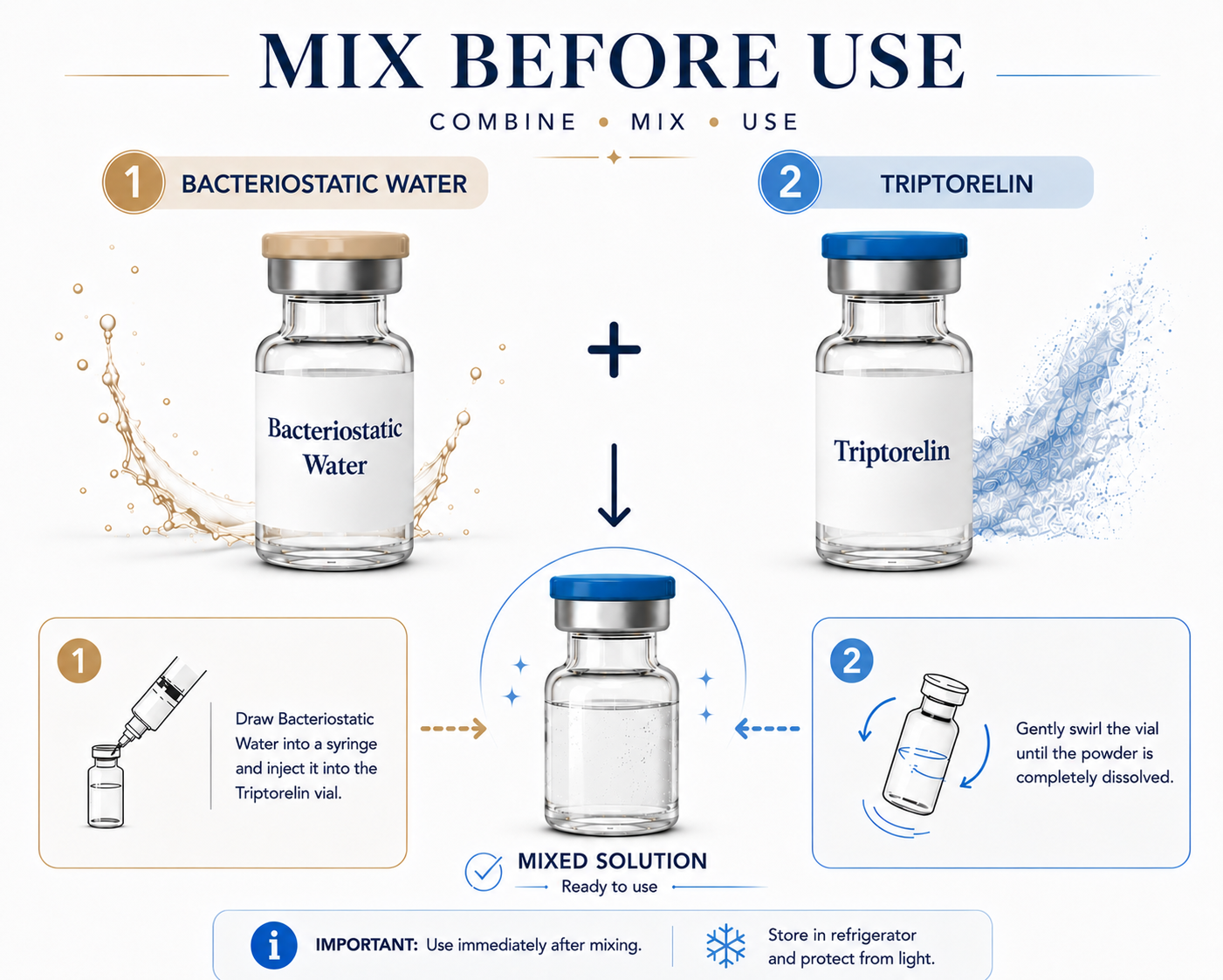
How To Mix Triptorelin

1
Clean

Use alcohol swabs to clean the tops of both vials.

2
Draw BAC Water

Draw the selected amount of bacteriostatic water.

3
Inject Slowly

Add the liquid slowly down the side of the vial.

4
Swirl Gently

Do not shake. Swirl gently until dissolved.

5
Store Properly

Store as directed and protect from heat and light.

Best Practices & Common Mistakes

Best Practices

  • Use sterile technique.
  • Protect from light and heat.
  • Store refrigerated when appropriate.
  • Use clean syringe-unit math before measuring.

Common Mistakes

  • Confusing milligrams with milliliters.
  • Choosing an option with awkward decimal units.
  • Using too little liquid for very small measurements.
  • Shaking the vial aggressively.

Triptorelin Storage & Handling

Lyophilized Powder: −20°C (−4°F) for long-term storage (up to 24 months). Refrigeration 2–8°C (36–46°F) for short-term use (up to ~3 months). Original sealed vial in the freezer is safest.
Reconstituted Solution: 2–8°C (36–46°F), use within ~7–14 days. Keep sealed, avoid light, and do not repeat freeze-thaw cycles.

Frequently Asked Questions

Triptorelin is an FDA-approved prescription medication — a synthetic decapeptide that acts as a GnRH (gonadotropin-releasing hormone) agonist, about 100 times stronger than the natural hormone. In the US it's sold as Trelstar and Triptodur; in Europe as Decapeptyl and Diphereline. It's used for advanced prostate cancer, endometriosis, uterine fibroids, central precocious puberty, and as a trigger in assisted reproduction (IVF).
Triptorelin has a paradoxical, two-phase effect on the hormone axis. For the first 1–2 weeks it stimulates the pituitary and causes a "flare" — a surge in LH, FSH, and sex hormones (testosterone or estrogen). With continuous or depot exposure, the receptors downregulate and shut down, producing deep, sustained suppression of those hormones — essentially a reversible medical castration used to starve hormone-driven conditions.
Triptorelin, leuprolide (Lupron/Eligard), and goserelin (Zoladex) are all GnRH agonists with broadly comparable testosterone-suppressing effect — triptorelin is the most-used one in Europe, and they differ mainly in depot schedules and branding. hCG is the opposite: it directly stimulates the testes to make testosterone, so it raises hormones where triptorelin ultimately lowers them. They are not interchangeable, and the right choice is a clinical decision.
The approved depot products aren't a home reconstitution: they come as a microsphere vial plus a supplied diluent (sterile water via a MIXJECT adapter) and are mixed and injected intramuscularly by a clinician right before use, in fixed strengths (3.75 mg monthly, 11.25 mg 3-month, 22.5 mg 6-month). If you're reconstituting a research-grade triptorelin acetate powder instead, the math is standard — a 2 mg vial + 2 mL bacteriostatic water = 1 mg/mL, so 200 mcg = 0.2 mL (20 units on a U-100 syringe) — but that powder is not the same as the approved drug.
Triptorelin is a real, approved drug with serious effects — bone-density loss with long use, an initial tumor "flare" in prostate cancer, QT-interval and metabolic warnings — so it belongs under a doctor's supervision, not self-use. Despite its online reputation as a one-shot "post-cycle therapy" reset, it's a medical-castration agent: the wrong dose or repeat exposure drives sustained hormone suppression, the opposite of a restart, and it's WADA-banned for tested athletes. Storage: the approved depot is stored per its label (room temperature), while any lyophilized research powder is kept cold and dark and used soon after mixing.
Practical takeaway: If your goal involves weight management, metabolic health, recovery, physical performance, cognitive function, appearance, or general well-being, discuss it with a licensed healthcare professional. They can help you evaluate approved, evidence-based options rather than relying on an unapproved or investigational compound. This calculator is intended only for transparent research-reference calculations and does not determine an appropriate amount, recommend use, or replace professional medical guidance.

About the author

Maria Hrabina is a pharmacist and scientific reviewer with a strong interest in peptide science, pharmacology, and emerging therapeutic compounds.

Her work focuses on understanding how peptide-based compounds interact with biological signaling pathways and how they are being investigated across areas such as metabolic health, dermatology, recovery, regenerative research, and pharmaceutical development.

Maria follows research on a broad range of peptides, from compounds used in approved medicines to experimental molecules still being evaluated in laboratory, preclinical, and clinical studies.

Her approach combines scientific curiosity with critical evaluation of evidence. She believes promising mechanisms and early research deserve attention, but should not be presented as established clinical benefits until they are supported by adequate human data.

Her areas of focus include scientific literature review, mechanisms of action, pharmacology, pharmacokinetics, safety, pharmaceutical formulation, and the overall quality of evidence behind peptide-based compounds.

She is particularly interested in the process of translating an experimental molecule into a reliable pharmaceutical product — including compound characterization, purity, stability, formulation, dose selection, safety assessment, and controlled clinical trials.

Maria believes peptide science has significant long-term potential, but that its progress depends on rigorous research, high manufacturing standards, transparent safety data, and responsible scientific communication.

Through her writing, she aims to help readers understand both sides of peptide research: what makes these compounds scientifically promising and what questions remain before their potential can be considered clinically established.

Areas of interest: Peptide Science · Therapeutic Peptides · Peptide Pharmacology · Metabolic Peptides · Cosmetic Peptides · Drug Development · Pharmacokinetics · Drug Safety · Pharmaceutical Formulation · Emerging Therapies · Evidence-Based Medicine

Important: This tool is for informational and research-reference purposes only. Not intended for human or veterinary use.
← All peptides