
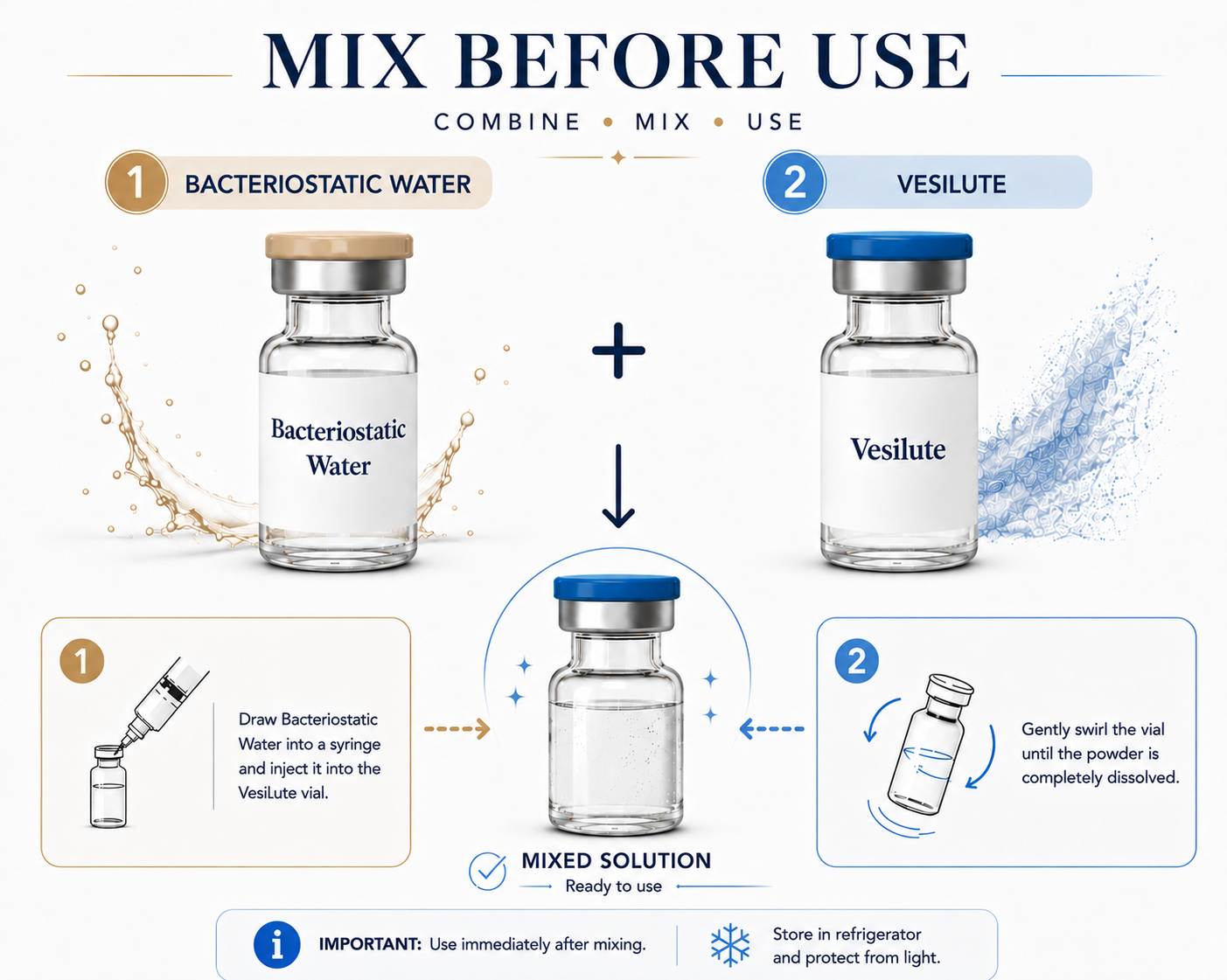
Vesilute and BAC Water Mix

Vesilute Reconstitution Calculator

Enter the amount you want to measure. The vial buttons will highlight which vial strengths create cleaner syringe-unit measurements.

What amount do you need?

Type the target amount, then choose mg or mcg. Example: 2mg or 500mcg.

Syringe size:
Possible vial strengths:
Best Match Good Match Usable Harder to Measure

Example Vesilute Titration Schedule

Protocol ItemGuidance
Dose1–5 mg per dose
Cycle NoteBioregulators are typically cycled as periodic doses rather than continuous daily consumption
Loading Phase (Year 1) — Month 1Daily
Loading Phase (Year 1) — Months 2–3Daily for 10–20 days at the start of each month
Loading Phase (Year 1) — Months 4–12Off
Maintenance Phase (Year 2+)10–20 day cycles, approximately 3× per year (spread out evenly)
Possible vial strengths:

What Is It?

Vesilute

Bladder-targeted peptide bioregulator.

Bacteriostatic Water

Sterile water containing a bacteriostatic preservative, commonly used when preparing multi-use research vials.

How To Mix Vesilute

1
Clean

Use alcohol swabs to clean the tops of both vials.

2
Draw BAC Water

Draw the selected amount of bacteriostatic water.

3
Inject Slowly

Add the liquid slowly down the side of the vial.

4
Swirl Gently

Do not shake. Swirl gently until dissolved.

5
Store Properly

Store as directed and protect from heat and light.

Best Practices & Common Mistakes

Best Practices

  • Use sterile technique.
  • Protect from light and heat.
  • Store refrigerated when appropriate.
  • Use clean syringe-unit math before measuring.

Common Mistakes

  • Confusing milligrams with milliliters.
  • Choosing an option with awkward decimal units.
  • Using too little liquid for very small measurements.
  • Shaking the vial aggressively.

Vesilute Storage & Handling

Lyophilized Powder: −20°C (−4°F) for long-term storage (up to 24 months). Refrigeration 2–8°C (36–46°F) for short-term use (up to ~3 months). Original sealed vial in the freezer is safest.
Reconstituted Solution: 2–8°C (36–46°F), use within ~7–14 days. Keep sealed, avoid light, and do not repeat freeze-thaw cycles.

Frequently Asked Questions

Vesilute is a Khavinson "bioregulator" — a synthetic dipeptide (Glu-Asp, ED, ~262 Da) developed in Russia to target the bladder and urinary tract at the gene level. It's one of the smallest bioregulators, and as the synthetic counterpart to Chitomur (the natural bladder peptide extract) it's aimed at urogenital tissue rather than acting as a conventional urology drug. It's sold as an oral/sublingual form and as a research-grade injectable powder.
All three touch the urogenital area but differ in target and form: Vesilute (ED, a dipeptide) focuses on the bladder and urinary tract, Prostamax (KEDP, a tetrapeptide) focuses specifically on prostate tissue, and Chitomur is the natural bladder extract that Vesilute was synthesized to mirror. The Glu-Asp sequence in Vesilute actually appears within larger peptides like Prostamax, but the two-amino-acid form is pitched for deeper cell penetration — they're paired for urogenital support, not swapped.
In preclinical and Russian studies, Vesilute is described as improving microcirculation in the prostate, easing bladder smooth-muscle function, and curbing excess cell proliferation — with proposed interest in BPH, chronic urinary symptoms, and male fertility. The framing is epigenetic: reactivating genes in urogenital cells rather than forcing muscle relaxation like a drug. Human data is limited, so it is not a proven treatment for BPH or any urinary condition.
Only the injectable research powder is reconstituted — the oral or sublingual form is taken directly. For a 20 mg vial, adding 3 mL of bacteriostatic water gives about 6.7 mg/mL, so a 670 mcg amount draws to roughly 0.1 mL (10 units on a U-100 syringe); adding more water lowers the concentration for finer measuring. There's no established injectable human dose and Khavinson courses are short and pulsed, so any figure is a research choice, not a recommendation.
Vesilute has no FDA approval and isn't a medicine in the West — it's a research compound or regional supplement, with its profile drawn only from Khavinson-affiliated work and very limited human data. A tiny dipeptide is expected to be low-toxicity, but urinary trouble and prostate symptoms can mask serious conditions, so they need a real urology workup (and a PSA check where relevant) rather than a self-run peptide. Storage: keep the lyophilized powder frozen or cold and away from light; once reconstituted, refrigerate and use within a few days.
Practical takeaway: If your real goal is weight or metabolic health, the most useful next step is discussing approved treatment options with a clinician rather than relying on an unapproved compound.
Important: This tool is for informational and research-reference purposes only. Not intended for human or veterinary use.
← All peptides