
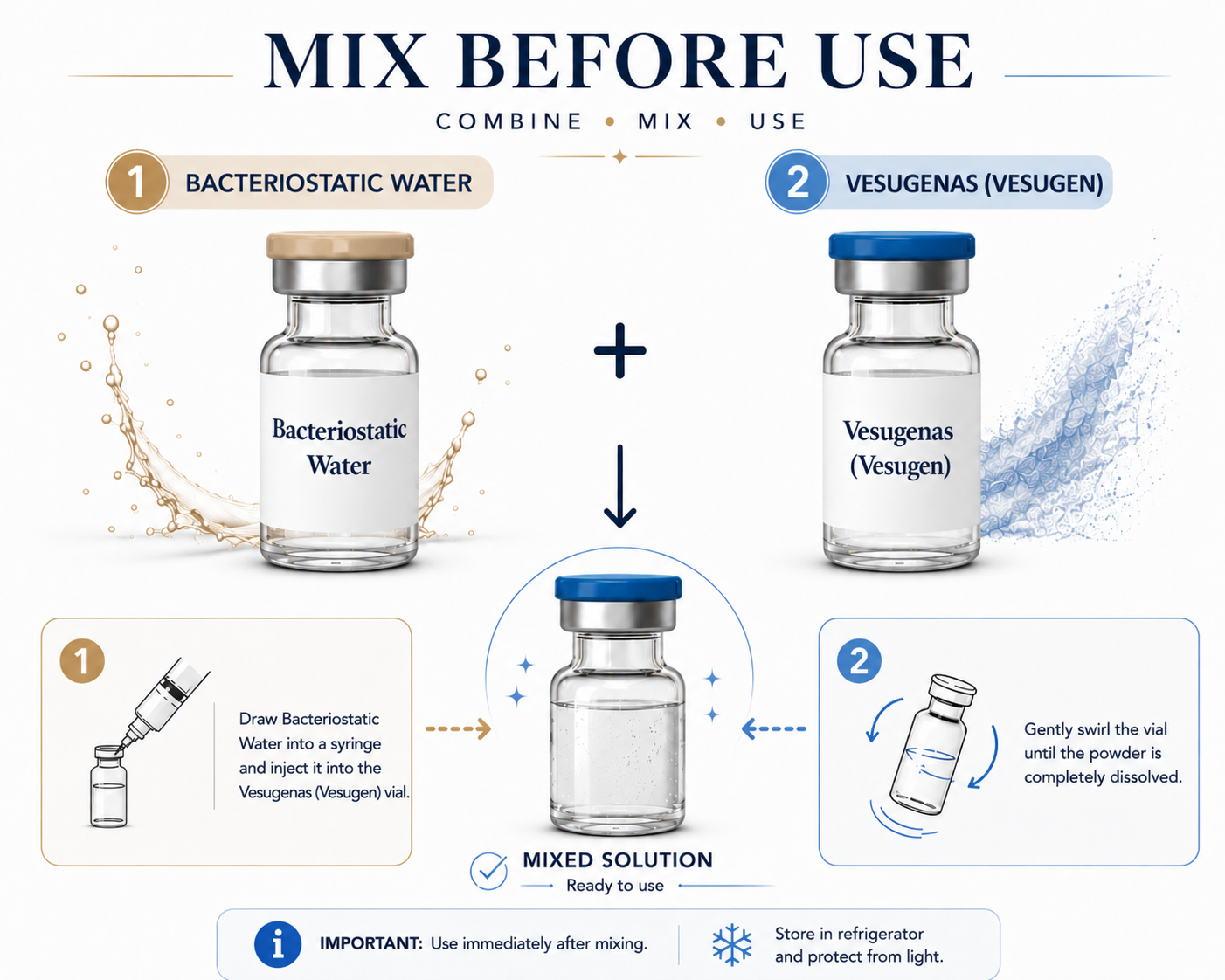
Vesugen and BAC Water Mix

Vesugen Reconstitution Calculator

Enter the amount you want to measure. The vial buttons will highlight which vial strengths create cleaner syringe-unit measurements.

What amount do you need?

Type the target amount, then choose mg or mcg. Example: 2mg or 500mcg.

Syringe size:
Possible vial strengths:
Best Match Good Match Usable Harder to Measure

Example Vesugen Titration Schedule

Protocol ItemGuidance
Dose1–5 mg per dose
Cycling StyleBioregulators are typically cycled as periodic doses (not continuous daily consumption)
Loading Phase (Year 1)Month 1: Daily
Maintenance Phase (Year 2+)10–20 day cycles, repeated 3× per year (spread out evenly)
Possible vial strengths:

What Is It?

Vesugen

Vascular peptide bioregulator.

Bacteriostatic Water

Sterile water containing a bacteriostatic preservative, commonly used when preparing multi-use research vials.

How To Mix Vesugen

1
Clean

Use alcohol swabs to clean the tops of both vials.

2
Draw BAC Water

Draw the selected amount of bacteriostatic water.

3
Inject Slowly

Add the liquid slowly down the side of the vial.

4
Swirl Gently

Do not shake. Swirl gently until dissolved.

5
Store Properly

Store as directed and protect from heat and light.

Best Practices & Common Mistakes

Best Practices

  • Use sterile technique.
  • Protect from light and heat.
  • Store refrigerated when appropriate.
  • Use clean syringe-unit math before measuring.

Common Mistakes

  • Confusing milligrams with milliliters.
  • Choosing an option with awkward decimal units.
  • Using too little liquid for very small measurements.
  • Shaking the vial aggressively.

Vesugen Storage & Handling

Lyophilized Powder: −20°C (−4°F) for long-term storage (up to 24 months). Refrigeration 2–8°C (36–46°F) for short-term use (up to ~3 months). Original sealed vial in the freezer is safest.
Reconstituted Solution: 2–8°C (36–46°F), use within ~7–14 days. Keep sealed, avoid light, and do not repeat freeze-thaw cycles.

Frequently Asked Questions

Vesugen is a Khavinson "bioregulator" — a synthetic tripeptide (Lys-Glu-Asp, or KED) developed in Russia to target the endothelial cells lining blood vessels at the gene level. It comes in oral capsule, sublingual, and research-grade injectable forms. The proposed idea is that this short peptide helps normalize vascular function rather than acting like a conventional cardiovascular drug.
Vesugen (KED) is the synthetic vascular tripeptide, while Ventfort is the natural vascular extract version — same target tissue, different source. It's also distinct from its siblings by target: Cardiogen is for heart muscle, and the near-identical KEDA (Livagen) is for the liver, so the tiny sequence change is what supposedly redirects the tissue focus. These are often stacked in Khavinson protocols but are not interchangeable.
In lab and Russian clinical reports, Vesugen is described as normalizing endothelial markers (like endothelin-1), activating SIRT1, and improving arterial blood flow in aging vessels. It's one of the better-published Khavinson peptides, but the evidence is still predominantly Russian, small-scale, and not independently replicated in the West. It is not a treatment for atherosclerosis, high blood pressure, or blood clots, and shouldn't replace prescribed cardiovascular care.
Only the research-grade injectable powder is reconstituted — the oral capsule and sublingual drops are taken as-is and never mixed. For that powder the math is standard: a 20 mg vial + 4 mL bacteriostatic water = 5 mg/mL, so a 1 mg amount = 0.2 mL (20 units on a U-100 syringe). Commonly cited protocols circle 10 mg over ~20 days, but no injectable human dose is formally established, so any figure is a research choice, not a recommendation.
Vesugen is not FDA-approved and hasn't been evaluated by any Western regulator — it's sold as a research compound or supplement, sourced mainly through Russian channels. As a simple tripeptide it's expected to have low toxicity and no significant adverse effects are reported in Russian use, but no independent Western safety assessment exists, and any real vascular or cardiac condition needs proper medical care. Storage: keep capsules cool and dry; store the lyophilized injectable powder refrigerated and protected from light, and use any reconstituted solution promptly.
Practical takeaway: If your real goal is weight or metabolic health, the most useful next step is discussing approved treatment options with a clinician rather than relying on an unapproved compound.
Important: This tool is for informational and research-reference purposes only. Not intended for human or veterinary use.
← All peptides